


Powders. Part 2
Description
This section is from the book "The Art Of Dispensing", by Peter MacEwan. See also: Calculation of Drug Dosages.
Powders. Part 2
Division Of Powders
The only method of division which is tolerated by examiners is weighing each powder. No guesswork is allowed. While we endorse this view we cannot overlook the fact that experienced dispensers divide, say, a drachm of compound jalap powder into twelve powders so well' by guess' that there is not 1 per cent of difference between any two of the powders. It is all a matter of practice, and if the dispenser begins by learning to divide by means of the scales and weights, he becomes as expert in dividing as the man who divides by guess. There are various mechanical contrivances for dividing, but they have never come into favour in this country, and the tendency is entirely towards division by weight.
Folding
A convenient size of paper for powders is 5 inches by 4 inches, but the size should be proportionate to the powder. The paper should be good calendered demy, rather to the thin side. In placing the papers on the dispensing-counter it is customary - say, in the case of a dozen powders - to arrange them in fours, leaving about 2 inches square of the first two rows exposed to receive the portions of powder. This is the arrangement for dividing by eye; but it has become the custom also in the more accurate method of division. After all the papers have received their portions of powder, the dispenser begins to fold them. This operation is simple enough. The powder is tilted to the centre of the paper, the side of the paper nearer the dispenser is raised and placed about a quarter of an inch from the edge of the other side, and, keeping a thumb on each end of the upper half, the forefingers lift the lower half, bring it over, and meeting at the centre are swiftly drawn to the edges, thus making the fold. A double fold is next made in the same manner. The aim in folding is to make the whole of a set of powders exactly the same width in fold, as well as the same length.
The latter is easily fixed by a powder-folder, but the width of fold is a matter of practice and eye-judgment. The sketches on page 169 show how it is done. The smaller sketch represents a piece of paper 4 1/4 inches long and 3 1/4 inches wide. The first fold was 3/8 inch deep, and the second was the same ; then 7/8 inch at each end was turned over by means of the folder. The finished powder is shown at the bottom of the sketch, 2§ inches long by 1 1/8 inch wide. This method may be called edge-folding. The second example represents a powder-paper 5 7/8 inches long, and 4 3/8 inches wide. The first fold was 3/8 inch deep, as in the former case, the second (arranged so that the fold should lie nearer the edge of the powder, as it is not so pleasing when exactly in the centre) was 7/8 inch deep, and the cross-foldings were made so that the ends overlapped each other by 1/8 inch. The finished powder was 2 3/4 inches long and 1 1/4 inch wide. When powders are to be wrapped in waxed paper it saves a folding if the waxed paper and white demy paper are put down together, the waxed paper being about 1/4 inch smaller each way than the outer white paper.
Deliquescent powders should be folded in this manner, and it is always advisable to cover with tinfoil powders which have to go to damp and hot climates.
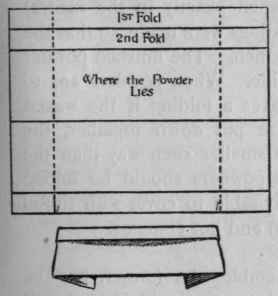
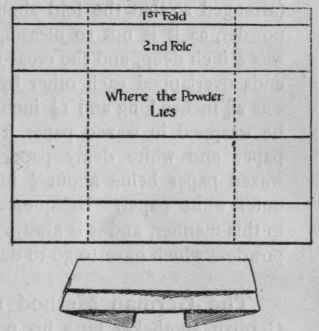
Diagrams Showing How Powders Are Folded, With Sketches Of The Finished Powders.
The German Method resembles the former, but the German apotheker buys his powder-papers ready folded, and cross-folded at one end. If he has to dispense a dozen powders, he weighs or divides (generally the latter) the required quantities of powder, putting each portion upon a horn scoop, next takes a dozen folded papers between the thumb and fingers of the left hand, and one after the other opens them, placing the contents of a scoop into each, and dexterously cross-folds each paper with the forefinger and second finger of the right hand.
The Powder-folder is a valuable implement to most dispensers. It is well to learn powder-folding with it rather than without, for powders of unequal length are as irritating to the equanimity of a practised pharmacist as pills of unequal size. The length of the folded powder should be about 1/8 inch less than the length of the powder-box, or 1/4 inch less than the powder-envelope. A block of wood somewhat longer than it is wide, and wider than it is deep, is the simplest folder. Next comes the kind made of two plates of brass with a pillar between, then the adjusting folder here illustrated.
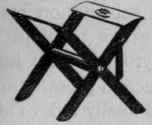
Maw's powder-folder.
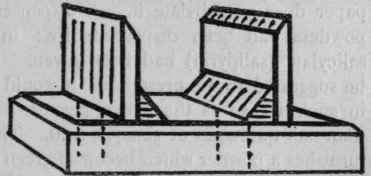
Powder-Folder Made Of Wood.
The second figure is a home-made folder-viz., a suitable box with two movable uprights in it which can be secured through the sides of the box by means of pegs. Punctilious dispensers record in the prescription-book the length of powders dispensed in particular cases. It is important to observe in folding that none of the powder gets in the turned-over parts of the paper.
Continue to:


My Books

