


Seed Emulsions
Description
This section is from the book "The Art Of Dispensing", by Peter MacEwan. See also: Calculation of Drug Dosages.
Seed Emulsions
Made from seeds containing a fixed oil, such as almonds, poppy or hemp seeds, etc, by crushing these and rubbing them with water. If necessary, the seeds are first washed several times with water; when clean, they are beaten, with about one-tenth their weight of water, into a soft mass, which, when taken between the fingers, reveals no albuminous lumps. The remainder of the fluid is then added gradually, with continual rubbing, until the whole is evenly suspended. The emulsion should lastly be strained through a clean coarse cloth (millers' cloth).
The small proportion of oil contained in the seeds is suspended in the water by means of the albumen and mucilage of the seeds, but if the seeds are first rubbed down dry, the oil is expressed, and, though it is taken up in the emulsion, it more quickly separates, generally as a cream.
Almonds are always decorticated before being made into an emulsion, unless an order to the contrary is expressed.
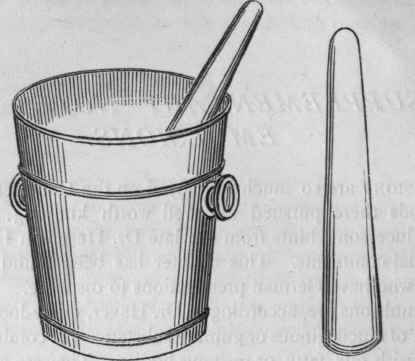
Poppy-seeds should be softened before being beaten, by letting them rest for five to ten minutes in warm- not hot- water.
Highly polished brass mortars and marble mortars have been used for making emulsions, but within the last twenty years mortars have been made of a special kind of very hard porcelain, particularly for emulsions. The pestle is made of boxwood, and the forms of both pestle and mortar are shown in the above engraving. The height varies from 5 to 8 inches. The boxwood pestle allows a good force to be used in crushing seeds without danger of injury to the porcelain. [An ordinary Wedgwood mortar and pestle should be used for oil emulsions.
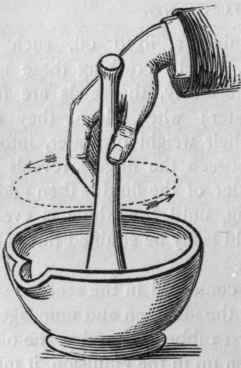
The second figure on page 330 shows such a mortar and the way in which the pestle should be used.-Ed.]
Seed emulsions must not be made very hot, nor must hot fluids be added to them, else the albumen will be coagulated.
Lycopodium - a seed-like substance containing oil- may be made into an emulsion. After sifting to free it from coarse impurities, it is rubbed in a mortar with a little water until a damp crumbly mass is obtained. An addition of gum acacia is desirable to get a good emulsion. Then syrup or water is added gradually. If gum acacia be added, the prescription should be marked stating the quantity, 'Emulgendo admixtum.'
An oil, such as castor oil, is sometimes ordered with a seed emulsion, as in the following:
Grammes | |
Amygdal. dulc. ...... | 20 |
Olei ricini ....... | 30 |
Aq. foeniculi ...... | 100 |
Aq. destill. ....... | 100 |
Sodii nitrat. ....... | 15 |
Syrupi sacchari....... | 25 |
M. Fiat emulsio.
This is really a double emulsion.
Continue to:


My Books

