


Galvanism. Part 2
Description
This section is from the "A Practical Treatise On Materia Medica And Therapeutics" book, by Roberts Bartholow. Also available from Amazon: A Practical Treatise On Materia Medica And Therapeutics
Galvanism. Part 2
The Bunsen combination is a most efficient one (Figs. 6 and 7). The outer zinc plate has a cleft, and is immersed in dilute sulphuric acid, while the carbon, of the variety known as gas-carbon, is contained in a porous cup with strong nitric acid. Here the hydrogen is intercepted by the nitric acid, nitrous-acid fumes are given off, and sulphate of zinc is formed. It is a very powerful combination, but the fumes of nitrous acid make it very objectionable. Although it is not suited for medical use in general, it is well adapted for galvano-caustic purposes. Mr. De la Rue's chloride-of-silver battery is admirably well arranged for forming a portable or permanent combination for the medical electrician. It may be made of test-tubes, closed with a rubber stopper containing two orifices for the elements, which consist of a zinc rod and flattened silver wire. At the bottom of the tube is placed some chloride of silver, and above this a solution of common salt. The silver element dips down into the chloride of silver, and above this is insulated by sheet gutta-percha. This cell has an electro-motive force a little more than the Daniell, and it is remarkably constant, portable, and unchangeable. A very efficient and at the same time economical cell can be constructed of a tin can, iron filings, a porous cup, and a rod of zinc. In the porous cup, about the rod of zinc, is put some common potash, and the iron fillings which form the positive element are packed around the porous cup.
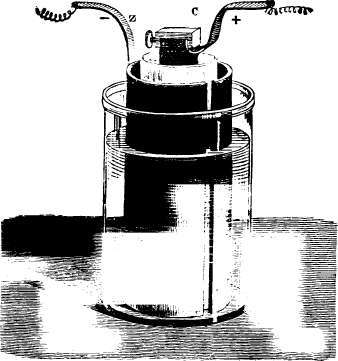
Fig. 6. Bunsen Cell.
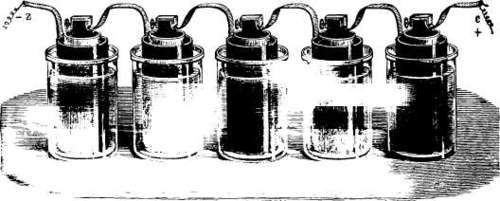
Fig. 7. Bunsen Battery.
Besides the above, mention should be made of the two-fluid bichromate of potash cell. A solution of the bichromate in dilute sulphuric acid is now chiefly used as the exciting fluid in single-fluid cells; but, in the two-fluid arrangement, the carbon element is placed in a porous cell containing a saturated solution of bichromate of potash in water only, and the zinc element is acted on by very dilute sulphuric acid (1 to 20). The performance of this cell is in a high degree satisfactory. The carbon in this, as in the other galvanic cells, is gas-carbon, which is remarkable for its density and for conducting power. The zinc is ordinary commercial zinc, amalgamated. The process of amalgamation consists in first immersing the zinc plate or rod in dilute sulphuric acid to make a clean surface, and then rubbing it with a little mercury until it presents a silvery whiteness. A homogeneous surface is thus made, and the loss of power due to the formation of innumerable couplets of zinc with the impurities contained in it is thereby prevented.
The force generated in the cup by the chemical action is termed electro-motive force, and it is the difference in potential between the two elements. The power of any combination of cups is the sum of the electro-motive force of each one less the difference caused by resistance in the circuit. The current from a battery has strength, tension, and quantity. The strength is the amount transmitted in the unit of time, along a given conductor; tension is the power to overcome resistance; and volume is the net quantity available. There are various objects which offer resistance to the passage of the current. The circuit of a galvanic battery consists of the space between the elements in the cup, the conducting element, and the wire which unites the poles—the conjunctive wire. The current passing over this circuit has to overcome the resistance opposed by these several parts. The conjunctive wire offers a degree of resistance determined by its length and section. A single large cup, having zinc and carbon elements of corresponding size, excited by bichromate solution, will heat to redness, even volatilize a platinum wire, while twenty small medical-battery cups connected in series will scarcely warm such a wire. Intensity, resistance, and quantity, are now given a mathematical mode of expression. The unit of electro-motive force is the volt, in honor of Volta, and is very nearly the power of a Daniell cell, which is, hence convenient as a standard of comparison. The unit of resistance is the ohm, so named from the discoverer of the celebrated law. The unit of intensity is the ampére, formerly the weber, both the names of physicists, distinguished in electrical science. An ampére, represents the quantity of electricity produced by the unit of electro-motive force —the volt—circulating in a conductor having the unit of resistance— the ohm—during the unit of time—the second. It has been practically ascertained that this is the quantity of electricity furnished by a Daniell cell, and made to pass through a hundred metres of telegraph-wire. The unit of capacity is the farad, from Faraday; but, as this amount is much too large for medical purposes, it is the usual practice to employ the term microfarad, which is equal to one millionth part of a farad
Continue to:
Books by Roberts Bartholow:


My Books

