


II. Dietetics In Diseases Of The Stomach And Intestines. Continued
Description
This section is from the book "Practical Problems Of Diet And Nutrition", by Max Einhorn. Also available from Amazon: Practical Problems of Diet and Nutrition.
II. Dietetics In Diseases Of The Stomach And Intestines. Continued
Food only to a small extent serves the purpose of reconstructing tissue waste; in its largest part, however, it is utilized for generating the heat requisite for the maintenance of life. For that reason it is customary to speak of the necessary amount of heat-units during twenty-four hours instead of the quantity of food. By "heat-unit" is meant, as is well known, that quantity of heat which is required to raise the temperature of 1 gm. of water one degree Celsius. "Great heat-unit" means the amount of heat required for warming 1,000 gm. of water one degree Celsius. Each kind of food is ultimately oxidized in the body into its end-products, and is in greatest-part exhaled in the form of carbonic acid; the more carbon atoms a food-stuff contains the more heat-units it-will generate. In speaking of the heat value of food, the great heat-units are used, the term "great," however, being omitted. Thus 1 gm. of albumin generates 4.1, 1 gm. of fat 9.3, and 1 gm. of carbohydrate 4.1 heat-units. If we know the quantity of nourishment taken, the amount of the introduced heat-units is easily determined by multiplying the different food-stuffs by the above given figures. The daily amount of heat generated by the body, or necessary for the maintenance of the same, has been approximately estimated at 2,500 heat-units.1 The heat value of the food taken by an average working person amounts, according to von Noorden.2 to about forty heat-units when working, and when resting to about thirty-four heat-units per kilo a day. According to K. Vierordt,3 an adult takes in form of food a daily average of 120 gm. albumin, 90 gm. fat, 330 gm.
1 Munk and Ufflemann: "Die Ernahrung des gesunden and kranken Menschen," Wien, 1887.
1 Koenig : " Die menschlichen Nahrungs- and Genussmittel."
Berlin, 1883, p. 58.
2 Von Noorden: Berliner Klinik, Heft 55.
3 K. Vierordt: "Grundriss der Physiologie des Menschen," 1887, 3. Auflage, pp, 288, 288.
Hydrate (the relation of the nitrogenous food-stuffs to the non-nitrogenous being 1 to 4), and 2,818 gm. of water. The above-mentioned figures differ from those given by F. Hirschfeld.' This author demands 80 gm. of albumin as the lowest amount contained in a sufficient diet. Victuals are composed mostly of all the three food groups (albumin, carbohydrate, fat) and water, and contain in minute amounts the inorganic salts found in the body.
I give here a small table (see page 13), showing the percentage of the three food groups ordinarily contained in most every-day victuals.
In order to have a correct idea of my own about the quantity of nourishment consumed daily, I have weighed and recorded for two successive days all the victuals and drinkstaken by my wife and myself. The record showed that I had taken during the first test-day 63.8 of albumin, 47.3 of fat, and 168.8 of carbohydrate; the total number of heat-units was 1,402.3. During the second test-day the corresponding figures were somewhat higher; the quantity of albumin was 79.30, fat, 54.3, carbohydrate, 263.9; the total of heat-units equalled 1,912.5.
The average figure of heat-units per day was (1402+1912.5)/2 = 1,657.4. As my weight is 52 kilos, the amount of beat introduced into the system per kilo and per day was 1657.4/52 = 32.3.
My wife partook during the first test-day 103.19 of albumin, 44.99 of fat, and 204.64 of carbohydrate. The total of heat-units was 1,660.5. On the succeeding day the figures were as follows: 64.03 of albumin, 31.14 of fat, 174.92 of carbohydrate. The total of heat-units was 1,269.29. The average figure of beat-units per day was (1660.50+1,269.29)/2 = 1,464.89.
1 F. Hirschfeld: Berliner klin. Wochenschr., 1893, No. 14.
Composition Or The Most Common Food Substances
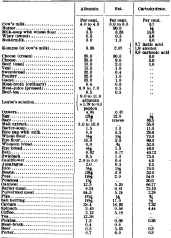
1Taken from Koenig, loc. cit., and principally from Munk and Ufflemann, loe. cit.
As my wife weighs 55 kilos, the amount of heat-units per kilo and per day was therefore 1464.89 / 55 = 26.63.
My wife, as well as myself, hold our weight, live regularly, and the food taken is not subject to very great differences; therefore, the figures mentioned may be considered as our average ones. These figures, however, are far smaller than the average given by all authors. This shows what great differences there are in the quantity of food taken by people in their normal condition in order to make up the daily loss. The one maintains his balance at a rate of 26 heat-units per kilo a day; the other may lose in weight at 30 heat-units per kilo a day. The scale is the best guide as to whether a certain amount of food is sufficient or not. It shows quickly and with certainty whether the organism maintains its balance or not.
After this lengthy dissertation on the diet in health, let us return to the sick.
As people with disturbances of the stomach have to replace for their existence no smaller losses than under physiological conditions, they will therefore need: 1. Just as large amounts. 2. The same kinds of foodstuffs as described for the normal state. The only difference possible will have reference to the selection of the various articles of diet and to their form and special preparation.
Thus the question arises, What qualities should the food of stomach patients possess!
In the treatment of a diseased organ one can often make use of two methods. One consists in sparing the diseased organ and giving it perfect rest; the other consists in strengthening the same by methodical adaptation for more work and practice. Both principles are, in fact, realized in the treatment of diseases of the stomach.
The first method is ordinarily applied in acute diseases, and only very seldom (and then only for a short time) in chronic affections of the stomach. In the latter the second principle, as a rule, is used. The stomach can be spared, firstly, by not introducing into it any food whatever (greatest degree of saving or rest). Secondly, by administering food substances which, during their stay in the stomach, do not impose much work upon this organ, and do not greatly irritate it. Here the main object will be to give the patient easily digestible food. In turning from the saving principle to that of strengthening the organ by methodical adaptation for work, it will be quite natural to change the diet, not suddenly, but gradually, into such as requires more work on the part of the stomach for the digestion. It is therefore absolutely necessary to have an exact table of the digestibility of different foods. In prescribing or changing a diet we shall have to act according to it. Such a scale has been arranged by different authors. The main sign of digestibility was gauged by the rapidity with which the various foodstuffs passed out of the stomach into the intestines. Beaumont, in many trials on his patient with the gastric fistula, determined the length of time the different victuals remained in the stomach, and constructed a scale according to the figures obtained. On the same principle, but more reliable and of greater value, is the scale constructed by Leube, according to the results obtained by emptying the stomach by means of the tube, after different kinds of food had been taken. We think it advisable and useful here to give Leube's scale:
1. Diet
Bouillon, Leube-Rosenthal's meat solution, milk, soft-boiled eggs, zwieback, English cakes (biscuits containing no sugar), water, natural acidulous waters (Apollinaris, Kronthaler, Seltzer, etc.).
2. Diet
Boiled calf's brain, boiled calf's sweetbread, boiled chicken (young without the skin), boiled pigeon, boiled calves' feet, tapioca pap boiled in milk, beaten white of egg.
3. Diet
Raw beef (chopped very fine), raw ham (chopped very fine), beefsteak (superficially fried in freshest butter), finely scraped tenderloin of beef, mashed potatoes, white bread (stale), coffee with milk, tea with milk.
4. Diet
Fried chicken, fried squab, roast venison, guinea hen, roast beef (cold), roast veal (leg, saddle), boiled pike, macaroni, rice pap, finely chopped spinach, asparagus, stewed apples.
These tables, however, have not as yet, on the one hand, been fully verified on healthy individuals or found always alike (giving the same results); on the other hand, such experiments only show what food remains in the stomach the shortest time. This would perhaps give reason for assuming what food may be easily digested as far as the stomach is concerned, but not what is most easily digested as a whole, i.e., utilized for the economy with the smallest amount of work. The digestibility of food substances depends, first, upon their shape and quality; secondly, upon their percentage of convertible material.
"Corpora non agunt nisi fluida," is an old, well-known axiom. Following this law one could arrange the following scale of digestibility, which is constructed according to the different physical conditions of the food;
1. In the first place, food in liquid form: (a) Liquid at ordinary temperature - milk, meat-juice, beef-tea, bouillon, peptone or sarcopeptone dissolved in water, bread-water,' strained barley, oatmeal, rice-water, strained oyster-soup, egg albumin-water; (6) liquid at the body temperature - jellies, fruit-jelly, calf's-foot jelly, ice-cream, water-ice.
2. Pulpy form: The food is mechanically converted into very minute particles and well mixed in liquid - pap soups (barley, oatmeal, farina, rice, sago); egg in bouillon; Leube's meat solution, pulverized meat, pulverized crackers in milk, water, or bouillon; buttermilk; kumyss; cream; butter.
3. Food which by slight trituration in fluids separates into minute particles: White bread in milk or water; the tips of well-boiled asparagus; carrots; mashed potatoes, baked potatoes; the yolk of hard-boiled eggs; oysters (raw).
4. Solid food: White bread, rye bread; meat, hard-boiled eggs, fish, cheese.
5. Substances not easily digested: Meat with tough fibre; lobster; sausages and Swiss cheese on account of their solidity; all substances containing much cellulose, particularly when eaten raw; cole-slaw; all salads, cucumbers, pickles, raw fruit, apples, pears, pineapple; fruit which contains much acid, therefore all unripe fruit, strawberries; substances containing much sulphur and forming gases in the intestines; all kinds of cabbage, principally white cabbage; beans.
This theoretically constructed scale of the digestibility of food is, at the same time, in the main points, similar to the one which has long stood the test of empiricism and which I ordinarily apply in my practice.
1 Bread-water. Stale bread is cut into slices and put in water at temperature of room for from two to three hours, then the water is strained.
After these general explanations we return to our special subject.
Continue to:


My Books

