


Causes Of Bright's Disease
Description
This section is from the book "Diet In Sickness And In Health", by Mrs. Ernest Hart. Also available from Amazon: Diet in Sickness and in Health.
Causes Of Bright's Disease
These are acute fevers, cold, alcohol, and excessive eating of meat.
Acute albuminuria is an almost constant symptom in scarlet fever, and frequently also of the other eruptive fevers. In these cases recoveryfrom the albuminuria is the rule with appropriate treatment; but sometimes the attacks leave behind a certain enfeeblement of the action of the kidney, which may finally result in the establishment of chronic Bright's disease. The progress of the disease may be so slow and insidious that it is not noticed till certain unexplained symptoms lead to the examination of the urine, when albumen is found to be present. Cold is a frequent cause of Bright's disease, in cabmen and others whose work requires them to be exposed to all weathers. The abuse of alcohol also frequently results in chronic albuminuria. The presence of albumen in the blood seems to exercise a peculiarly irritating influence on the tissues of the kidney. To excessive consumption of meat, and the consequent labour thrown upon the kidneys, some of the cases of Bright's disease, from which the well-to-do and well-fed suffer, are attributed. Worry and anxiety are also, there is little doubt, frequently the cause of chronic albuminuria. It may be objected to the assertion regarding meat eating as a cause, that a great variety of experiments have demonstrated that temporary albuminuria cannot be produced experimentally a. Normal epithelium. b. Epithelial cells cloudy and swollen. c. Cells in extreme degeneration. d. Loose degenerate epithelial cells.

Fig. 15. - Course of the Uriniferous Ducts, Diagrammatic Plan.
1, 1. Rectilinear uriniferous tubule; a collecting duct passing from the periphery of the lobes towards the papilli of the kidney towards which it opens. 2. Lower end of the tubule, which has been cut off a little above its mouth for the convenience of the drawing. 3, 3, 3. Other collecting tubules opening into the cavity of the preceding. 4, 4, 4, 4, 4. Malpighian bodies or glomeruli. 5, 5, 5, 5, 5. Contorted tubules springing from the glomeruli and forming the greater part of the cortical substance of the kidney. 6, 6, 6, 6, 6. Straight tubes succeeding the contorted tubes and descending from the cortical into the medullary substance. 7, 7, 7, 7, 7, Larger branches forming loops. 8, 8, 8, 8, 8. Other ascending branches.

Fig. 16. - Section of Diseased Kidney in Bright's Disease.
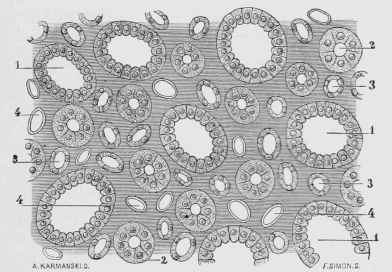
Fig. 17. - Transverse Section of the Medullary Substance of the Healthy Kidney, Magnified 350 Diameters.
1, 1, 1. Section of the collecting tubes, showing their diameter, their cavity, and their lining epithelium. 2, 2. Ditto of the ascending portion of the urinife-rous tubules. 3, 3, 3. Section of the descending branch of the same, showing their much smaller calibre, slightly larger cavity, and very flat epithelium. 4, 4, 4. Section of the blood vessels.
by an excessive albuminous diet. This may be the case, and yet the continuous use of an extravagantly albuminous diet, combined with an abuse of alcohol, may and does throw on the kidneys so great a work of elimination, that subacute congestion and consequent albuminuria may be the result. Certain it is that in meat-eating countries Bright's disease is much more prevalent than in those where the staple articles of diet are rice and fish.
Continue to:


My Books

