


Chapter III. The Elements Of Food. Proteins
Description
This section is from the book "Food In Health And Disease", by Nathan S. Davis. See also: Food Is Your Best Medicine.
Chapter III. The Elements Of Food. Proteins
Proteins - Digestion, Assimilation, Elimination; Effects in Health and Disease. Fats and Oils - Uses; Digestion and Assimilation; Effects in Health and Disease; Butter; Cream; Cod-liver Oil.
Proteins
Proteins have both an animal and a vegetable origin. They form so large a proportion of animal food, however, and so small a proportion of vegetable food that the former is their chief source. They are composed of carbon, hydrogen, nitrogen, oxygen, and sulphur, which are united to form a very complex molecule.
The first step toward the digestion and utilization of proteins is mastication, by which the food is broken and roughly disintegrated and lubricated with mucus, while some of the salts in it are dissolved. Unless mastication is thoroughly performed when meat - pre-eminently protein food - is eaten, its further disintegration and digestion by the stomach will be slow, and in pathologic states may be painful. Cooking is of importance in preparing meats for easy digestion, for by it the connective tissues are converted into gelatin, which readily dissolves in the gastric juice and permits the rapid separation of cell from cell.
Hydrochloric acid is the essential acid of the stomach, and its presence is necessary for the proper digestion of proteins. Meat and bouillon rich in meat extractives are the best stimulants to the formation of hydrochloric acid by the glands of the stomach. Acids taken before a meal of meat will hinder the formation of gastric juice and are to be deprecated at this time. If taken at the end of the meal, they are not harmful.
The normal churning movements of the stomach are most important in order to facilitate the commingling of food and gastric juice so that digestion may progress as rapidly as possible, and to transfer what has been well disintegrated or digested into the intestines. Many cases of functional derangement of digestion are due primarily to slow and imperfect movements of this organ. Impaired mobility is also an important factor of indigestion when there is structural disease of the organ. A sedentary life and reduced muscular strength and nervous energy from any cause will lessen the activity of the stomach. Although its churning movements are altogether involuntary, they are much influenced by emotional excitement, especially when great or prolonged. Distress, anxiety, sorrow, and fear will often check digestion for the time being.
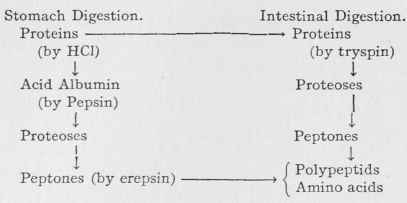
The first chemical change that proteins undergo in gastric digestion is the conversion of a part of them, by means of the hydrochloric acid that the stomach's juice contains, into acid albumin. Under the influence of pepsin the latter is still further transformed by several changes into a series of proteoses, and finally into the terminal product, peptone.
Peptone is absorbed from the stomach in comparatively small quantity. Most of it, together with the proteoses and the proteins, as yet undigested, is emptied into the duodenum. Here the acidity of the stomach-contents is neutralized, and protein digestion is completed under the influence of the pancreatic ferment, trypsin.
Trypsin is formed in the small intestines from trypsinogen which is excreted by the pancreas in its juice or secretion. A ferment secreted by the glands of the intestines called entero-kinase converts inactive trypsinogen into active trypsin. The intestinal glands also secrete erepsin, a ferment which splits peptones into aminoacids and ammonia.
In the intestine, proteins that have not undergone digestion in the stomach are first transformed into alkali albumins, then into proteoses, peptones, polypeptids and amino acids. The proteoses and peptone that come from the stomach are also converted into antipeptone and amino acids. The following diagram will make these processes clearer:
It is uncertain whether the products of protein digestion are absorbed as polypeptids or amino acids or both. Certainly the latter finds its way to some extent into the portal vessels. It is doubtful if the epithelial cells of the intestine synthesize the products of digestion into the albumens of the blood as was once supposed, certainly they do not do so completely. Synthesis takes place probably in every cell of the body, the amino acids brought to them by blood and lymph or possibly formed by their disintegration being utilized for cell production. Moreover, it is known that the products of protein digestion are transformed in part at least into nitrogenous derivatives which may be eliminated as such and into nonnitrogenous derivatives which may be utilized for the production of energy or stored as fat or glycogen.
The nitrogenous derivatives are ultimately eliminated by the kidneys as urea, ammonia and purin bodies. Urea the form in which they are mostly eliminated is produced in the liver from ammonia made in the tissues and brought to that organ by the blood as a carbonate. Imperfect functional activity on the part of the liver causes a relatively large amount of ammonia to be eliminated by the kidneys. Pathologic conditions such as fever and diabetes also disturb the relative proportion of these substances in the same way by forming acids during metabolism which produce stable ammonium salts. Normally 2 to 6 per cent, of the total nitrogen eliminated by the kidneys is in the form of ammonium salts. The purin bodies including uric acid are formed from nucleoprotein. From 0.3 to 0.4 grams per day is produced by metabolism of the tissues; the remainder from nucleoprotein in food. The amount of nitrogenous excreta varies with the diet as is shown by this table modified slightly from Sherman.1
On High Protein Diet Grams | On Low Protein Diet Grams | |
Total nitrogen...................... | 16.8 | 3.6 |
Urea... | 14.7 | 2.2 |
Ammonia... | 0.49 | 0.42 |
Purins, etc. | ||
Uric acid......................... | 0.18 | 0.09 |
Creatinin......................... | 0.58 | 0.60 |
Undetermined.... | 0.85 | 0.27 |
The acidity of the contents of the small intestine is due to the acids derived from the stomach and to organic acids formed from fats in the intestine. As these are in part absorbed, and in part neutralized by the secretions normally poured into the intestine, the contents grow less acid and often become alkaline very quickly.
Continue to:


My Books

