


Fats And Lipoids As Body Constituents
Description
This section is from the book "Chemistry Of Food And Nutrition", by Henry C. Sherman. Also available from Amazon: Chemistry of food and nutrition.
Fats And Lipoids As Body Constituents
From what has been stated above, fat is seen to be a form of reserve fuel to which any of the organic foodstuffs may contribute (see also the discussion of fate of the foodstuffs in Chapter V (The Fate Of The Foodstuffs In Metabolism Carbohydrates. Oxidation Of Carbohydrate)). It is as reserve fuel that the large deposits of body fat are chiefly significant, but it should not be forgotten that even this "depot fat" may function as a protection to the body from mechanical injury and too rapid a loss of heat when exposed to cold, and as a packing and support to the visceral organs, particularly the kidneys. In recent years it has come to be recognized that modified fats and fat-like substances (lipoids) are essential constituents of body tissues. Thus cell membranes are not simply walls of protein matter but probably are composed of both proteins and lipoids of different kinds and in varying proportions, and protoplasm is to be thought of as an emulsion of proteins and lipoids rather than as a jelly of proteins alone.
Taylor, writing in 1912, says: *"Fat plays two roles within the body. Fat represents the ultimate form of the storage of fuel, and the depot fats are quite the most inert and dead of any of the body structures. On the other hand, fats joined with protein and in complex combinations of still unknown composition, represent the most essential structures in cellular protoplasm, cell membranes, and in the central nervous system. The subjects of fat in its cellulometabolic relations and fat in the energy metabolism are almost as distinct as though different substances were under consideration. Our information on the two subjects is not equal; we know much concerning fat as fuel; we know little concerning fat in cellular structure."
Mathews, in 1915,† writes: "It will be recalled that all living matter contains a larger or smaller amount of organic substances which are soluble in alcohol, ether, and other fat solvents. These substances help to give to protoplasm its properties of containing large amounts of water but not dissolving ; and also the power of taking up readily and in large amounts chloroform, ether, and other substances soluble in fats but not readily soluble in water. They are among the fundamental and ever-present constituents of living matter."
* Digestion and Metabolism, page 342. † Physiological Chemistry, page 61.
Following the suggestion of Gies,* Mathews includes all such substances under the group name of lipins (from the Greek, lipos, fat) which is thus made to cover both the true fats and all fat-like or lipoid substances. According to Mathews' classification based on that proposed by Gies, the term "lipins" covers: "Alcohol-ether soluble constituents of protoplasm having a greasy feel and insoluble in water." These are divided into nine groups as follows:
1. Fats and fatty acids, the term "fat" being here confined to those neutral glycerides which are solid at 200 C.
2. Fatty oils (liquid at 2o°C.) including (1) drying oils such as linseed oil, (2) semidrying oils such as cottonseed oil, (3) non-drying oils such as olive oil.
3. Essential oils. Volatile, generally odoriferous, oil substances of varied chemical nature.
4. Waxes. Esters of fatty acids with monatomic alcohols of high molecular weight such as the sterols.
5. Sterols. Alcohols, generally of terpene group, soluble at ordinary temperatures. Cholesterol, phytosterol, etc.
6. Phospholipins. Phosphatids. Fatty substances, yielding on hydrolysis phosphoric acid and fatty acids (as well as glycerol). Lecithin, cephalin.
7. Glycolipins. Fatty substances free from phosphorus, yielding on hydrolysis fatty acids and a carbohydrate. Cerebron, phrenosin.
8. Sulpholipins. Fatty substances, yielding on hydrolysis fatty acids and sulphuric acid. Sulphatide of brain.
9. Aminolipins. Fatty substances, free from phosphorus, which contain amino nitrogen.
Mathews remarks: "While the group of lipins contains such widely different chemical substances as the aromatic essential oils, like clove oil, the true neutral fats, like mutton tallow, the sterols, which are aromatic alcohols, and the phosphatids, or phospholipins, which contain large amounts of phosphoric acid, the members of the group all possess two or three properties by virtue of which they are called lipins. These properties are their greasy or fat-like feel, their solubility in chloroform and fat solvents, and their insolubility in water. They constitute, then, a very heterogeneous group, chemically and physiologically."
* A more elaborate classification of the lipins is suggested by Gies and Rosen-bloom in the article cited at the end of this chapter.
We have therefore, in the large heterogeneous group of substances called lipins: (1) true fatty substances - fats, fatty oils, fatty acids, (2) fat-like or lipoid substances - some of these latter (like lecithin and other phospholipins) being closely related to the fats both chemically and biologically, others (like the sterols) showing little direct chemical relation to the fats but apparently bearing significant biological relationships, while still others (like certain of the essential oils) appear to bear little relationship to the fats and to be classified as lipins merely because of their physical properties. If the term "lipins" is to be so broadly used, it may be convenient to apply the term "lipoid" to substances other than fats or fatty acids but which are related to them chemically or biologically.
Prominent among the lipoids (or fat-like substances other than true fats) are the sterols (solid alcohols) and the phospho-lipins or phosphatids. The latter are substances which contain a substituted phosphoric acid radicle in place of one or more of the fatty acid radicles of a fat.
Sterols occur, at least in small amounts, in all natural fats. The best-known sterols are cholesterol (C27H44O) and phytosterol (C27H46O). Cholesterol occurs in animal fats, and phytosterol (or the closely related sitosterol) in those of vegetable origin. One method of determining whether vegetable fat is present in butter or lard is to examine for the presence of phytosterol, since phytosterol is not, like the substances to which the color reactions of cottonseed and sesame oils are due, carried over from the fat of the food to that of the animal body.
Although its functions are not yet clearly defined, cholesterol appears to be a substance of much physiological significance. The name indicates "bile-solid-alcohol," as it was earliest and best known as a prominent constituent of gall stones. Its deposition in the form of gall stones is attributed to the presence of an insufficient amount of bile salts to keep the cholesterol of the bile in solution. It may also be deposited in the walls of the arteries. As a constituent of the blood cholesterol acts to protect the red blood cells against the action of hemolytic substances, which unless neutralized by cholesterol would tend to cause anemia through excessive destruction of red corpuscles. According to Mathews, cholesterol is one of the most abundant lipins of the brain and occurs in nearly all living tissues; as a constituent of waxes and the sebum of the skin it protects the dermal structures; it, or its degradation products, aids the other lipins in giving to cells their power of holding large quantities of water without dissolving or losing their peculiar semifluid characters; it is believed to be the mother substance from which the bile acids are derived and so plays an important part in the intestinal digestion and absorption of fat; and, on the other hand, cholesterol itself appears to check the action of fat-splitting enzymes in the body and thus to function as a regulator in the metabolism of the cell lipins.
Phospholipins or phosphatids are also widely distributed in living cells and doubtless essential to their structure and functions.
Of the phospholipins or phosphatids the best-known are the lecithins, which are abundant in egg yolk and occur also in significant quantities in brain and nerve tissue, blood, lymph, milk, many seeds, and other plant and animal tissues. The structure of lecithin has usually been represented by the formula in which R stands for a fatty acid radicle.
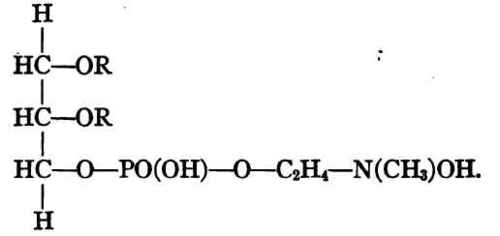
On hydrolysis such a compound would yield glycerol, fatty acids, phosphoric acid, and the nitrogenous base choline (tri-methyl oxyethyl ammonium hydroxide). If one of the radicles be that of oleic and the other that of palmitic acid the hydrolysis may be represented thus:
C42H84NPO9 + 4H2O→ C3H8O3 + C18H34O2 + C16H32O2
Glycerol Oleic Palmitic acid acid.
+ H3PO4 + C5H15NO2
Phosphor- Cholineicacid.
Recent investigations throw doubt upon the view that the nitrogen of typical lecithin is present only as choline groups.
Taylor defines the simpler phosphatids as "lipoids in which two molecules of a higher fatty acid are combined with glycerol-phosphoric acid, to which is bound an amino body."
A phosphatid which, like the above, contains one atom of nitrogen and one of phosphorus to the molecule is classified as a monamino-monophospholipin or monamino-monophosphatid. Monamino-diphospholipins, diamino-monophospholipins and triamino-monophospholipins have also been described.
The fat of the active tissues of the body, as distinguished from that of the adipose tissue, seems to consist largely of phospholipins. Thus MacLean and Williams found 84 per cent of the total ether extract of pigs' liver to consist of phospholipins.
Bang holds that it is "no mere coincidence that the most highly organized cells are always richest in lipoids."
Other lipoids may also prove to be of much importance in nutrition. Butter fat and some other natural fats show nutritive functions which cannot be attributed to their glycerides alone and appear to be due to other substances soluble in fats and perhaps of the nature of lipoids. Such as yet unidentified fat-soluble substance appears to be absolutely essential to a fully complete diet since several investigators (Stepp, McCollum and Davis, Osborne and Mendel) have found it impossible to raise young animals to full maturity on rations apparently adequate otherwise but lacking in this "lipoid" of "fat-soluble" factor. These experiments will be cited more fully in con- nection with the discussion of the specific relations of food to growth (Chapter XIII (Food In Relation To Growth And Development And The Dietary Deficiencies Of Some Individual Articles Of Food)).
Continue to:


My Books

