


Composition. Fish Food
Description
This section is from the book "Food - What It Is And Does", by Edith Greer. Also available from Amazon: Food: What it is and Does.
Composition. Fish Food
Fish are available as follows:
All Year
Bass (3-8 lb.), clams, cod (3-20 lb.), eels (1/2-1 lb.), flounder (1/2-4 lb.), haddock (5-8lb.), halibut, lobster (1-2lb.), pickerel(1-4lb.), sardines, salt and smoked fish. (Range in cost, 6-25¢ per lb).
Winter
Oysters (September-May), smelts (September-March), white-fish. (Range in cost, 10-25 c.) Oysters higher.
Spring
Herring, shad, trout. (Cost, 25¢-$ 1.) Herring cheaper.
Summer
Bluefish (June-October), crabs, mackerel (April-October), perch, salmon (May-September), swordfish (June-September). Range in cost, 5-50¢. Bluefish least expensive.
If expense needs to be carefully guarded, what effect would this have in the choice ? Which fish could be depended upon at each season? Which would need to be supplemented by fatty or other heat-giving foods.
Fish And Equivalent Foods Compare These
Refuse | Water | % IN | Protein | Fat | Carbohydrates | Ash |
29.9 | 58.5 | Cod (fresh) | 1 I.I | .2 | - | .8 |
24.9 | 40.2 | Cod (salt) | 16. | .4 | - | 18.5 |
17.7 | 61.9 | Halibut | 15.3 | 44 | - | •9 |
44.4 | 19.2 | Herring (smoked) | 20.5 | 8.8 | - | 74 |
447 | 40.4 | Mackerel | 10.2 | 4.2 | - | ■ 7 |
35.1 | 50.7 | Perch | 12.8 | 7 | - | •9 |
50.1 | 35.2 | Shad | 94 | - | - | |
- | 71.2 | Shad roe (eggs) | 20.9 | 3.8 | 2.6 | 1.5 |
- | 63.5 | Salmon (canned) | 21.8 | 12.1 | - | 2.6 |
5. | 53.6 | Sardines | 23.7 | 12.1 | - | 5.3 |
80.8 | Clams | 10.6 | I.I | 5.2 | 2.3 | |
52.4 | 36.7 | Crabs | 7.9 | •9 | .6 | 1.5 |
- | 88.3 | Oysters | 6. | 1.3 | 3.3 | 1.1 |
61.7 | 30.7 | Lobsters | 5.9 | 7 | .2 | .8 |
- | 87.1 | 3.3 | 4. | 5. | 7 | |
11.2 | 65.5 | Eggs | 13.1 | 9.3 | - | •9 |
41.6 | 43.7 | Chicken (young) | 12.8 | 1.4 | - | 7 |
25.9 | 47.1 | Chicken (old) | 13.7 | 12.3 | - | 7 |
24.5 | 54.2 | Veal (fore) | 15.1 | 6. | - | 7 |
20.7 | 56.2 | Veal (hind) | 16.2 | 6.6 | - | .8 |
(Rearranged from Farmers' Bulletin No. 142, United States Department of Agriculture)
Egg - Characteristics

Eggs raw are usually digested in the intestines. This makes them of use when the stomach itself is not in condition for use, but may cause diarrhea. Eggs serve as a concentrated protein food.
The sulphur in eggs, which blackens the spoon, forms, in union with other salts and fat, a compound fat (lecithin) in the egg-yolk, not always easily digested by every one. When it is not, the egg-white can, and should still, be eaten alone. But as egg-yolk contains not only more fat and protein than egg-white, it promotes growth and is to be eaten when possible. It digests raw or hard-boiled, if mixed with vinegar.
Eggs when fresh sink in cold water. As eggs decompose, the gas formed makes them lighter and the egg is thinner in constituency. When fresh, eggs look clear through the center, if they are held before a candle-flame in a dark room. Fresh eggs do not rattle when shaken. Their shells are full. Evaporation with standing empties them somewhat.
In brine (salt 2 oz. - water 1 pt.) eggs 1 day old sink; eggs 3 days old float beneath surface; those 14. days old, on the surface.
For Egg-Refrigeration see p. 220.
Egg, milk, seeds {grains), are foods for young animals and plants Food for young animals or plants stores for them their tissue- and heat-supply J
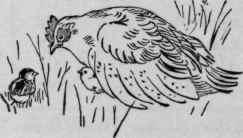
Young Chickens
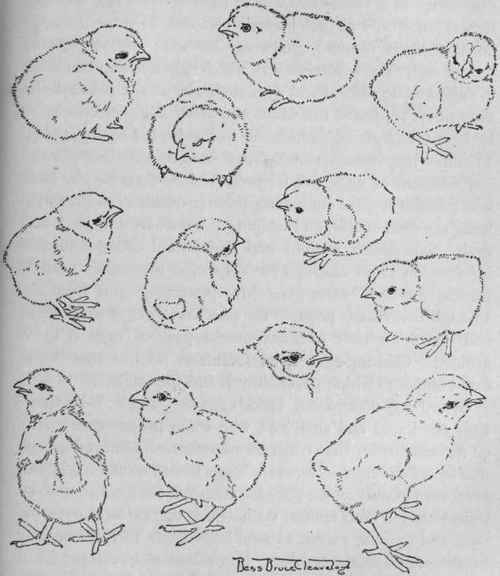
"These chickens are but a few days old. Older chickens have relatively larger bodies and longer necks and legs "
Copyrighted by The School Arts Publishing Co., 120 Boylston Street, Boston, Massachusetts. Reproduced from "The Good Zoo Drawing Cards," by permission of publishers.
Continue to:


My Books

