


Digestion Of Nutrition-Aids
Description
This section is from the book "Food - What It Is And Does", by Edith Greer. Also available from Amazon: Food: What it is and Does.
Digestion Of Nutrition-Aids
The body is a living organism; it needs to be active as well as supplied with the air, water, food, that will so nourish it as to make effective activity possible to it. Its internal activity must itself be sustained for health and strength of body. Digestion of food is as important to nourishment as is food itself. A body that cannot digest food cannot be nourished; a food that cannot be digested cannot provide sustenance'.
It is therefore as important to make and keep a body wholesomely active in all its functions as to supply the food materials it needs. Oversparing a body in health weakens it; in illness such care is often its temporary need. To make a body able to use all usual foods is its health-necessity. To prepare foods so that the body-processes are not utilized in digesting the food tends to incapacitate the digestive tract by non-use. Whatever aids in bringing about the above, necessary conditions aids nutrition; that is, the nourishing of the body by the utilization of food.
Pure air in abundance is imperative for assimilation of food, as it is food combining with oxygen which gives heat-energy and brings food into form for transformation into body-tissue. Deprived of air a body cannot be nourished, no matter what it may be fed. If air is cut off from a candle or lamp, the flame dies down and goes out; if air is cut off from a fire, it dies out; if air is exhausted in a building, as it may be in a fire, people die because they cannot breathe. If the air-supply is limited where people live or work, their food is not digested. Their bodies are harmed in other ways by lack of air. If impure air is breathed, it acts as would deficiency of air, and also causes such diseases as its impurities propagate.
The air-need is 30 cu. ft. per hour per person.
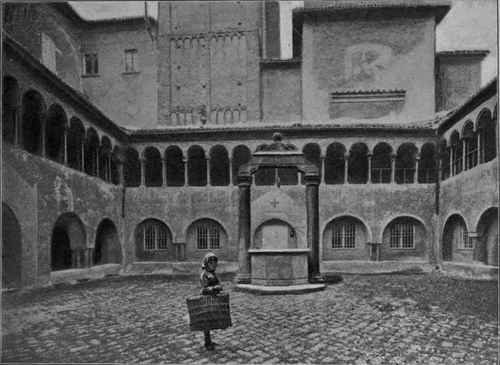
AN ITALIAN WELL-HEAD.
Food. Digestion-Needs
No less imperative than an abundance of pure air to digestion of food is plenty of pure water. Water and air perform different functions, hence the necessity of both. Their purity is important for all. Water liquefies food and aids in its transformation; air effects the oxidation of food, through which it is made useful to the body.
Besides the water taken in food (see Food-Composition) usually about three pints (or six glasses) of water a day is advised as drinking-water. The habit of drinking water between meals should be formed, for then water does not overdilute digestive juices at the time they are needed to digest the food eaten at meals. Drinking water between meals has the further advantage of bringing it into the digestive tract at the time the food eaten needs to be further liquefied. At night and in the morning (1/2 hr. before breakfast) a glass of water further aids nutrition by assisting in the removal of waste products.
Rest no less than activity is essential to health of digestion as it is to health of body. The digestive tract needs an abundant blood-supply when actively digesting food. As extreme physical or mental activity prevents this, there is need to lessen both for at least half an hour after meals, to which one should come not overtired, as exhaustion decreases digestive activity. Sleep does too, hence the inadvisability of sleeping immediately after eating. The digestive tract itself needs a period of rest between those of activity; eating too frequently prevents digestive recuperation. To digest food and to keep itself free from accumulated waste products the digestive tract itself needs health.
Activity alternating with rest, leisure to digest a suitable supply of wholesome food, periodic thorough removal of waste products, secure health of body and digestion of the food the body needs for its life and work.
Continue to:


My Books

