


Tea-Culture. Growth - Varieties
Description
This section is from the book "Food - What It Is And Does", by Edith Greer. Also available from Amazon: Food: What it is and Does.
Tea-Culture. Growth - Varieties
Tea is the leaf of the tea plant that is indigenous to Assam in Burma. For over fifteen hundred years it has been produced in Japan and China. Assam tea grows large but tender leaves. Its growth is luxuriant but needs protection from blights of drought and cold. A score of crops may be obtained in a season. Other kinds of tea produce three or four crops annually. Chinese tea is a hardy, coarser plant, less dependent upon soil, climate, or water supply. Its leaves are tougher, smaller, darker.
It is young leaves that are desirable for tea, hence their abundance is sought in tea-growing. The varieties of tea as purchased are but gradation of the leaves. The undeveloped bud is known as flowery pekoe. It is not usually imported here. The last developed leaves are called orange pekoe and pekoe (see below). Souchong and then congou come next. No more are used here.
Any variety of tea may be made either black or green. Japanese tea is usually green; Indian, black; Chinese, both. Green is produced by withering leaves in iron receptacles by quick heating or steaming on mats. Leaves are then rolled to release oil and heated long at low temperature. Black tea is sun-wilted, rolled, spread thin, moistened, left to ferment, then furnace-dried. The fermentation makes tannin more insoluble, so less dissolved in making tea.
In green teas hyson is a finer variety, gunpowder a coarser. Teas often carry the name of the location of their growth, as Ceylon. Each has some distinctive characteristic due to its culture or manufacture. Teas obtainable in the United States are usually not the finest that nature produces.
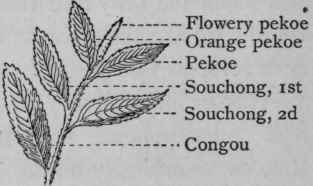
Tea leaves.
Continue to:


My Books

