


(8) Patellar-Reflex Latency, Amplitude, And Refractory Period
Description
This section is from the book "Human Vitality And Efficiency Under Prolonged Restricted Diet", by Francis G.BENEDICT, Walter R. Miles, Paul Roth, And H. Monmouth Smith. Also available from Amazon: Human Vitality and Efficiency Under Prolonged Restricted Diet.
(8) Patellar-Reflex Latency, Amplitude, And Refractory Period
The patellar-reflex records were made from muscle thickening. The technique was the same as that used and described by Dodge and Benedict1 in their investigations of the effect of alcohol. The apparatus was essentially the same as that illustrated and described by these authors, but has been slightly modified since the previous description. The present form is shown in figure 31, page 160, of this monograph. It had been found that considerable latitude was needed for adjusting the height of the light wooden bar B, which rests against the tendon of the subject. A rough adjustment (1) and a fine adjustment (2) were arranged to raise or lower as needed the sliding base, S, which carried the stimulus apparatus and to which was fastened one end of the bar B. The position of this bar in relation to the hammers, H, was constant, regardless of whether the bar was raised or lowered. A screw clamp (3) made possible the suitable adjustment of the height of the other end of the bar.
1 Dodge and Benedict, Carnegie Inst. Wash. Pub. No. 232, 1915, pp. 36 ff. They ilustrate their apparatus in their fig. 4.
In actual use the apparatus was not placed as in figure 31, but was moved closer to the table. The subject's left foot was placed at F, and his shin rested in the two notches above. The position of the subject under the stimulus apparatus was so oriented that A, the adjustable connection between the quadriceps muscle and the light-recording lever which rests on the kymograph drum, was directly over the middle of the quadriceps muscle. The hammers, H, fell through 90° from the magnets, M.
A modification was made on the Blix-Sandstrom kymograph whereby the interval between the two blows from the hammers could be gradually lengthened or shortened at will without causing an interruption in the experiment. The general form of this modification is indicated in figure 27, where M is the kymograph motor and shift gear and D is the drum. A movable gear, G, in the form of a collar, is mounted on the fixed sleeve, V, through which the moving kymograph shaft S extends. To this movable gear a block of insulation material is secured which carries a contact or switch device, C. A small brass worm, W, mounted in the fixed block B, engages with the gear. Thus, by turning the rod R, which extends to a convenient position for the operator, the contact C may be moved in relation to the fixed contact C". Each contact is made of two leaves, one longer than the other, which, by their spring tension, hold themselves together. The insulated arm A is mounted on the revolving shaft and turns with the kymograph drum. The adjustable points in the end of this arm sweep past the contacts and open them in turn, whatever may be their relative positions. As these switches are in series with the electro-magneto (see M, fig. 31) which are supporting the hammers just previous to the stimulation of the patellar reflex, they control the action and the interval between the blows. The wiring diagram for the apparatus as used is shown in schematic form in figure 28. The meaning for the different letters is given in the legend of this figure.
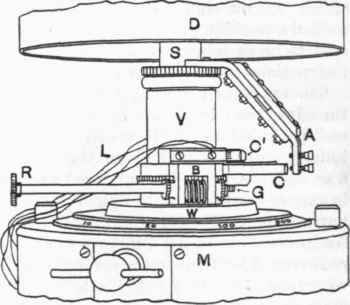
Fig. 27. - Detail of a device mounted on a Blix-Sandstrom kymograph whereby the interval between the opening of two circuits may be progressively changed.
M, electric motor; D, drum; S, shaft carrying D; V, fixed sleeve; L, leads to two independent circuits; C', a fixed contact mounted on V; B, block in which IF, a small worm, is mounted so as to mesh with the gear, G; G is movable about V and carries contact C. By turning the hand wheel R, which actuates the worm and gear, C may be made to advance or recede from C' which is fixed. The insulated arm, A, carried by S and revolving with D, opens C and C in turn, regardless of their relative positions.
The subject reclined in a steamer chair, the height of which was the same for all subjects and all sessions. At first the patellar tendon was explored to find the point of greatest sensitivity. Then, beginning with the stimulus blows separated by an interval of 0.8 second or thereabouts, the interval was grad-ually shortened until the second stimulus failed to produce a reflex. Then the interval was varied in length a number of times in an effort to secure several records in which the second stimulus produced only a slight reflex or no reflex at all. The 100-gram weights did not seem to be uncomfortably intense for any subject. Some of the subjects had no reflex which was measurable. The routine was carried out, however, in every instance, so that if a reflex should suddenly appear or become sensitive it would not be omitted. This did happen to some extent in the case of Tom, Squad A, who, after an operation for hemorrhoids,1 had a reflex which was considerably larger than that he had previously shown in the experiment. A sample record, reduced in size, is given in figure 29. The records for patellar reflex, finger movements, and word reactions taken on the subject in room B were all made on the same kymograph paper. The reader will therefore disregard for the present the part of the record below the cross which may be seen on the left side of figure 29. The reflex record (see upper part of fig. 29) was started near the middle of the paper, where the interval between reflexes is longest. Reading a record from the left, the fall (1) in the line is caused by the stimulation of the tendon; the second drop (2) is from the reflex thickening of the muscle. The distance from the beginning of 1 to the beginning of 2 is the latency for the reflex, which is measured in thousandths of a second (the kymograph speed was 100 mm. per second). The amplitude is the vertical distance from the base-line of 1 to the lowest point of 2. The mechanical magnification in the record was 6 times the actual height of muscle-thickening.1 There is naturally some confusion in the tracings of such records, but it is evident that when the interval between stimuli is decreased to a certain point, the second stimulus fails to produce a reflex. When the interval is lengthened slightly, a small reflex appears in response to the second stimulus. A record was kept of the height to which the bar which rests against the subject's knee had to be raised, and also whether the subject had on shoes or slippers.
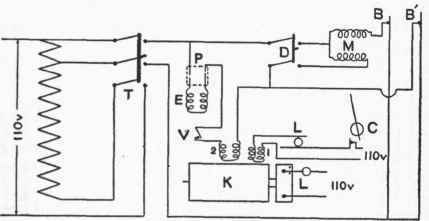
Fig. 28. - Schematic wiring diagram for the apparatus used in room B in the evening measurements: patellar reflex and word reactions.
A triple pole switch T and a double pole switch D, when closed, caused current to flow in the electro-magnets M, which held up the pendulum hammers used to stimulate the patellar tendon for eliciting the reflex. The hammers were released from the magnets when the circuits were broken at B and B'. The temporal relation of these could be changed (see fig. 27). A large clock C interrupted a circuit (110 volts, lamp L, in series, 0.5 amp. current flowing) and so actuated an electro-magnet, 1, and registered the control time on the kymograph K. By opening D and connecting the exposure apparatus E in circuit by means of the plug P, the word reactions could be recorded. The opening of the circuit at B' exposed the word and caused at that instant the operation of the marker, 2. The circuit was reestablished at B' before the subject could react by speaking into the voice key V. The reaction opened V and the marker, 2, was operated a second time and recorded the moment of response.
1 See his personal history, p. 52.


Continue to:


My Books

