


a. Experiments in Subjects that Were not Obese
Description
This section is from the book "Part. 6. Drink Restriction (Thirst-Cures), Particularly In Obesity", by Prof. Carl von Noorden and Dr. Hugo Salomon. Also available from Amazon: Clinical Treatises On the Pathology and Therapy of Disorders of Metabolism and Nutrition, Part 6
a. Experiments in Subjects that Were not Obese
Case 1. - Schm., age twenty-two, servant girl. Chlorosis of a pasty type; fairly well developed fatty layer. Weight on admission 54 kg., height 1.48 m.
The patient during the fore-period, without restriction of liquids, imbibed from 1500 to 1700 c. c. During the period of thirsting this quantity was gradually reduced to 300 c. c., and, in addition, an electric-light bath was administered on three days of this period.
During the period of restriction of liquids the appetite remained good; thirst was very severe.
The concentration and the specific gravity of the urine were greatly increased. Despite the small intake of fluids, the girl's weight was not greatly decreased. The greatest difference observed during the period of thirsting was a decrease of 1.1 kg. as compared with her weight at the beginning of the thirst period.
The withdrawal of blood from a vein was refused.
The average consumption of oxygen during the fore-period of four days was 221.8 c. c. a minute, during the thirst-period of twenty-two days 206.6 c. c., during the after-period of twenty days 204.3 c. c.
We are not inclined to attach any importance to the difference observed between the fore- and the main-period.
As already mentioned, we took particular pains not to begin the proper "fore-period" until a certain constancy in values for the oxygen-consumption in the morning before breakfast had been attained. This point could occasionally not be determined until the experiment was already under way, and sometimes the values for the oxygen-consumption became unavoidably smaller during the experiment itself. In order to eliminate the error introduced in this way, the "after-period" was prolonged.
In this particular case so much at least was determined, viz.: that the values for the respiratory interchange of gases, i.e., for the total oxygen-metabolism of the organism, were not increased during the period of thirsting.
During menstruation, that occurred during the period of thirsting, no particular fluctuations in the values for the oxygen-consumption were noted.
Record Of The Consumption Of Oxygen

Case 2. - O. Sch., age eighteen; chlorosis. No treatment so far. The patient from October 23 to November 19, inclusive, received liquids ad libitum, the total daily intake fluctuating from 1250 to 1500 c. c.
The period of restriction of liquids lasted from October 12 to October 20, inclusive. The patient suffered severely from the subjective manifestations of thirst, notwithstanding the fact that the restrictions imposed upon her were not especially severe. The ingestion of solid food was a little, but not markedly, decreased during this period of thirsting.
During the period of restriction of liquids the specific gravity of the blood rose from an average of 1036.3 to 1043.55, that the serum from 1028.8 to 1031.1.
It is interesting to note that the specific gravity of the blood and the serum remained at the same height during the after-period. This recalls the observations of von Noorden (40) and Romberg (41), who showed that chlorotic patients often deposit too much water in their tissues. It is useful in such cases to precede the specific iron-treatment with a course of water-restriction.
The consumption of oxygen in this case was decreased a little after the fore-period - for the same reasons, apparently, that were discussed under Case 1 - but the values did not become lower than those obtained in single determinations during the three weeks of the after-period.
Record Of The Consumption Of Oxygen
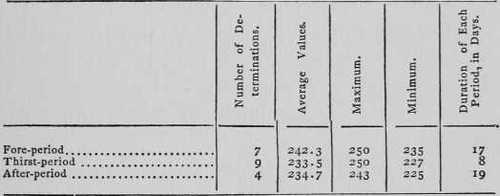

There is no evidence whatsoever of an increase in the consumption of oxygen during the period of thirsting.
During menstruation, by the way, the values obtained corresponded exactly to the average values.
During the period of thirsting the patient's weight fell from 70.2 kg. to 68.3 kg., but already on the fourth day of the after-period she had regained her original weight.
Case 3. - A. S., age nineteen, chlorosis, also no previous treatment; weight 49 kg., height 1.58 m. Course very similar to previous cases.
After a fore-period of 6 days (March 16 to March 22) came a main-period of 15 days (April 23 to May 8, inclusive); severe sensation of thirst, moderate reduction in the intake of solids during this period.
Loss of weight during the thirsting period from 48.9 kg. to 47.0. During the after-period of three weeks the patient regained her original weight (48.5 kg.).
Record Of The Consumption Of Oxygen

Blood Findings

Case 4. - Dora L., age twenty-two, anaemia. Moderately well-nourished subject; weight 53.7 kg., height
1.53 m. The fore-period lasts from July 12 to 18 inclusive, the main-period from July 21 to August 3, inclusive. The intake of solid food was decreased during the period of thirsting. The body-weight decreased 2.7 kg., the specific gravity of the blood and serum were markedly increased. During the after-period the specific gravity of the blood remained as high as during the main-period, the specific gravity of the serum, however, was decreased, but still remained higher than it had been at the beginning of the experiment.
During the thirsting-period a few remarkably low values for the oxygen consumption were found in this patient (e.g., on July 30 and 31). This discrepancy is so striking that we hesitate to include these figures as completely valid in our calculations, notwithstanding the fact that the experiment was each time carefully revised and no sources of error whatsoever were discovered.
Blood Findings

Record Of The Consumption Of Oxygen

Case 5. - Kath. F., age twenty-six; nephritis chron., without oedema, existing for one and one-half years, occurring after an attack of angina, with albuminuria 1/4 to 1/2 pro mille, few casts; no change about the heart and arteries. Small (1.5 m.) but strong girl, fairly well nourished; weight 50.6 kg.
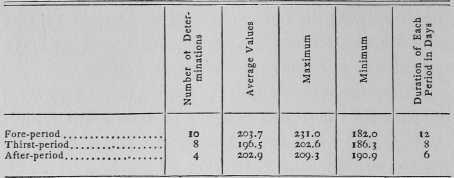
The oxygen-consumption, taking the average of ten determinations made during the fore-period, was 203.7 c. c. a minute; the figure obtained on October 17 was for unknown reasons abnormally high, and we have neglected it in calculating the above average.
During the main-period, the patient being very willing to help us, it was possible to reduce the liquid-intake to 300 c. c. a day. During this period of thirsting the appetite and the intake of solids were much reduced. The weight of the patient during this time fell from 50.5 to 48.2 kg. This loss, however, was rapidly regained during the first six days of the afterperiod.
The specific gravity of the blood and the serum was high in this patient before the withdrawal of liquids was begun, i.e., 1062.9 and 1031.3, on and average. These figures during the period of thirsting rose to 1066.4 and 1034.8.
In this case, too, great restriction of fluids failed to produce any increase in the oxidative processes.
Blood Findings

Record Of The Consumption Of Oxygen
Continue to:


My Books

