


d. The Restriction of Liquids in Hemorrhages
Description
This section is from the book "Part. 6. Drink Restriction (Thirst-Cures), Particularly In Obesity", by Prof. Carl von Noorden and Dr. Hugo Salomon. Also available from Amazon: Clinical Treatises On the Pathology and Therapy of Disorders of Metabolism and Nutrition, Part 6
d. The Restriction of Liquids in Hemorrhages
The attempt to produce concentration of the blood in cases of hemorrhage, and hence greater coagulability, has often been made; on the same principle is the prescription of powdered salt and strong salt solutions in hemoptosis. Diaphoretic means are counterindicated in pulmonary hemorrhages, and have never become popular in hemorrhages of the digestive organs. The absolute withdrawal of liquids in such cases is more conservative than sweating, and at least equally rapid in effecting the result. We have repeat edly insisted upon the complete withdrawal of liquids (and in gastric or intestinal hemorrhages, of course, also of all food) for from three to five days, and we can recommend this apparently cruel, but in reality very useful and readily borne procedure, with a clear conscience. In view of the great danger to life, or, at the very least, of long-lasting weakness from repeated hemorrhage, thirsting (or thirsting and fasting) for several days is often to be considered as decidedly the lesser evil.
In the clinical and historical introduction to this article, and in the paragraphs on "Therapeutic Conclusions," a variety of maladies have been enumerated that can be benefited by more or less rigid restriction of the liquid-intake. Our disquisition is by no means, however, to be interpreted as signifying that this method of treatment is to be carried out schematically and in a routine manner in all of these conditions. One should never forget that the restriction of liquids is no indifferent procedure, but on the contrary one that often exercises a most profound influence upon the general nutrition of the body; so that the physician before ordering a restriction of the liquid-intake should always realize the great responsibility he is assuming and carefully weigh all the circumstances in each individual case. Applied correctly and within wise limits the method of restriction, however, is as important as, under certain other conditions, the opposite method of flooding the organism with large quantities of liquid.
Table I (to Case I)

Table II (to Case II)
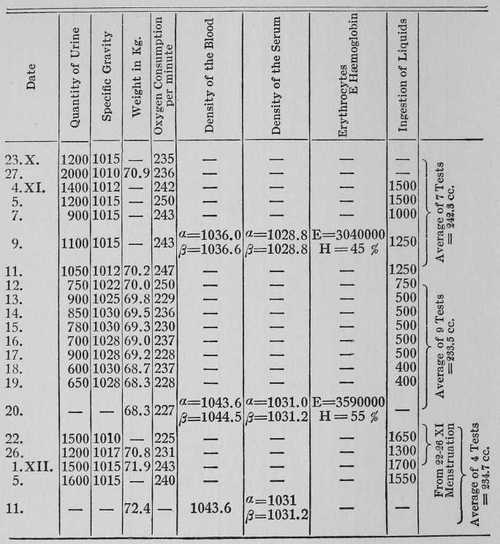
Table III (to Case III)

Table IV (to Case IV)

Table V (to Case V)

Table VI (to Case VI).

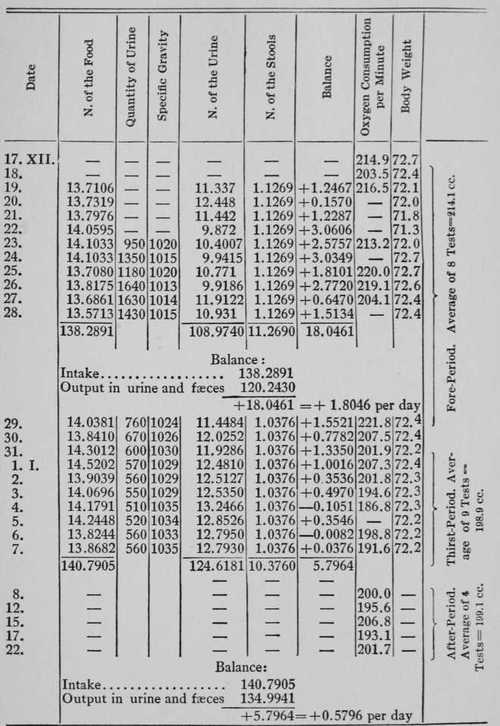
Table VII (to Case VII)
Continue to:


My Books

