


II. Conditions Preliminary To A Fattening Cure
Description
This section is from the book "Part 8.2. Inanition (Fasting) And Fattening Cures - On the Pathology and Therapy of Disorders of Metabolism and Nutrition", by Prof. Dr. Carl von Noorden. Also available from Amazon: Clinical Treatises On The Pathology And Therapy Of Disorders Of Metabolism And Nutrition V8: Inanition And Fattening Cures (1910)
II. Conditions Preliminary To A Fattening Cure
The determination of the "Maintenance Diet" (Erhaltungskost) is a necessary preliminary to any endeavor that may be made towards increasing a reduced state of nutrition. In a previous paragraph the method of calculating this factor has already been described. It is clear from what has been said above that the maintenance diet fluctuates within broad limits according to the condition of the body and according to the demands made upon its musculature. For a definite body weight (70 kg) we calculate variations lying between 2100 and 4200 calories. There is, therefore, no diet that can be called a "fattening diet" that is based upon any definite standards - unless we exclude certain extreme conditions that are rarely seen. A certain diet may be very fattening for one individual, while it may induce undernutrition with considerable loss of weight in another individual. The following example may illustrate this:
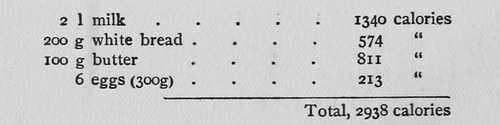
An individual of an average bulk weighing 80 kg and performing an ordinary amount of labor could not remain in nutritive equilibrium on a diet of this kind, because his caloric demands lie between 3200 and 3600 calories a day. In other words, on such a diet this individual would progress to a condition of undernutrition of a mild degree.
Such a man would without doubt lose weight (approximately from 300 to 400 grammes a week) and grow weaker.
For a reduced tuberculous individual weighing 60 kg and resting in bed the same food would be an excellent fattening diet, for the demands of such an individual would be 1800 calories, and the surplus pabulum of about 1100 calories would enable this individual to gain about 1 kg a week.
These examples seem so self-evident that it might be considered superfluous to mention them at all. Matters, however, are never quite so clear as delineated above, and I consider it necessary to advise a careful estimation of the maintenance diet, because I continually encounter instances in practice where serious errors are committed simply because these simple calculations are neglected. Under such conditions both the patient and the physician object that all attempts at fattening remain futile; the patient is considered unsuitable for a fattening cure and time, trouble and money are considered wasted with further attempts in this direction.
If in such cases the diet that is being used as a fattening diet is carefully calculated, one will find, how ever, almost without exception, that no true conception was arrived at in regard to the real demands of this individual for food in regard to the nutritive value of the so-called "fattening diet," and that the two, i. e., demand and supply, were not arranged in proper proportion.
It is, of course, also very important to know what increase in weight can be justly expected in a fattening cure. I have been collecting material of this kind for several years and can indicate the following values as representing an average :

I offer as a definition of a surplus of food or a fattening addition the sum of the nutritive units (calories) administered in excess of the calculated nutritive demands (Maintenance Diet) of the individual.
Continue to:


My Books

