


A Special Roof Tank
Description
This section is from the book "American Plumbing Practice", by The Engineering Record. Also available from Amazon: Plumbing: A working manual of American plumbing practice.
A Special Roof Tank
(Published In 1889.)
In a recent search for plumbing details, a member of our staff sketched the construction shown in Figs. 1 and 2 of a roof tank in a new residence on West End Avenue, New York.
Figure 1 is a general perspective. A is a 1-inch pipe affording an independent supply to a slopsink on third floor. B and C are ¾-inch relief pipes from the hot-water supply and heating systems. D is the strainer-plate covering safe waste pipe.
Figure 2 shows the tank broken at Z Z, Fig. 1 and shows pipes and details not visible in Fig. 1. A is the safe with lead cover B. C is a relief pipe. D is a 1¼-inch pipe supplying tank water to the house; it is connected with the city pressure, which, when sufficient, forces street water into the tank through branch E and ball cock G. F is a check valve that closes towards the right and thus prevents street water from overflowing the tank when ball cock G is closed. As the street water is likely to rise above the bottom of the tank sooner and oftener than it would rise to the top, the ball cock G is set very low and its floor H works on a long arm so as to operate whenever possible. I is the 1½-inch force pipe from the pump. J is the overflow and K the emptying pipe, both discharging through the 2-inch pipe L to the roof gutter. The tank is reinforced by twelve ⅝ - inch tie-rods (see Fig. 1) M; the six inside rods are jacketed by 1-inch copper pipes N, that are soldered to the copper tank lining O. PP, etc., are 2 x 1-inch tongues set with white lead in the grooves of the tank boards at all joints.
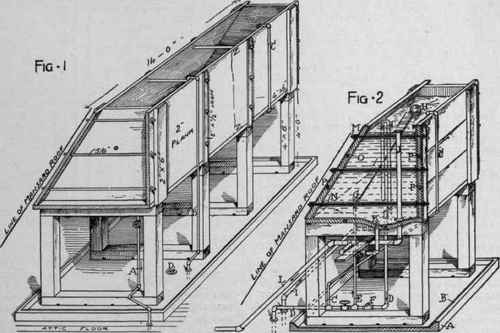
A SPECIAL ROOF TANK.
The plumbing in this house was done by Byrne & Tucker, of New York, who were at that time completing the work in an apartment-house on Eighty-fourth Street, where the hot-water pipes from the kitchen boilers to the bathrooms conspicuously crossed the dining-room walls. All the plumbing in this building was exposed, and as the position of these pipes could not be changed they were bronzed, supported on frequent brackets, and served for tasteful picture rods.
All distribution pipes were pitched up a little continuously all the way from the main pipe, and so arranged that when the water supply was turned off from any apartment all the pipes in its system could be emptied by one drip cock, thus avoiding the danger of freezing when the place chanced to be untenanted.
Continue to:


My Books

