


Tools Used In Plumbing
Description
This section is from the book "A Working Manual Of American Plumbing Practice", by William Beall Gray, Charles B. Ball. Also available from Amazon: Plumbing.
Tools Used In Plumbing
Some of the tools used in executing pipe work will now be briefly described. Of the lead-pipe tools, Fig. 212 is a drift plug or pin used for removing accidental dents from, and rounding up, lead waste pipe after it has been coiled for shipment. It can be used only when the pipe is detached and comparatively straight. The plug is greased, and is forced through with a piece of gas pipe with a cap on the driving end.
These plugs are made in various lengths, for all sizes of pipe, generally with a slight taper. Boxwood is best for the purpose, but dogwood and even softer woods are used. Three to five plugs constitute a set for one size pipe; the smallest being at least \ inch less than the diameter of the pipe, so that, when the plug of the exact diameter has worn so that it is too small, one of the smaller plugs for the next size larger, used to begin the removal of the dents, may be employed instead. After a pipe is in place, there is scarcely any easy way to remove a dent, except by soldering a strong piece of strap solder to the lowest place and gradually pulling the dent out, keeping it warm with the torch so that the lead will give easily.

Fig. 212. Drift Plug or Pin..

Fig. 213. Tampion or "Turn-Pin.".
Fig. 213 is a tampion - generally called turn-pin by plumbers, because it is turned after each stroke of the hammer, so as to insure swelling the end of the pipe uniformly. The turning is necessary because the pins become somewhat oval while seasoning. The heart of the wood is seldom in the center of the pin, and the shrinkage therefore is not only quite unequal but varies as the center of the timber is eccentric to that of the pin. These pins are made of boxwood, with various tapers according to the work for which they are designed. Fig. 214 is an expanding device for enlarging holes in drum-traps and for aiding in preparing the receiving end of the pipe, as heretofore described for the turn-pin.
Fig. 215 is a tap-borer. It is made for boring the openings in traps and waste pipes, and for reaming out the ends of supply when preparing for wipe-joints. Its work is seldom true, and the turn-pin is used for finishing. The plumber's rasp plays an important part in the preparation for joints, especially in preparing the spigot end.

Fig. 214. Expanding Device for Enlarging Holes.

Fig. 215. Tap-Borer.

Fig. £16. Bending Iron,.

Fig. 217. Ordinary Shave-Hook.
Fig. 216 is a bending iron, used for straightening the ends of pipe and enlarging holes made by the tap-borer, generally performing in a satisfactory way the work described in connection with Fig. 214.
Fig. 217 is a shave-hook of the type generally used on regular work. Lead tarnishes quickly; and in preparing joints, it is necessary to scrape clean the portion to which it is intended the solder shall adhere. The shave-hook is used for this purpose. To prevent reoxidation before use, joint cleanings must be immediately covered with tallow, lard, or sperm candle. The acid in sperm candle grease will cause solder to adhere where not intended, if one is not very careful.
On new lead, soiling is necessary, regardless of the kind of flux used. The whole end of the pipe or other surface about a joint is soiled usually to a distance of four inches for wiping purposes, before making the cleaning. Plumber's soil consists of glue and lampblack, a little glue being dissolved in water, and lamp black added to make the mixture about the consistency of cream or thicker, the whole being boiled to incorporate the glue thoroughly. Soil should be laid on hot, with a brush. The surface to which it is applied must be free of grease and dirt, or it will not stick.
Sheet lead is generally more or less greasy, no matter how clean and bright it looks, because tallow is used as a lubricator when rolling into sheets at the factory. New sheet lead should therefore be well rubbed with dry chalk, and dusted clean before soiling. Good soil should take a slight polish by rubbing with the hand after it is dried on the pipe. If it rubs off, for Use in Corners and Other there is not enough glue; if it cracks or peels or checks while drying, too much glue has been used.

Fig. 218. Shave-Hook with Bent Shank,.
Inconvenient Places.
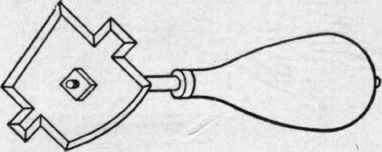
Fig. 219. Shave-Hook with Special Blade for Cleaning Seam Edges, etc..

Fig. 220. Copper Bit or "Soldering Iron.".

Fig. 221. Hatchet Iron,.
Fig. 218 is a shave-hook with bent shank, convenient for cleaning in corners or other inconvenient places.
Fig. 219 is a shave-hook with special blade, with recessed edges of different lengths and depths, intended for cleaning tank-seam edges, etc.
Fig. 220 is a copper bit, generally called a soldering iron. It is of the same pattern as used by tinners.
Fig. 221 is a hatchet iron, being distinctly a plumber's tool. It is adapted to soldering tacks on lead pipe and for making seams, also for other uses peculiar to the plumber's trade. It will revolve on the handle.
Continue to:


My Books

