


Hot Water Circulation In Buildings Bath Boilers. Part 2
Description
This section is from the book "Plumbing Problems", by The Sanitary Engineer. Also available from Amazon: Plumbing Problems, or Questions, Answers and Descriptions Relating to House Drainage and Plumbing.
Hot Water Circulation In Buildings Bath Boilers. Part 2
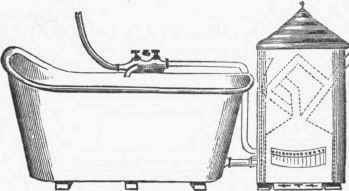
Figure 82.
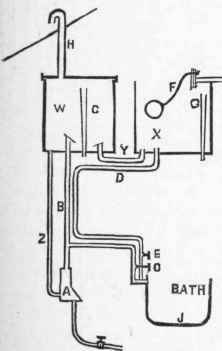
Figure 83.
By extracts taken from the English papers, I notice that the bursting of hot-water boilers, as they are there called, has been very frequent this winter, and in several cases has been attended with very serious results. This has doubtless called out the circular issued by the Manchester Steam-users' Association, in which some good suggestions are made to householders.
In the newspaper accounts of these casualties I notice they always speak of the "boiler burstin," but I apprehend it is what we in America call a water-back. The unusual number of these occurrences this winter is doubtless due to the very cold weather and the want of proper provision to prevent the freezing of the hot and cold water pipes, which might be expected in a country where such extreme cold was an uncommon thing. To this fact and to the ignorance of servants in building a fire in a range before it was certain that there was no impediment to the circulation of water in the pipes, must be attributed these disasters, and in reading of them it is plain to be seen that the ignorant plumbers and householders are not all on this side of the Atlantic.
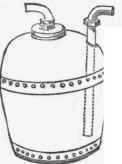
Figure 84.
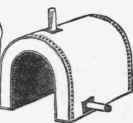
Figure 84A.
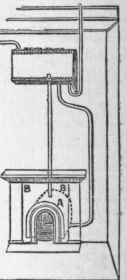
Figure 85.
Figure 87, which is copied from an English catalogue, shows a more complete arrangement than those illustrated before. In this there is a range to do the duty of heating the water. B is the boiler or water-back; C the hot cistern, which in this case is tightly closed. It is made usually of galvanized wrought-iron, and really answers the same purpose that our boilers do which we place alongside our ranges. D is the cold-water pipe from the hot cistern to the boiler or water-back; E, the return or hot-water pipe to the hot cistern, and F is the cold-water tank. G is the pipe to convey cold water from the tank to the hot cistern; I is the pipe to convey hot water to the bath-tub; K is a relief-pipe from the hot cistern to above and over the cold-water tank.
The place selected for locating the hot cisterns depends on circumstances; it is usually placed above the points where it is proposed to draw hot water, but it is sometimes put in the bath-room at the end of the bath-tub, with a warming-closet or linen-warmer placed just above it, so that it can secure some of its waste heat for the purpose of warming towels, etc.
The editor of the Sanitary Engi-neer has received a description of the usual manner of fitting up hot-water boilers in Montreal, from Mr. J. W. Hughes, of that city, and I am pleased to give it herewith. Mr. Hughes says: "Having read the-articles by "Sanitas" on the different styles of setting hot-water boilers, it occurred to me a short sketch on the prevailing method of fitting hot-water attachments for bath and other purposes here might be of interest to my American colaborers at the plumbing trade. Boilers, or, as you call them, copper reservoirs, are the exception; and the cistern plan is the rule, although I have fitted up several houses on the American plan.
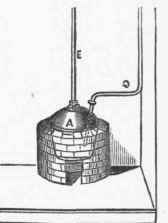
Figure 86.
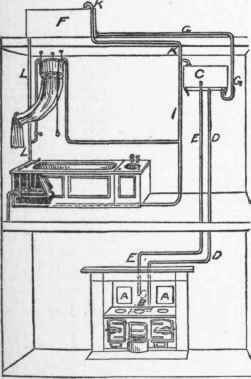
Figure 87.
"The greatest objection to the cistern plan is, that they are usually set immediately over the closet (pan water-closets generally used here), and as they are fed from the cistern supplying the water-closet, said cistern being uncovered, they are not at all right in a sanitary point of view, especially when, as is frequently the case, careless servants take hot water from the taps for cooking purposes.
" In the plan, Figure 88, A is the hot-water compartment, usually lined with 5-pound lead or light copper; B, the division between hot and cold cisterns; C, the cold cistern supplying the water-closet, and also hot-water cistern through pipe P, which is joined about the centre of division, the end in hot-water cistern being turned down to within one inch of bottom. A galvanized-iron cover is fitted tight on the hot-water cistern; E is the ball-cock on city service for cold water; F, service-box; G, service-pipe; H, cold-water supply-pipe; I, water-closet; J, hot-water circulating-pipe, standing up about eight inches from bottom of cistern and carried direct to ceiling over range or stove, to which it is connected from top outlet of heater by an iron pipe. From this pipe, J, are taken branches L M N, to supply hot water to bath, basin-sink, etc. K is the cold-water circulation taken direct from bottom of the cistern and joined to the heater, as shown. O is the heater in the range; the arrows show the direction of circulation-pipes J K, generally 5/8" 6-pound to the yard lead pipe. A good supply of hot water is obtained, by this method.
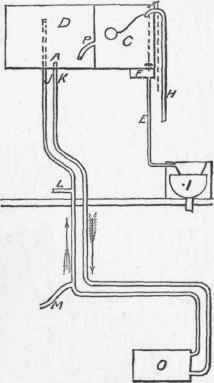
Figure 88.
"The sketch shows front of cistern removed; if the water boils or steam is made in large quantities, a 2-inch galvanized ventilator is run from the cover D."
Continue to:


My Books

