


Bidets
Description
This section is from the book "Principles And Practice Of Plumbing", by John Joseph Cosgrove. Also available from Amazon: Principles and Practice of Plumbing.
Bidets
A bidet, Fig. 151, is a form of sitting bath for use after using the closet, and for the administration of injections and treatment of haemorrhoids. They are made of porcelain enameled iron, and of porcelain, with a simple waste connection or with a unique waste so that a body of water can be held in the bowl.
The supply pipe to bidet baths is always so arranged that hot water cannot be turned on without also turning on the cold, although cold water can be drawn without turning on the hot water. This arrangement of valves makes it impossible for anyone to be scalded while using the fixture.
Bidet attachments are made that can be attached to a closet bowl. While these are very convenient they are not as satisfactory as a bidet fixture, without which no bathroom is complete.
Urinals should be made from the least absorbent and least corrosive of materials, and all exposed connections, walls, floor and partition, should be equally non-absorbent and non-corrosive. If the urinals or surroundings are absorbent they will soon become saturated with urine and emit a most pungent and disagreeable odor. If made of corrosive materials they will be energetically attacked and destroyed by the urine.

Fig. 151
The simplest type of urinal is a Bedfordshire flat-back urinal, either plain or lipped; the lipped, Fig. 152, being the better form. Urinals of this type are provided with a perforated outlet and the better grades have an overflow molded in the bowl to prevent an overflow should the perforated outlets be stopped. This type of urinal is usually flushed direct from the water supply and the flow of water is controlled by a compression stop cock. A flushing rim, extending around the opening to the bowl, admits water to all parts and insures a good flush. The objections to this type of urinal are: First, the perforated outlet prevents a thorough scouring of the waste pipe when the urinal is flushed; second, the connections are exposed and cannot easily be kept clean; third, there is too much dry surface to the bowl; fourth, the flushing cock is seldom if ever turned on by the person using the fixture.
An improvement on the Bedfordshire urinal is shown in section in Fig. 153. The improvement consists of first, a wide open outlet that permits a scouring flush of the waste pipe; second, a large flush connection and flushing rim to permit a copious flush of water; third, a flush connection suitable only for a flush tank or flush valve, and fourth, no exposed metal connections. This type of urinal is made with a trap also forming part of the bowl, and is a slight improvement on the other one shown.

Fig. 152
Siphon-jet Urinals, Fig.
154, are the most sanitary type of urinals. In addition to all the good qualities possessed by the other types, they contain a large body of water to chill, deodorize and dilute the urine, which is siphoned from the bowl at each discharge of the fixture. Stall Urinals - Urinals made of marble, porcelain or slate in the form of stalls with a grooved floor slab draining to a gutter at the rear and a perforated pipe or fan to spread a thin sheet of water down the back slab, are sometimes used. Under some conditions, particularly where water is plentiful, they are fairly satisfactory, but as a rule they are not perfectly sanitary. Marble and slate each to a slight degree is absorbent. There are many joints and crevices about the stalls to foul, and such urinals are very extravagant in the use of water. Urinal Flush Tanks - The improved types of urinals are generally flushed from urinal tanks or through flush valves similar to closet flush valves, only of smaller size. Where water is plentiful, or in insane asylums or other institutions where the inmates cannot be depended on to flush the urinals, automatic flush tanks will be found effective for this purpose. Automatic flush tanks can be so adjusted that they will discharge at any desired interval of time.

Fig. 153
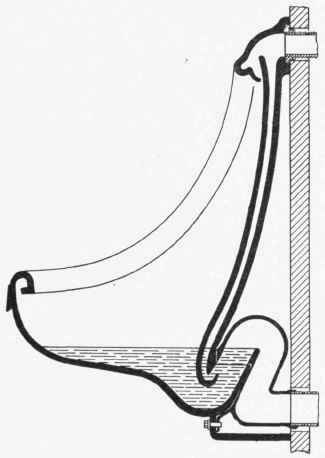
Fig. 154
Continue to:


My Books

