


Double Heater Connections To Boilers
Description
This section is from the book "Principles And Practice Of Plumbing", by John Joseph Cosgrove. Also available from Amazon: Principles and Practice of Plumbing.
Double Heater Connections To Boilers
Two or more heaters are sometimes connected to one boiler. For instance, a coal or gas heater is sometimes used to heat the water during summer months, and a steam coil used to heat the water during winter weather. Each connection would be made independently of the other under such circumstances, and either means or both means could be used together to heat the water.
The real test of the efficiency of a double heater connection to a boiler is the ability to heat with one or both heaters together. When two waterbacks or heaters are connected to the one hot water tank, by joining the flow and return pipe from both circuits, great care must be taken to connect them in such a manner that the current from one circuit will not be stronger than the current to the other circuit, and thus short circuit the strong current and shut off the flow from the weak one. That is what usually happens when one heater is located at a lower level than the other heater, or if located at the same level but at a great distance. Also, it might happen if one circuit was made of smaller pipe than the other one, or for any other cause was subject to greater friction.
The best way to connect two or more heaters to one tank is to connect each one separately. If there are only two heaters they may be connected as shown in Fig. 134, or the flow connection can be reversed, so the flow pipe from the heater on the lower floor will enter the top of the boiler. This will not affect the circulation from either heater otherwise than to cause a loss of velocity in the upper circuit, due to loss of head. If more than two heaters are to be connected, special tappings should be provided in the tank for the extra flow and circulation pipes.
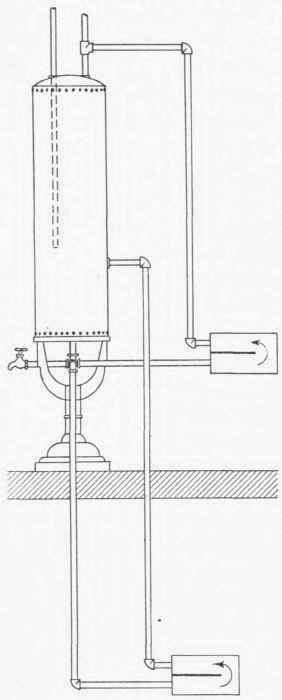
Fig. 134
When two heaters are located at different levels they are sometimes connected so the water will pass in circuit through both of the waterbacks. This, however, is a poor method of connecting them. When a fire is burning in only one heater, a great amount of heat is lost by radiation in passing through the cold heater and extra circulation piping, and when there is a fire in both heaters the heat imparted to the water in the tank is less than if each heater was connected separately to the tank.
Heater Connection To Boiler At Lower Level
Circulation can be secured and the water heated in a boiler that is located below the level of the waterback, as shown in Fig. 135. When the boiler is so located, however, the circulation is sluggish at all times, and the weights of the two columns of water so nearly balance each other that good circulation cannot always be depended upon. In connecting the waterback to the boiler under such conditions, the circulation pipe from the boiler to the waterback is taken from the bottom of the boiler, and the flow pipe from the waterback to the boiler is extended vertically from the waterback to a distance equal to the distance from the waterback to the bottom of the boiler. If greater vertical height can be given the flow pipe, the more positive will be the circulation. The circulation pipe returns from the highest point to which it is carried and enters the top of the boiler. The hot water pipe is taken from the top of the circulation loop.
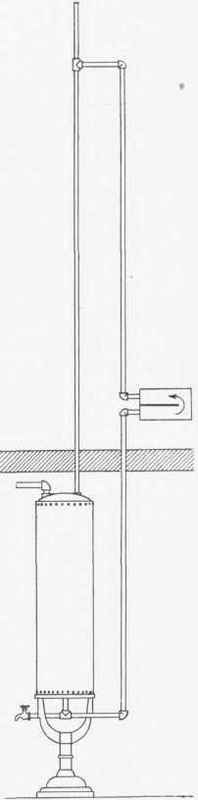
Fig. 135
Connections To Horizontal Boilers
Boilers are sometimes placed in a horizontal position when there is no floor space to set them vertically. The usual tapping for a vertical boiler may be used when set horizontally, but the better practice is to have special tappings. When a vertical boiler is placed horizontally and stock tappings used, a boiler tube should be placed in the hot water pipe and curved upward inside of the boiler so as to offer an outlet near the top of the boiler for the hot water. The side tapping of the boiler is turned down and used for the circulation opening to the waterback. The flow pipe from the waterback enters what would be the bottom tapping of the boiler and the cold water enters the cold water tapping without a tube. The only special tapping necessary for a horizontally placed boiler is on the top side, to provide a connection for the hot water pipe.
Continue to:


My Books

