


Baths And Lavatories. Continued
Description
This section is from the book "Principles And Practice Of Plumbing", by S. Stevens Hellyer. Also available from Amazon: Principles and practice of plumbing.
Baths And Lavatories. Continued
Fig. 153. - Showing Bath, Lavatory, and Draw-Off Sink discharging into one Waste-Pipe, aerially disconnected from the Drain, K, with Anti-Syphoning Pipe, N, and Ventilation-Pipe, P, incomplete. The slop-sink, B, is only intended for the reception of the contents from slop-pails, from floor-washings, and toilet-basins.
9. Notwithstanding all that has been said about the evils of small plug-holes in wash-hand-basins, basin manufacturers still go on making lavatories which will only receive 1/2 in. or 3/4 in. brass plugs-and-washers, as shown in fig. 154; though some of the more enlightened manufacturers make the holes and countersinkings large enough to take an inch clear-way plug-and-washer; but for a basin to receive a 1 1/4 in. plug-and-washer, as shown in fig. 156, it would require to be specially made, or to be obtained from a special house.

Fig. 154.
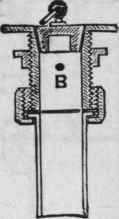
Fig. 155.
10. With such a small plug-and-washer as shown in fig. 154, it is impossible to empty a basin fast enough to satisfy the person using it, or in a way to be of any value for cleansing either the trap or waste-pipe. Where such plug-basins are fixed, the traps under them should only be 1 in., and this size trap is only large enough for basins with 1 in. plugs, as fig. 155; but for l 1/4 in. plugs, as fig. 156, or l 1/4 in. and 1 1/2 in. waste-valves, as shown at s, fig. 153, the traps should be l 1/4 in. with l 1/4 in. or 1 1/2 in. waste-pipes from them.
11. The evil attending the use of a brass plug-and-washer is the handling of the chain, and although many people have no objection to a chain, for many years past in my works we have fixed a special waste-valve, which is actuated by a pull-up knob arrangement fixed to the lavatory top, as shown in fig. 153.
12. The great advantage of a tip-up basin is that you can turn the contents of the basin out into a receiver instantaneously; but, as a general rule, the under side of a tip-up basin and the interior of the receiver soon become foul and filthy; I mean when they are fixed in private houses. In places where there is a lavatory attendant, it would be his special duty to look after them; and if lift-out (as well as lift-up) basins, as improved by the Messrs. Jennings, were fixed, the attendant would have no difficulty in keeping them clean.
13. In my works I prefer a trap under each basin, as shown in fig. 157, especially when such a range of basins would be fixed near a bedroom or living-room.
14. How often one comes across, not two or three basins emptying into one trap, but ten, fifteen, and even more than twenty, and that too adjoining a dormitory, if not actually in direct communication with it. In such an arrangement the waste-pipes from the basins are generally branched into the " horizontal " waste-pipe at right angles, as shown at b and c, fig. 158. In such cases a discharge from the basin, b, would flow back towards e1, as well as towards the natural outlet, e. At the lectures I gave an ocular demonstration of this, using a small wash-hand-basin and a glass waste-pipe. A little soapy water was put into the basin - similar to the basin, b, in the diagram (fig. 158), - and on palling up the plug the water flowed both ways in the "horizontal" pipe; and though the water naturally gravitated out of the pipe again, the suds remained behind, where in practice they would decompose and throw off bad air.

Fig. 156. - l 1/4 in. Clear-Way Plug- and-Washer.

Fig. 157. - Showing a Range of Basins properly Trapped.
There is another evil attending such an arrangement.

Fig. 158.
A discharge from the basin, c, would drive the foul air out through the basin, a, as shown by the arrows, and this would be aggravated in a longer range. The foul air thus sent out of the basin, or its overflow, would often be breathed by the person bending over it to wash his face or his hands.
For general and well-ventilated lavatories, remote from bedrooms and living-rooms, I should have no very great objection to the arrangement shown in fig. 158; but I should want a greater fall in the "horizontal" waste-pipe, which should only be of a size which could readily be flushed out, and I should require the branches from the basins to be connected by bent pipes or Y-junctions, to prevent backwash. And, further, I should not care to extend the horizontal waste-pipe beyond the third basin. I should also require the basins to be supplied with hot water, so that the pipe should be scalded out occasionally.

Fig. 159. - Diagrammatic Section of a Range of Basins, showing Bad Arrangement.
15. A still greater error is often made in the arrangement of lavatory wastes, where a range of basins is discharged into one trap. The main branch is taken into the heel of the trap in such a way that about two-thirds of its length always stands full of water, as shown in the diagrammatic section, fig. 159. When this is the case, how is it possible to change the water standing in the waste-pipe, G G1, and trap, f, with a flush of water sent through either of the basins? The body of water standing in the trap and piping might become very offensive from the use of scented soap and the washings-down of the lavatory top, and it would prevent the waste-pipe from being cleansed; for no flush of water could be sent through the pipe with any cleansing force in such an arrangement.
16. All waste-pipes from baths and lavatories should be made to discharge with an open end into self-cleansing disconnecting-traps fixed outside the external walls of the house; 3 in. stoneware traps are quite large enough in most cases. Or where there is a stack of lavatories, or of bath and lavatories, the pipe can discharge into a drain-interceptor, similar to that shown at k, fig. 153. The ventilation-pipe, p, should be continued up full bore, or if a larger size, to some high point, well above all windows.
The anti-syphoning pipe should be of equal bore, or it should not be smaller than the bore of the traps, as shown at n n N, fig. 153, which is 2 in., the main waste-pipe being also 2 in.
17. The waste-pipe from the draw-off and slop-sink combined is shown in the illustration (fig. 153) to be in communication with the bath and lavatory waste-pipe, but this slop-sink is only meant to receive the general slops from bedroom pails, which would be much diluted by the water from the toilet basins, and into which a great deal of slop water - from the draw-off sink - would be constantly running, to keep the pipe clean. But I would not allow a general slop-closet to be connected to a bath-waste, especially a slop-closet fixed in hospitals, into which excreta and all sorts of filth are emptied. (Chap. XXXIII., Art. 7.)
18. It sometimes happens that though a bath is fixed in a dressing-room, in direct communication with a bedroom, it is but rarely used, the owner of the bedroom having little or no liking for water. In such cases the waste-pipe should have no connection with any other waste-pipe, not even a waste-pipe from a lavatory, and the pipe in such cases, instead of discharging under the grating of a disconnecting-trap, should empty into an open channel-pipe leading into a trap; and if it is of any great length, it should have aerial disconnection again before entering the bath-room, so that, in case of evaporation of the water-seal of the bath-trap, the risk of bad air entering the house through the lost seal of the bath-trap would be reduced to a minimum.
19. Combination baths, combining what many consider to be nothing more than fads, such as spray, sitz, douche, and shower baths, can be fitted up to suit the sweet wills and long purses of the rich; but it is not necessary here to go into the great variety now in use. Wherever any such bath is fixed, and whatever form it may take, great care should be bestowed upon its trapping and its ventilation, so that whilst no part of a bath may become an inlet for bad air to enter a house, so no part of a bath or its traps, or its waste-pipe or overflow-pipe, shall become a collecting place for soapsuds to decompose in.
Continue to:


My Books

