


Edge-Tools
Description
This section is from the book "Woodworking For Beginners: A Manual for Amateurs", by Charles G. Wheeler. Also available from Amazon: Woodworking For Beginners.
Edge-Tools
Bear in mind that all cutting tools work more or less on the principle of the wedge. So far as the mere cutting is concerned a keen edge is all that is required and your knife or other cutting tool might be as thin as a sheet of paper. But of course such a tool would break, so it must be made thicker for strength and wedge-shaped so that it may be pushed through the wood as easily as possible.
You know that you can safely use a very thin knife to cut butter because the butter yields so easily that there is not much strain on the blade, but that when you cut wood the blade must be thicker to stand the strain of being pushed through. Soft wood cuts more easily than hard, because it is more easily pushed aside or compressed by the wedge-shaped tool, and it does not matter how keen the edge may be if the resistance of the wood is so great that you cannot force the thicker part of the tool through it.
You will understand from all this that the more acute the angle of the cutting edge the more easily it will do its work, provided always that the angle is obtuse or blunt enough to give the proper strength to the end of the tool ; and also that as the end of the tool encounters more resistance in hard than soft wood, the angle should be more obtuse or blunter for the former than for the latter. Theoretically, therefore, the angle of the cutting edge, to obtain the greatest possible advantage, would need to be changed with every piece of wood and every kind of cut, but practically all that can be done is to have a longer bevel on the tools for soft wood than for hard. Experience and observation will teach these angles. See Sharpening in Part V.
When you cut off a stout stick, as the branch of a tree, you do not try to force your knife straight across with one cut. You cut a small notch and then widen and deepen it by cutting first on one side and then on the other (Fig. 5). The wood yields easily to the wedge on the side towards the notch, so that the edge can easily cut deeper, and thus the notch is gradually cut through the stick. The same principle is seen in cutting down a tree with an axe. You have only to look at the structure of a piece of wood when magnified, as roughly indicated in Fig. 6, to see why it is easier to cut with the grain than across it.
You can often cut better with a draw-stroke, i. e., not merely pushing the tool straight ahead, but drawing it across sideways at the same time (Fig. 7). You can press the sharp edge of a knife or razor against your hand without cutting, but draw the edge across and you will be cut at once. Even a blade of grass will cut if you draw the edge quickly through your hand, as you doubtless know.
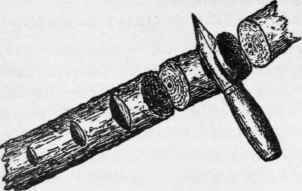
Fig. 5.
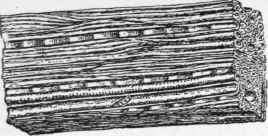
Fig. 6.
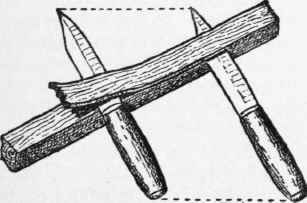
Fig. 7.
If you try to push a saw down into a piece of wood, as you push a knife down through a lump of butter, or as in chopping with a hatchet, that is, without pushing and pulling the saw back and forth, it will not enter the wood to any extent, but when you begin to work it back and forth it cuts (or tears) its way into the wood at once. You know how much better you can cut a slice of fresh bread when you saw the knife back and forth than when you merely push it straight down through the loaf. You may have noticed (and you may not) how much better your knife will cut, and that the cut will be cleaner, in doing some kinds of whittling, when you draw it throngJi the wood from handle to point (Fig. 7), instead of pushing it straight through in the common way, and you will discover, if you try cutting various substances, that as a general rule the softer the material the greater the advantage in the draw-stroke.
Now put the sharpest edge-tool you can find under a powerful microscope, and you will see that the edge, instead of being so very smooth, is really quite ragged, - a sort of saw-like edge. Then look at the structure of a piece of wood as roughly indicated in Fig. 6, and you will understand at once just what we do when we cut wood with an edge-tool. You see the microscopically small sticks or tubes or bundles of woody fibre of which the big stick is composed, and you also see the microscopically fine saw to cut them. Now if the edge of the tool is fine you can often do the work satisfactorily by simply pushing the tool straight through the wood, but do you not see that if you can draw or slide the tool either back or forth the edge, being saw-like, will do its work better?
This stroke cannot be used of course in chopping with the axe or hatchet, splitting kindling-wood, or splitting a stick with the grain with a knife or chisel. In these operations the main principle is that of the wedge, pure and simple, driven through by force, the keen edge merely starting the cut, after which the wedge does the rest of the work by bearing so hard against the wood at the sides of the cut that it forces it to split in advance of the cutting edge, as in riving a log by the use first of an axe, then of an iron wedge, and finally a large wooden wedge (Fig. 8).
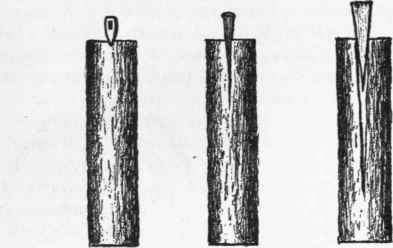
Fig. 8.
Practical directions and suggestions about the different Tools and their Uses and the various Operations will be found alphabetically arranged in Part V.
Continue to:


My Books

