


Scows And Punts. Continued
Description
This section is from the book "Woodworking For Beginners: A Manual for Amateurs", by Charles G. Wheeler. Also available from Amazon: Woodworking For Beginners.
Scows And Punts. Continued
Instead of laying the bottom boards tightly together, as directed above, they can be laid slightly apart, so that the cracks between them will be about 1/8" wide. These can then be caulked with oakum, cotton-batting, or wicking, or something of that nature. Roll or twist the material into a loose cord, unless already in that form, and force it into the cracks with a putty-knife, screwdriver, case-knife, or anything of the sort. A regular caulking-iron is not at all necessary for a small boat. A piece of hard wood will do. Be sure to fill the seams thoroughly and tightly with the oakum or other caulking material. Then apply white lead plentifully to the caulked seams. But the method first given is usually satisfactory if you do your work with care.
Pitch or tar can be used in making the bottom of a boat of this kind tight.
A form which is a decided improvement on the preceding is shown in Fig. 411. The process of making this punt will be first to get out the cross-board which goes in the middle, and next the sides and ends. These pieces having been put together, the bottom is nailed on, and finally the seats and other fittings are added.

Fig. 411.
The one here described is small, but large enough for two good-sized boys. The dimensions are given merely to help illustrate the process. As much larger boat as may be desired can, of course, be made upon the same principles.
Before beginning work read carefully Marking, Rule, Square, Saw, Plane, Nailing, Painting, in Part V., and look up any other references.
Care should always be taken to select clear, straight-grained stock, free from knots, checks, and other defects, and thoroughly dry. Pine is excellent, but almost any good wood can be used for a boat of this sort.
First get out carefully a board, perhaps 3' long, or the width of the boat (at the middle), and of the shape shown in Fig. 412, removing a small piece at each lower corner, to allow for the passage of any water which may leak in. Get out each side of the boat, 10' 4" long, of 3/4" stock, carefully squaring the ends. After these are cut, mark a distance of 3' from each end towards the centre on the edge of one of the boards and a distance of 3" on the ends, measuring from the other edge, and mark the curves shown in Fig. 413, which should sweep easily from the edge of the board without any abrupt turn. If you cannot draw a good curve free-hand, take a spline or thin strip of wood, bend it on the side of the board towards one end till you get a good curve, hold it in position, and using it as a ruler mark the line with a pencil. You can cut this curve and use it for a pattern by which to mark the other curves. These curves can be band-sawed or cut with the draw-knife or hatchet and plane (see Paring). Whatever method you adopt, the curves should finally be run over with the plane to remove irregularities, and care must be taken to keep as accurately to the line marked as possible. The top edges must also be jointed, although it is not material that they should be absolutely straight. Mark a line with the square across each board at the centre. Next get out the end pieces, 2' long, 3 3/4" wide, and of 7/8" stock (Fig. 414). Bevel the ends of these pieces at the same angle as the centre board already sawed, from which you can mark the angle.
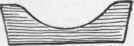
Fig. 412.

Fig. 413.
An easy way to put this boat together will be to put the sides and ends together, and then, by spreading the sides apart, to put the middle board in its proper place. Bore holes for 2 1/2" screws at each end of the sides (see Boring) and screw the sides and ends together loosely (see Screws), not driving the screws home, but leaving their heads sticking beyond the sides perhaps an eighth of an inch. Now lay the boat (so far as made) bottom side up on the horses or boxes, or even with one end on the floor and the other raised by a box, and, spreading the sides in the middle as much as may be necessary, push the middle board up into place, getting it exactly opposite centre lines previously marked on the sides and so that the bottom edge of the board is just even with the inner edge of the bottom of the sides. This piece can now be nailed in place by three nails at each end.

Fig. 414.
Now, on looking at the ends where the sides are screwed, you will see that spreading the sides has caused the joints (purposely left loose) to open slightly at the inside, and that the ends require to be slightly bevelled or trimmed to make a close joint. Unscrew one end, do the necessary trimming with the plane, replace the piece, and screw it into position again, driving the screws home and adding- one or two nails. Do the same with the other end and the boat will be ready for the bottom.
But before the bottom is nailed on, the lower edges of the sides must be bevelled with the plane, owing to the sides flaring outwards. The degree of bevelling required can be determined by laying a board across (Fig. 415). At first it will only touch the outer angles of the edges, and the planing must be continued until it bears flat on the entire edge.
Now get out of 7/8" stock the bottom boards, the edges of which should be carefully jointed to fit together as tightly as possible. These boards should be thoroughly nailed to the sides of the boat with 2 1/4" or 2 1/2" nails, care being taken not to nail too near the edges of the boards, lest they split. As the sides are only 3/4 " thick you will have to be careful in driving the nails or they will split the sides. Before you finish nailing the first bottom boards, test the symmetry of the frame by measuring the diagonals. These should be equal. If not, you can easily make them so with your hands, and tack a couple of strips diagonally across the gunwales to keep the frame in position until the bottom is nailed on. Also sight across the gunwales to see that the frame is true. . 30

Fig. 415.
If it winds, correct the error by blocking it up where needed.
Sheathing can well be used for the bottom of this boat, as for the one just described, if you can get it without the moulding. The bottom can also be caulked (see page 302), but if you cannot get the sheathing the way first described will answer every purpose.
After the bottom is nailed on, turn the boat on each edge and plane off any irregularities at the ends of the bottom boards, so that they will be flush with the sides.
Next nail a strip, about 3" or 4" wide and 3/4" thick,' lengthways on the middle of the bottom, on the inside. Fasten this to each board with a couple of nails driven through and clinched on the outside. This will serve to stiffen the bottom.
Next deck over each end with a seat 12" wide nailed directly on top of the sides. Put in a seat, or thwart, 9* wide and 7/8" thick, next to the middle brace, as shown. Cleats can be nailed to the sides under this seat. This should be a fixed seat, nailed to the cross brace and to the sides of the boat, which will assist in stiffening the sides.
You can nail a gunwale strip, 2" wide by 7/8" or 3/4' thick, on top of the sides and reaching from one end seat to the other, or you can put a somewhat smaller strip around the outer edge of the gunwale, which is quite as good a way. It is not really necessary to put any gunwale strip on so small a boat, but if omitted a cleat must be screwed on for the rowlocks (Fig. 409). If you put the gunwale strip on top, it will make a more workmanlike job to first plane the edges of the gunwale so that they will be horizontal across the boat, in the same way that you planed the bottom edges to receive the bottom boards.
Put the centre of the rowlocks about 12" aft of the centre of the boat, raising them an inch or so above the gunwale by means of a cleat (Fig. 416), as shown.
At a distance of about 28' from the bow, you can, if desired, put in a 6" thwart between the gunwales or a little lower, and in the middle of this thwart bore a hole for a small mast, putting below and slightly forward upon the floor a block with a smaller hole. Sailing does not amount to very much in a boat of this sort, but a small sail is often very useful when going before the wind and adds to the fun.

Fig. 416.
This makes a very useful and safe boat for a couple of boys for river or pond work.
If you wish to make a larger one you will have no difficulty after studying the process given above. The only difference need be in the dimensions.
For one 12' long you could make the beam at the gunwale (outside) 3' 6" and at the bottom 2' 10", the beam at the bottom of the ends (outside) 2' 10" (same as amidships) - the ends to flare upward at the same angle as at the centre, the boards for the sides being 14" wide.
For one 14' long, you could make the beam 4' at the gunwale, 3' 4" at the bottom, the same at the ends, and the sides could be made of boards 15" wide. Stock 3/4" thick is sufficiently heavy for the sides of a boat 14' long.
The seats for a larger boat than that described can be arranged to rest as shown in Fig. 417, and an extra mould or cross-board not far from each end can be used, as shown.

Fig. 417.

Fig. 418.
A piece of keel or skag can be added at the stern end, if desired, as shown in Fig. 418. This will assist in rowing straight. Fit a piece of 7/8* board to the curve of the bottom, keeping the straight edge parallel with the top. Square off the end in line with the stern, nail the skag firmly to the bottom, and nail a stern-post, \' x 1 1/4" or 1 1/2", securely to the stern and the skag. A rudder can be hung to the stern-post if desired. A centreboard is sometimes added to a punt, being arranged in the way shown on page 330. A lee-board is often used on punts and scows. It is merely a centre-board lowered outside of the boat instead of in the centre.
Continue to:


My Books

