


201. Notching
Description
This section is from the book "Bench Work In Wood", by W. F. M. Goss. Also available from Amazon: Bench Work In Wood.
201. Notching
Notching. In placing several timbers upon another which is to support them, in the manner represented by Fig. 239, it is usually desired that the tops of the supported timbers be uniform in height. This would not be accomplished by simply placing them in a row, because timbers of the same nominal size vary in their breadth and depth. The ends of the deeper ones must therefore be cut or "notched," as shown by Fig. 239, to make them agree in depth with the lightest timber of all. Properly speaking, this is a preparation for the bearing of one timber on another, and not a joint; but if the end of the supported timber is allowed to project, as represented by Fig. 240, a true joint is made.
Fig. 240
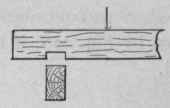
Fig. 241

Double-notching requires a notch in both timbers, Fig. 241.
202. Cogging is represented by Fig. 242. It has some advantage over notching in point of strength, inasmuch as the timber B has its full depth over its support. The "cog" A makes the union between the two timbers, as a joint, quite as satisfactory as the double notch.
If the surrounding conditions require it, the cog may be formed near one edge, instead of in the middle of the timber as shown by the illustration.
Continue to:


My Books

