


212. Beads
Description
This section is from the book "Bench Work In Wood", by W. F. M. Goss. Also available from Amazon: Bench Work In Wood.
212. Beads
Beads. A single-quirked bead is shown by Fig. 259, a being the quirk; a double-quirked bead is shown by Fig. 260, and a staff, or angle, bead by Fig. 261. The term reeding is applied to a succession of beads, as shown by Fig. 262. A bead is said to be stuck when it is formed on the piece of material on which it is used, and planted when it is formed on a separate piece and glued or nailed in place. The size of a bead is indicated by the distance A, Fig. 259.
Fig.259
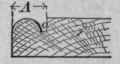
Fig.260

Fig. 261

Fig. 262

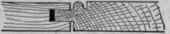
213. Beads are sometimes used wholly for ornament, but they are designed chiefly to conceal cracks by the shadows they cast. It is a principle in joinery that when two boards are to be joined they must be made as one complete board, with the joint so concealed that no crack is left, either when first made or after shrinkage; or there should be a very decided crack, which will appear to have been made intentionally. The first kind of joint is made by means of glue; but as the boards forming a surface of considerable width must have some freedom of movement on account of shrinking and swelling tendencies, it follows that when large surfaces are to be covered, glued joints cannot be used. Under such circumstances it is found best to make no attempt at a close joint, but to allow the pieces to shrink and swell as they may, and depend upon beads to conceal the cracks. Thus the joint shown by Fig. 263 would seem to have been intended for a close fit; but since it is not, the opening is allowed to remain, and a bead applied, as shown by Fig. 264. The crack is thus converted into a quirk of a bead, and is not noticeable except on close inspection.
Fig. 263
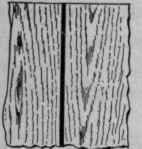
Plan.
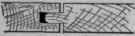
Elevation.
Fig. 264
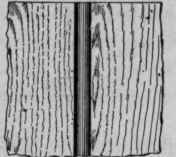
Plan.
Elevation.
Fig.265

Plan.
Elevation.
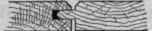
214. A chamfer is a narrow surface produced usually at an angle of forty-five degrees with two other surfaces. Like the bead, it may be used for ornament, or for disguising cracks as shown by Fig. 265.
215. A stop chamfer is one which does not extend the full length of the piece on which it is formed. See A, Fig. 212.
216. Moldings, while of the same character with beads, are larger and often much more complex in form. They may be stuck or planted. Among the most simple forms is the ogee, Fig. 266, which is frequently used as a finish for the edge of a projecting board - a table top, for example.
217. A round-nose, Fig. 267, is, perhaps, the simplest of all, and is especially useful where a projecting board is subject to usage severe enough to destroy sharp angles or small details, as is the "tread" of a stair.
218. From a few simple forms, of which the two shown are types, have sprung the variety of styles which, for the most part, have no designation but the number given them by the manufacturer. While most of them may be stuck, as is the ogee, Fig. 266, and the common forms shown by Fig. 268, they are generally planted. Fig. 269 shows a molding at A, planted on a plain surface; at B, one planted in an angle; and at C, a rabbeted (bolection) molding which overlaps one of the pieces forming the angle.
Fig. 266

Fig.267
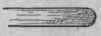
Fig.268

Fig. 269
A.

B C


A fillet1 is a light strip of material used in a joint as a fastening, or, in connection with beads and moldings, as a means of ornamentation.
219. In joining boards, use is frequently made of some outside support, which, though not considered a part of the joint, is often the one element that makes the adaptation of the joint possible. For example, two boards of a floor may be joined to each other in a variety of ways; but they are both supported and retained in position by being fastened to the "flooring joist." A consideration of the joint between the boards, however, need not involve the joist except as a fastening.
1 Fillet, or thread.
Heading-Joints, or Joints for uniting Pieces in the Direction of their Length.
220. The length to which boards may be sawed is, in practice, limited only by man's ability to handle and transport them with economy. For most purposes the lengths of from ten to twenty feet, which are supplied by the trade, serve as well as longer ones. They can be handled more easily - in other words, more cheaply - than boards of thirty or forty feet.
Fig. 270 shows a square heading-joint which is usually "cut under" a little, as indicated by dotted lines, to insure a close joint on the surface.
Fig. 270
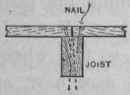
Fig.271

A splayed heading-joint is shown by Fig. 271. As a joint, this will seem more perfect than Fig. 2 70, but it is more difficult to make, and the latter is in most places quite as satisfactory.
Joints for uniting Pieces in the Direction of their Width.
221. Joints of this class have two offices to perform: first, to prevent shrinkage from making an open joint; and, secondly, to distribute to adjoining boards stress that may be received by any one of them at points between supports.
222. Fig. 272 shows at A a plain butt joint, which has no provision against opening, and in which the boards do not support each other; it is really no joint at all. The same figure shows at B, C, and D, respectively, a filleted joint, a rabbeted joint, and a matched joint. Any of these may be beaded, as shown by Fig. 264. The marring of the surface by nail heads may be prevented by secret nailing, which is shown in Fig. 272.
Fig.272

Joints of this class which have no support outside of themselves must be held by glue.
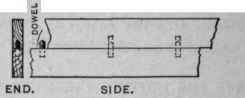
223. A Glued Butt Joint, if well made, will be quite as strong in the softer woods as a glued matched or a glued filleted joint. It is difficult, however, especially if the boards are long, to keep the two pieces forming the plain joint in proper position while the glue is setting. Even if they are clamped, they are almost sure to slip, so that when the joint has finally become firm, the boards may have assumed a position similar to that shown, Fig. 273. The fillet, and the tongue and groove (B and D, Fig. 272), are useful in keeping the parts in place until the glue has hardened. Dowels may be used for the same purpose, Fig. 274. If they are placed at short intervals, and are well fitted, they will add strength to the joint.
Fig.273

Fig.274
Continue to:


My Books

