


260. Oak (Quercus)
Description
This section is from the book "Bench Work In Wood", by W. F. M. Goss. Also available from Amazon: Bench Work In Wood.
260. Oak (Quercus)
Oak (Quercus). The oaks, of which there are in all more than forty varieties, produce woods which are exceedingly variable, but they are usually heavy, hard, tough, porous, very strong, and of coarse texture, the sapwood whitish, the heartwood ranging in color from a light to a reddish brown. There are three well-marked kinds, - white, red, and live oak. These are kept distinct in the market, the white and the red oak being the most common.
261. White Oak (Quercus alba Linn.). - This variety of oak is found widely distributed over the north-central and the eastern portions of the United States. It grows from seventy-five to one hundred feet in height and from three to six feet in diameter. The bark has a grayish white color from which the variety takes its name. The annual layers are well marked and the medullary rays are broad and prominent. The wood is hard and liable to check unless carefully seasoned. It is durable in contact with the soil and is capable of a high polish. It is used in shipbuilding, cooperage, cabinetmaking, and in the framework of buildings, as well as for furniture, agricultural implements, carriages, railway ties, and fuel. The weight of the seasoned wood is fifty pounds per cubic foot. It exists in large quantities and is one of the most valuable woods in general use.
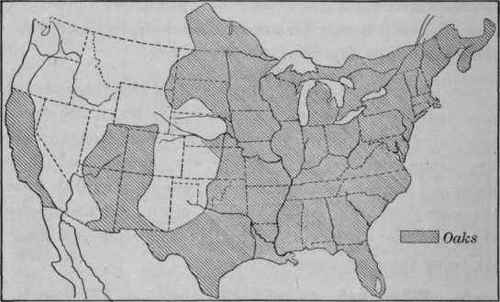
262. Red Oak (Quercus rubra Linn.) is found in Nebraska and Kansas, and east of the Rocky Mountains ranges from Nova Scotia to Georgia, reaching its best development in Massachusetts. It is often brittle, and is usually of coarser texture than white oak, being more porous, less durable, and even more difficult to season. The tree grows to be from ninety to one hundred feet in height, and from three to six feet in diameter, and has brownish gray bark, which is smooth on the branches. The heartwood is light brown or red, the sapwood darker, the medullary rays few and broad. For carpentry and for furniture making it brings about the same price with white oak. It is used for clapboards, barrels, interior finish, chairs, and other work of secondary importance. Its weight is forty-five pounds per cubic foot. The distribution of the oaks is shown by Fig. 311.
Fig. 311
263. Maple (Acer) wood is heavy, hard, strong, stiff, tough, of fine texture, and often wavy-grained. It is not durable in the ground or under exposure to the weather. Its color is a creamy white with shades of light brown in the heartwood. It shrinks moderately, seasons, works, and stands well, wears smooth, and takes a fine polish. It is used for ceiling, flooring, paneling, for stairways and other finishing work in houses, for ship and car construction, and for furniture. It is a good material for shoe lasts, shoe pegs, school apparatus, wood type, tool handles, wood carving, turnery, scroll work, and the mechanism of pianos. The principal varieties are the sugar maple and the silver or white maple.
264. Sugar Maple (Acer Saccharum Marsh.). - This tree yields a sap which is made into sugar, from which fact it takes its name, though it has various local names, as hard maple, black maple, sugar tree, and rock maple. It is found principally in the southern part of Canada and the northern part of the United States, though its range extends as far south as Florida and Texas. The tree grows from seventy to one hundred feet in height and from one and one-half to four feet in diameter. It is the hardest variety of maple known and its wood is superior in quality.
Dry maple weighs forty-three pounds per cubic foot. Bird's-eye, blister, and sometimes curly effects are found in this wood.
265. Silver or White Maple (Acer dasycarpum Ehr.), also frequently called soft maple, and locally swamp maple, water maple, and river maple, is found in a region extending from New Brunswick to Florida, and westward intermittently to Dakota and the Indian Territory. Its general characteristics are similar to those of the sugar maple, though it is softer, its sapwood somewhat lighter in color, and its weight less. Its grade is somewhat inferior to that of sugar maple and its use extends to cheaper kinds of work. White maple weighs when seasoned thirty-two pounds per cubic foot.
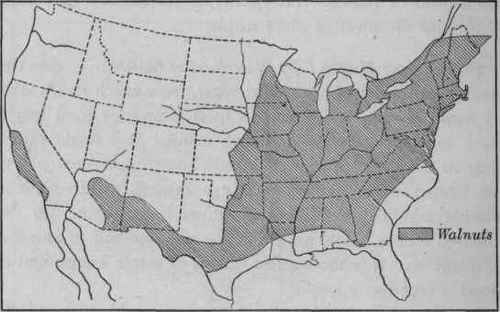
266. Black Walnut (Juglans nigra Linn.). - Of the genus Juglans there are two species, known as black walnut and white walnut, or butternut, though the former is characterized popularly by the name walnut. Black walnut is found in Ontario and Florida, on the Allegheny Mountains, and westward intermittently to Nebraska and Texas, and also in California. Its distribution is well shown by Fig. 312. The tree reaches a height of from ninety to one hundred and twenty-five feet, and a diameter of from three to eight feet, has an almost black bark, and makes a fine appearance, except in some portions of the West, where it is small and low and much-branched. It is now everywhere scarce because of the great demand. The wood is heavy, hard, strong, rather coarse-grained, liable to check if not carefully seasoned, easily worked, and is durable in contact with the soil. Its color is a chocolate brown with lightish sapwood.
Fig. 312
The annual rings are obscure, the medullary rays numerous but thin and not conspicuous. Until lately, when oak has become its competitor, walnut has been more generally used for gun-stocks, for all kinds of furniture, and for the interior finish of buildings than any other North American tree. The weight of the seasoned wood is thirty-eight pounds per cubic foot.
267. Yellow Poplar (Liriodendron Tulipifera Linn.). -This wood is also commonly called tulip tree and whitewood. It is found in the region extending from New England to Florida, and westward intermittently to Michigan and Mississippi. The tree grows to be from sixty to eighty feet in height and two feet or more in diameter, the bark being smooth and of a gray color, and the sapwood lighter. It is usually light, soft, stiff but not strong, and of fine texture, with the annual rings very obscure and the medullary rays thin and inconspicuous. The wood shrinks considerably when drying, but seasons without injury, does not split in nailing, and works under a tool exceptionally well. It is one of the largest and most useful of the broad-leaved trees of the United States. It is used for siding and paneling, for finishing lumber in the building of houses, cars, and ships, for the side boards and panels of wagons and carriages, and for the manufacture of furniture, implements, machinery, wooden pumps, wooden ware, boxes, shelving, and drawers. Large quantities of the wood are used in the manufacture of paper pulp. The weight of the seasoned wood is twenty-six pounds per cubic foot.
268. Beech (Fagus ferruginea Ait.). - This wood has only one representative on the American continent, though in different localities it is called red beech, white beech, and ridge beech. It is found in the region extending from Nova Scotia to Florida, and westward intermittently to Wisconsin and Texas. The tree grows to be from sixty to eighty feet in height and from two to four feet in diameter, but there is not an abundant supply of the wood nor can it be obtained in pieces of very large dimensions. Ironwood, sometimes called blue beech, is similar to it and is sometimes confounded with it. The heart-wood is of a reddish color with variable shades, and the sap-wood is nearly white. The grain is close, the annual rings obscure, and the medullary rays conspicuous. The wood is heavy, hard, strong, works well, and takes a good polish. It is not durable in the ground, is liable to the attacks of boring insects, and shrinks and checks in drying. It is used for the manufacture of lasts, handles, and furniture. The variety common in European countries (sylvatica) is also used in wood carving, carpentry, millwork, and wagon making. The weight of the seasoned wood is forty-two pounds per cubic foot.
Continue to:


My Books

