


Of The Centre Of Gravity
Description
This section is from the book "Elementary Principles Carpentry", by Thomas Tredgold. Also available from Amazon: Elementary Principles Of Carpentry.
Of The Centre Of Gravity
30. In a beam there is a single point, by which it may be supported, and if so supported, it may be placed in any position, and remain at rest. Whereas, were it supported by any other point, it would rest only in certain positions.
This point is called the centre of gravity of the beam.
A beam A B, suspended by a pin at C (Fig. 17) passing exactly through the centre of gravity, will rest in the position AB; or in that shown by the dotted lines ab, or any other. And the same will be the case let the body be ever so irregular, provided the support passes exactly through the centre of gravity.
The centre of gravity of an uniform cylinder or prism, is at the middle of its axis.
In a triangle the centre of gravity is in a line drawn from the vertex to the middle of the base, and at the distance of one-third of that line from the base.
In cones or pyramids the centre of gravity is one-fourth of the height from the base.
Fig. 17.
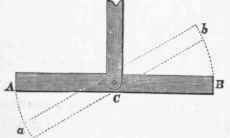
Fig. 18.

The centre of gravity of a circular arc (Fig. 18), is in a line drawn from its centre to the vertex, and at the distance from the centre equal to the chord multiplied by the radius of the circle, and divided by the length of the arc.
When the arc is a semicircle the distance from the centre equals the radius multiplied by .63662.
In a circular segment (Fig. 19) it is in a line drawn from the vertex to the centre of the circle of which the segment forms a part, and at a distance from that centre equal to the cube of the chord A B divided by twelve times the area of the segment.
When the segment becomes a semicircle, the distance equals the radius multiplied by .42441.
The place of the centre of gravity in various planes, lines, and solids, has been determined by mechanical writers; and as the subject is considered in most works on mechanics,* it is not necessary to enlarge upon it here; because when the rules become complicated it is easier to ascertain it by mechanical means, and in irregular figures such contrivances must be resorted to.
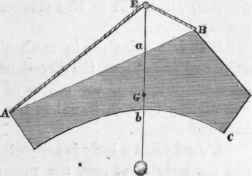
The most useful mechanical methods of finding the centre of gravity are the following: the cord upon the pin E, so as to change the position of the body as much as possible; and when it is at rest again, draw another vertical line upon it, and where this vertical line crosses the former one will be the centre of gravity of the body.
31. To find the centre of gravity of a body with plain sides, suspend it by the cord AEB (Fig. 20) fixed to the body at A and B, and passing over a pin E. When the body is at rest by means of a line and plummet, draw a plumb or vertical line upon it, as at ab. Then, slide
Fig. 19.
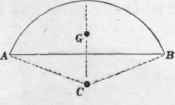
Fig. 20.
* See Gregory's ' Mechanics,' vol. i., chap. iii.; or Marat s ' Mechanics,' Book i., sect. iii.
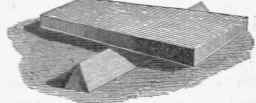
32. Another method. Balance the body upon the edge of a triangular prism (see Fig. 21), and mark a line upon it close by the edge of the prism; then change the position of the body upon the prism, balance it again, and a line drawn by the edge of the prism will cross the former one, and the point of intersection will indicate the place of the centre of gravity which is within the body.
The intersecting lines should cross each other nearly at right angles if possible, as the nearer they cross at right angles the more accurately the point will be found.
The same thing may be done by laying the body upon a bench, and moving it so as to balance over the edge, or till it be just on the point of falling off. Then mark a line along by the edge of the bench, and do the same in another position, which will in like manner determine the centre of gravity.
33. It is a principle in mechanics, that when a body is supported and at rest, the directions of the supporting forces must either meet at the centre of gravity, or in a vertical line passing through it, unless the forces be parallel to one another.*
34. And when a body is supported by one or more planes, and the body is at rest, the pressure on the planes is in a direction perpendicular to their surfaces; when the pressure upon the plane is in an oblique direction, the body will not remain at rest, unless it be in consequence of the friction of the surfaces, a subject which is neglected in the present inquiry.
Fro 11.
* Gregory's ' Mechanics,' vol. i., art. 106.
By the help of these principles it will be easy to determine the direction-of the pressures produced by a heavy beam or other body in some of the most useful cases.
Continue to:


My Books

