


Lumber Measure
Description
This section is from the book "Shop Projects Based On Community Problems", by Myron G. Burton. Also available from Amazon: Shop Projects Based on Community Problems.
Lumber Measure
Paragraph 28. In measuring the distance from one city to another we use the mile as the unit. In measuring grain we speak of so many bushels. Coal is measured by the ton. We are all, more or less, familiar with these various units of measure. In measuring lumber the board foot is used as the unit. So you should become familiar with the board foot. In speaking of the price of lumber, it is generally given at so much per thousand, or so much per hundred board feet. A board foot means a piece of material an inch thick, 12 inches wide and 12 inches long. The surface of a board foot would be one square foot, that is, it would measure 12" each way. Of course we do not buy lumber cut in units of this size, so it is necessary for us to learn how to figure the number of board feet in any irregular-shaped piece of material. To do this you might think of how many board feet a piece of material would make if cut up into pieces the size of the unit. If you had a block of wood 2" thick, 12" wide and 12" long, you can easily see that it could be ripped into two board feet. If it were 3" thick it would make three; if it were 4" or 5" thick it would make four or five board feet, etc. It is also easy to see that a board 1" thick and 12" wide would contain as many board feet as it is feet long. If it were 10 ft. long it would of course contain ten board feet.
If the material is more than one inch thick, the thickness is always considered in figuring the board feet. If it is less than one inch it is considered an inch thick; this means that if you are buying material which is more than one inch thick, you are charged extra for it, but if it is less than one inch you do not usually get any reduction on that account. This may not seem quite fair when you are buying material, but as much of the thin lumber is made by planing down one-inch boards, you must pay for the material wasted in the planing, therefore you are charged for material one inch thick.
There are several ways to think of the problem in figuring the number of board feet in any piece of material, but they all get the same results.
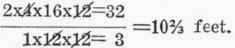
A simple rule which is practical and easy is to multiply the thickness by the width by the length, all being expressed in inches, and divide by 1x12x12, the dimensions of a board foot. This makes a simple problem in cancellation. With thickness times width times length (in inches) above the line, and 1x12x12 below the line, you could then complete your problem by the method of simple cancellation and the answer will be the number of board feet. For an illustration, if a piece of material is 2"x4"x 16', we would write above the line 2x4x16x12 (notice that the 16 is feet, therefore we must multiply by 12 to reduce it to inches), and 1x12x12 below the line -
Continue to:


My Books

