


10. Bonding
Description
This section is from the book "Constructive Carpentry", by Charles A. King. Also available from Amazon: .
10. Bonding
Bonding. (A.) Bonding is the term applied to the method of laying bricks by which the inside and outside walls are fastened together and at the corners to strengthen them. Bricks which are laid with their ends to the face of the wall are called headers, and those showing their edges are called stretchers.
The English bond, Fig. 11, consists of alternate courses of headers and stretchers, and is the strongest bond, though rarely used in this country except upon engineering works and important buildings.
The bond commonly used is known as the garden, American, or running bond (Fig. 12), which is made by laying from five to seven courses of stretchers between the courses of headers.

Fig. 11. - English Bond.

Fig. 12. - American Bond.
There are many forms of patent metal bonds, which are used to hold walls together, especially a face wall upon which it is desirable that no headers shall show.
(B.) A brick veneered building is one having a layer of bricks laid outside of a strongly braced wooden frame, which is boarded in to make it as rigid as possible and to which the veneer is fastened by means of an iron bond as shown in Fig. 13. This form of construction has many advantages and is increasing in use. ii. Anchors.- -Anchoring is the method of fastening brick walls to prevent them from falling outward. One method is shown in Fig.
14, in which the floor joists.are splayed or cut as illustrated, to allow the floor to fall in case of a fire, so that the wall will not be pulled over.
The anchor a is fastened, as indicated, upon the side near the bottom edge of the floor joist which will split and release the anchor should the floor fall. The wall plate shown in Fig. 15 is an efficient and simple way of anchoring a wall, the timbers easily freeing themselves in case of fire. Anchor bolts frequently are run through the building from one side to the other and screwed up on the outside. This gives great strength, but in case of fire, the walls probably will be pulled over, allowing the fire to spread.
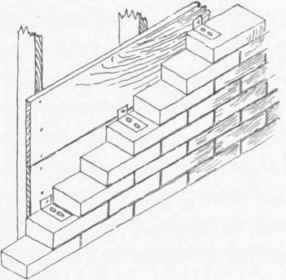
Fig. 13. -Brick Veneering.

Fig. 14. - Strap . Anchor.

Fig. 15. - Plate Anchor.
Continue to:


My Books

