


53. Hip Rafters
Description
This section is from the book "Constructive Carpentry", by Charles A. King. Also available from Amazon: .
53. Hip Rafters
Hip Rafters. (A.) By referring to Fig. 70, it will be seen that the plan, base line, or the run of a hip rafter, a, of a rectangular roof of equal pitches, is at an angle of 45° with the plates of the house, and equals the length of the diagonal of a square formed by the runs of the common rafters, c, of the adjoining sides of the main house.
The rise of a hip rafter is the same as the rise of the common rafter which extends to the same height as the top end of the hip rafter, or which stops at the ridge against which the hip rafter is fitted, if a ridge is used.
(B.) The length of a hip rafter is measured from the apex of the hip to the line of the outside of the corner of the plates, upon the top of the rafter, and is the hypotenuse of a right angle triangle, of which the other two sides are the rise and the run.
Its length may be found mathematically by using the following formula: -
R = run of the hip rafter = X of R3 upon To. and Bl. X = bridge measure.
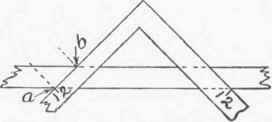
Fig. 76. - Diagonal of the thickness of the Hip Rafter.
A = rise of the roof.
H = length of the hip rafter.
R3 = run of the common rafter.
Formula 17. H =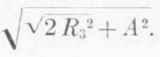
The length of the hip rafter may be found with the steel square thus: -
Formula 18. H = X of R on Bl., and A on To.
If a perfectly square roof is being framed, the hip rafters should he joined at the apex of the hip by the method indicated at a. Fig. 77. The first pair of hip rafters c, c, should be cut the exact length of the hip as calculated by the above formula; the plumb cut of each of the other two hip rafters d, (I. should be made shorter than rafters c, c, a distance equal to one half of the thickness of the rafters c, c, for the same reason that the plumb cuts of common rafters which rest upon a ridge are shortened one half of the thickness of the ridge, as explained in the last paragraph of B, Topic 50. The cuts of both ends of the hip rafters framed by this method are square with the sides, as though common rafters of the same dimensions were being cut. See Formulas 11-12.
If the house is longer than it is wide, a ridge should be used; in which case, the hip rafter will have to be shorta, method of joining hip rafters of a square house b, method of joining hip rafters to a ridge ened by measuring back from the plumb cut, which indicates the exact length of the rafter, a distance equal to /, of Fig. 77, or one half of the diagonal thickness of the ridge; this must be measured square from the plumb cut upon the side of the rafter. In doing this, it should be remembered that the measurements of a rafter are made upon the center line of its top edge, thus the long corner of a hip rafter, see a, of a, Fig. 79, will be longer than the actual length of the rafter. This difference will equal the distance of the hip pitch line in a run equal to one half of the thickness of the hip rafter. K of Fig. 77 shows a common rafter which should be shortened the distance from g to the end of the ridge j, parallel with the plumb cut.
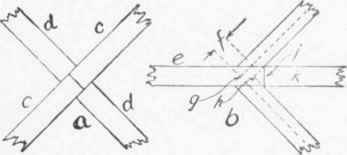
Fit;. 77. - Ridge and Hip Rafters.
The length of a hip rafter which fits against a ridge may be found mathematically by using the following formula:
Hi = length of a hip rafter which rests against a ridge.
R3 = run of the common rafter.
A = rise of the roof.
C = constant; found by calculating the ratio of the rise of the hip to its run; for half pitch it is equal to .707; for a third pitch, .47; and for a quarter pitch house, .353.
D = diagonal thickness of the ridge at the angle of the intersection of the hip rafter; in a rectangular house, it would be equal to 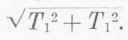 If a 2" ridge is being used,
D = 2.823". If the ridge is a 7/8" board, D = 1.23". T1 = thickness of the ridge.
Formula 19. H1 =
The formula would be applied to the steel square as follows: -
X = bridge measure.
R1 = run of hip rafter.
A = rise of hip rafter.
H1 = length of hip rafter.
T3 = hip pitch line of the thickness of the ridge.
Formula 20. Hl = X of R1 on Bl., A on To. - T3 / 2
The method of finding T3 upon the steel square is illustrated by Fig. 78. Upon the top edge of the ridge indicate the angle at which it is intersected by the hip, as at ab, using the constants described in subtopic C of this section in this case, 12 To., 17 Bl. - lay out R1 by the blade of the square as indicated at de; transfer the distance ab, the run of the hip in the thickness of the ridge, to ef; erect the perpendicular, fg, by sliding the tongue of the square to f, marking g accurately. The distance ge = T3 For a house in which R1 is at any angle but 45° with the plates, the actual rafter dimensions should be used.
In finding the length of the common rafters, we used the common rafter dimensions, though they may have been used for the cuts; likewise, in obtaining the length of hip rafters, we use the hip rafter dimensions, though the same figures may be used for the plumb and seat cuts.
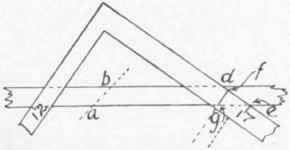
Fig. 78. - Method of finding the Hip Pitch Link of the Thickness of the Ridge.
(C.) As there are constants which give the cuts for common rafters, so there are constants which will give the angles of the seat and plumb cuts for hip rafters.
Continue to:


My Books

