


Wood. Part 2
Description
This section is from the book "Design and Construction in Wood", by William Noyes. Also available from Amazon: Design And Construction In Wood.
Wood. Part 2
Wood shrinks most cir-cumferentially, that is, in the direction of the annual rings, and somewhat, radially. This explains why boards often warp as they do, that is, in the direction opposite to that of the annual rings in them (Fig. 1). A board is said to be "warped" when one side shrinks more than the other. This warping is sometimes due to the fact that one side is drier than the other. In such a case the board can often be straightened by drying the other (convex) side. But usually the warping is due to the direction of the annual rings in it. A "comb grain" or "rift" board, Fig. 2, which is cut radially in the log, is less likely to warp than a "slash grain" or "bastard" board which is cut from the side of the log.
It is partly for this reason that much fine lumber is "quarter sawed," Fig. 3. That is, radial boards are sawn out first, dividing the log into quarters which are then sawed up as nearly radially as is consistent with economy. In some woods, as in oak and sycamore, the beauty of the grain caused by the exposure thus made of the pith rays, is an additional reason for quarter sawing. See frontispiece.

Fig. 1 Boards usually warp in the direction opposite to hat of the usual ring's in them.

Fig. 2 A, Comb grain board; B, Slash grain board.
Disadvantageous as the shrinking and swelling of wood is for most purposes, it is sometimes made use of, as in splitting soft stone by means of wetting wedges which have been driven into borings in the stone.
The beauty of wood depends largely upon the "grain," a term which means several things. Usually the grain of wood means the pattern formed by the distinction between the spring wood and the summer wood. Hence, according to the "figure" formed, wood may be straight grained, crooked grained, wavy grained, curly grained, or bird's eye. The term "grain" may also refer to the appearance caused by the presence of the "pith rays," as in oak, (see frontispiece), or to the peculiar changing reflection of light due to cross grain as in mahogany. The terms coarse grain and fine grain may refer respectively either to the width of the annual rings or to the presence or absence of pores1. Wood is sold by the board foot; that is, the unit of measurement is a board, one inch thick, one foot long, and one foot wide, or 144 cubic inches, Fig. 4. A simple method of measuring is to multiply the length in feet by the width and thickness in inches and divide by 12. For example 1" (thick) X 8" (wide) X 10' 0"(long)_ 12=6'8" B.M. (board measure). Boards less than one inch thick are calculated as one inch. Dressed lumber, that is, planed on both sides, comes 3/16" less in thickness than sawn lumber. For example, boards sawn 1" thick are planed to 13/16". For all ordinary purposes it is economical to buy 13/16" stuff. For thinner boards one may have this resawn at the mill.2
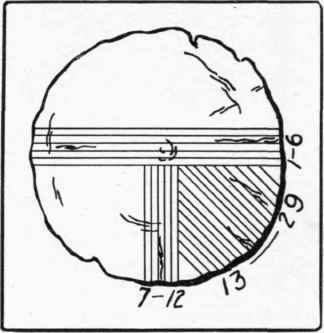
Fig". 3. Common method of quartering log.

Fig. 4. A board foot.
1A fuller discussion of this subject will be found in the author's Wood and Forest, Chapter I (Wood). The Manual Arts Press, Peoria, 111.
Following are descriptions of a few common varieties of wood.
As an aid to their recognition, see the illustrations, frontispiece.
White pine has been the most useful of all trees in the United States. The wood is one of the easiest and most satisfactory to work, owing to its uniformity of grain. For all purposes that require a wood that shrinks and checks but little and holds its shape well, such as molding patterns, window sashes, cores of doors and cabinet work, white pine is unrivaled. It is very light and soft, and is of medium strength, elasticity, and durability. It splits easily but nails well. In color it is light brown, almost cream color. The grain is not noticeable and has no particular beauty. Hence when used for house trim it is usually painted. Its former abundance made it cheap and it has therefore been used so recklessly that now it is becoming scarce. Red pine is often sold with and for white pine. Price in N. Y. C, 1913, $120 per M (thousand).
Continue to:


My Books

