


Grinding Tools
Description
This section is from the "Educational Woodworking For Home And School" book, by Joseph C.Park . Also see Amazon: Educational Woodworking For Home And School.
Grinding Tools
69. Grindstone
One of the most useful tools about a workshop is the grindstone, which is used in sharpening tools. Perhaps the best grindstones are obtained from the quarries in Ohio. One of the largest grindstone companies in the world, if not the largest, is the Cleveland Stone Company. Grindstones are made in an assortment of sizes and grit. An important factor in the operation of a stone is its speed. The average speed varies from 2500 to 4000 feet per minute. The stone should be kept free from dirty water, grease, or oil.
Use clean water and keep the stone true. In grinding small tools the tendency is to hollow the grindstone and thus render it untrue. A Jackson Grindstone Truing Device, Fig. 102, or some other truing device, should be used frequently to keep the stone true.
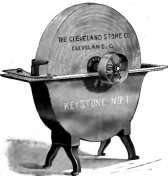
Fig. 101. Power grindstone.
70. Oilstone
A tool that is indispensable about a bench is an oilstone. It is needed every little while for putting a keen cutting edge on chisels, planes, and knife. A good oil stone is hard to get, for most stones are too hard or too soft, or have other imperfections. Perhaps the most commonly used and the best known of all oilstones are the Washita oilstones. The manufacturers or cutters of these stones make four grades, which are known as 1, "Lily White," and "Rosy Red"; 2, "Extra Washita"; 3, "No. 0 Washita"; and 4, "No. 2 Washita." The "Lily White" and 'Rosy Red " are the best stones, the "No. 2 Washita" the poorest. The Arkansas oilstones are also quite common. These, however, being of finer grit than the Washita stones, are not so good for woodworking tools, as they cut too slowly. They are used extensively by engravers, surgeons, tool makers, etc., where very keen edges are required. Among the many kinds of stones might be mentioned the Turkey oilstones, the Deerlick, Seneca, Niagara, Chocolate, Lake Superior, Hindostan, and others. Fig. 103 shows an Arkansas stone mounted in a polished cherry box. Fig. 104 shows a Washita slip used in sharpening gouges. Before using an oil stone it should be wiped off with waste and a few drops of oil pat on the stone. After using the stone should be wiped off again.

Fig. 102. Jackson grindstone truing device.

Fig. 103. Oil stone.

Fig. 104. Oil slip.
When an oilstone becomes concave or untrue by constant use, it may be made true by using sand paper on it, or by means of a sand wheel. Tack a sheet of sandpaper over a block of wood and rub the stone back and forth over the sandpaper until the surface of the oilstone is true. Use coarse sandpaper at first, then fine sandpaper.
71. Carborundum Stones
Another very important abrasive is carborundum, which is manufactured by The Carborundum Company, Niagara Falls, N.Y. The following characteristics of carborundum are given out by the manufacturers of this remarkable substance:
Hardness
Diamond is the only material exceeding it in hardness. It cuts emery and corundum with ease.
Brittleness
Not as tough as the diamond, closely resembling corundum in this respect.

Fig. 105. Combination stones (one face coarse, and one face fine, grit).
Weight
Its specific gravity is 3.12. It is a little more than one and one fifth the weight of sand. One pound of carborundum is equal in volume to one and one quarter pounds of emery.
Infusibility
Infusible in the highest attainable heat. Decomposition occurs in the electric arc.
Insolubility
It is insoluble in any of the ordinary solvents. Water, oils, and acids have no effect upon it, not even hydrofluoric acid, which readily dissolves sand.
Chemical Composition
It is composed of carbon and silicon in atomic proportions, and by weight thirty parts carbon to seventy parts silicon. Its formula is SiC.
Color
Pure carborundum is white. In its commercial manufacture the crystals are produced in many colors and shades, partially as the result of impurities, and partly owing to surface oxidation. The prevailing colors are green, black, and blue. The color has no effect upon its hardness.
72. How To Sharpen Edge Tools
In sharpening edge tools, such as chisels, plane bits, sloyd knife, etc., certain principles must be observed. The correct shape of the tool must be preserved in the sharpening process, and at the same time a keen cutting edge must be secured. The first process of sharpening is called grinding. This is done by means of a grindstone set in motion. If a chisel or a plane bit is to be ground, it should be held as shown in Fig. 109. The angle at which the tool is ground is determined by the kind of material to be cut. If it is to be used on soft wood, the tool should be held at an angle of about 20 degrees with the stone, and for hard .wood it should be held at about 30 degrees with the stone. The grindstone should turn as shown by the arrow in the cut. Avoid rounding the bevel in grinding. Keep the bevel straight. A sloyd knife and turning chisels are ground as shown in Fig. 110, with a straight bevel on each side of the cutting edge. Ordinary chisels and plane bits have a bevel only on one side, as shown in Fig. 111.

Fig. 106. Pocket stone.

Fig. 107. Slip stones.

Fig. 108. Carborundum stones.
After the tool has been ground it should be sharpened on the oilstone, as shown in Fig. 112. The tool is shoved back and forth as indicated by the arrows until a delicate wire edge is turned up on the straight edge. The straight edge is then held flat on the stone and shoved back and forth a few strokes. These two processes are repeated until the wire edge disappears and a keen cutting edge is produced. A few strokes made across the palm of the hand will also help to remove the wire edge. Test the cutting edge to see if it is sharp by drawing the thumb very lightly across the cutting edge.

Fig. 100. Showing position of chisel on grindstone.

Fig. 110. Blade of sloyd knife (showing correct grinding).

Fig. 111. Chisel (showing correct grinding).
Gouges and other edged tools are sharpened in a similar way.
Continue to:


My Books

