


Lumbering And Varieties Of Wood. Part 6
Description
This section is from the book "Elements Of Woodwork", by Charles A. King. Also available from Amazon: Elements Of Woodwork.
Lumbering And Varieties Of Wood. Part 6
(T.) Oak (dec.) is our best all-round native wood. It is found abundantly in nearly all parts of the country, and forms the larger part of our broad-leaved forests. There are a number of species of oak, but they are in general known to commerce as the red and the white oak. Nearly all these trees are cut for commercial purposes, but the white oak is the finest. The wood of some varieties of oak is so similar to the white oak that the difference can not be distinguished after the work is finished, therefore they are all put together and sold as a medium grade of white oak for purposes where the strength of the genuine is not required. This will generally account for the dif ference in the grain and the color which is noticed in handling the commercial white oak.
Red oak is a coarser wood, and is more apt to give trouble in seasoning than white oak, though they both have to be dried very carefully, or there may be checks and cracks to such an extent that the wood will be ruined. Both the red and the white oak are used extensively in finish ing and cabinet work, but the red oak is used commonly upon the cheaper grades, as it is easier to work.
The two varieties should never be used upon the same job, unless the wood is to be stained a dark color, as there is a marked difference in their appearance when finished. White oak is much used for flooring, quartered oak resulting in a beautiful floor, if the work is well done.
Oak is not a suitable wood for exposure to trying cli matic conditions, though if buried deeply, or in water, where there is no alteration in moisture or dryness, it gives satisfaction. White oak is used to great extent for railroad ties, but what these are to be made of in the future is causing much speculation, as the end of the present supply of white oak is already in sight.
(U.) Pine (con.) in its different varieties is used more than any other kind of wood. It is found in nearly all parts of the United States and in Canada. Certain sec tions of the country which were once covered with virgin pine forests have, however, been so denuded of their wealth, and so many of their young trees destroyed, within a few short years, by the depredations of lumber men who cared more for their immediate profit than for the prospective good of the nation, that instead of a per manent and continual supply of this valuable wood, there are now nothing but barren hillsides, and the moss-grown ruins of the lumber camps and sawmills by means of which this irremediable wrong was perpetrated against posterity.
White pine is soft, easily worked, and when thoroughly seasoned will hold its shape better than any other wood except mahogany. For these reasons, and on account of its adaptability to gluing, it is used almost exclusively by pattern makers. It is found in the Northern states and in Canada. Farther south is the belt in which grows the grade of pine known as "Carolina," the bastard or yellow pine. This belt extends from the Mississippi valley to the Atlantic coast, and is of a width to include Virginia and the Carolinas. This pine is harder to work, and has a more pronounced grain than has the white pine, but it makes a handsome wood for interior trim, as it is capable of a fine finish. Carolina pine is neither so hard nor so strong as "Georgia" pine, which is also known commercially as long-leaved pine, pitch pine, or hard pine. This wood is found from Virginia to Texas, in the states bordering upon the ocean and the gulf.
Pitch pine has a finer, closer grain than has either of the two above described, being much stronger and more dense. This is the wood which is used for heavy timbers of large buildings, and the above described grades should never be confused with it, the Carolina pine resulting in work of less strength, for instance, if used where the pitch pine was intended. Although this wood is very hard and strong, and is the best wood for heavy construction, as has been stated, it should never be used in any place which is not dry and well ventilated, as it will decay rapidly if placed in a damp location, or where it will come in contact with the earth.
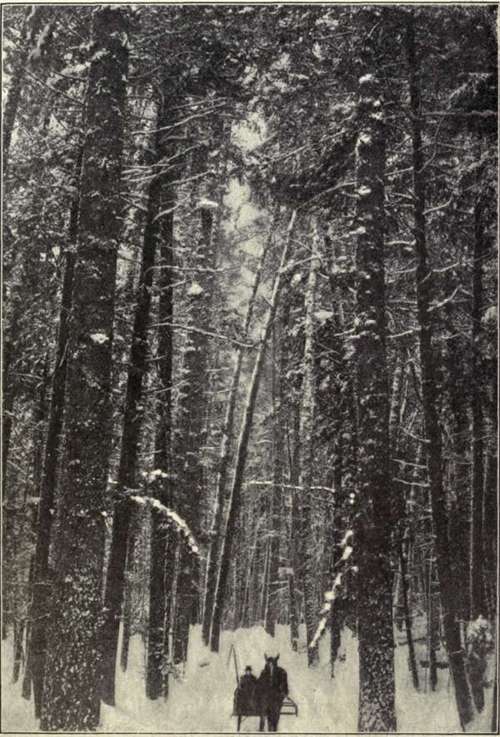
Fig. 19. - White Pine Forest.
There are several varieties of pine besides those above mentioned. These are generally less desirable for finish or for construction than is the white, yellow, or Carolina pine, but they are used extensively for the common work of light building, and by box factories.
(V.) Poplar or whitewood (dec.) is cut from the tulip tree, and is found principally in the Middle West and in some parts of the South. It is of light weight and color, with few knots, and is soft and easily worked. It is used for the common grades of cabinet work, inside finishing, veranda posts, etc. It takes a stain remarkably well, and its even texture makes it a favorite with wood carvers. It warps and shrinks considerably in seasoning, and unless held in its place, it is apt to twist.
(W.) Redwood (con.) is taken from the big trees on the Pacific slope; it is straight-grained, soft, and free from knots, and may be obtained in boards of any size which it is possible to cut. It has the reputation of being one of the best woods for use in trying conditions, or where it will be exposed to alternations of dryness and moisture.
It has a very coarse grain and takes a finish well, but it is not apt to become very popular for inside finish, as it is easily marred, and, although very soft, will, when thor oughly dry, destroy the edge of tools quicker than many harder woods. It turns to a dull, unattractive brown as it ages, if it is finished in its natural color.
It is claimed by many to be the best wood for shingles, as it resists decay indefinitely. It shrinks both ways of the grain, and burns very slowly.
(X.) Spruce (con.) is moderately hard and strong, and in New England is used generally for framing light buildings and for rough boarding. Its color is almost pure white, and it has the valuable quality of holding nails firmly. There is little difference between the heart and the sap wood, and its texture is sometimes such that it is difficult to distinguish it from white pine. It warps and twists badly in seasoning, and on that account is not suit able for framing trusses, unless seasoned lumber is used.
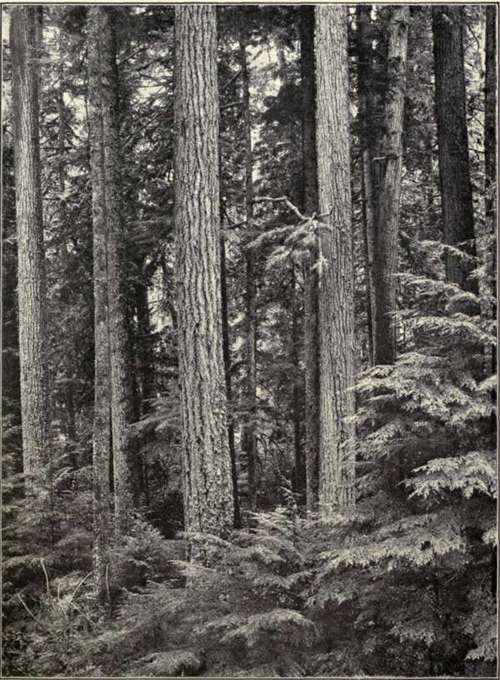
Fig. 20. - Douglas Spruce Forest.
Spruce is used also for a cheap grade of clapboards, for flooring, ceiling, and laths, and also by paper pulp manufac turers in immense quantities. It is a fairly satisfactory wood for immersion, but if exposed to alternations of dry ness and moisture, it decays rapidly.
(Y.) Sycamore, or buttonwood (dec), is found in nearly all parts of the Mississippi valley and in the Eastern states. It is a moderately stiff and strong wood, coarse grained, and quite difficult to smooth to a surface, as the grain seems to run in all directions at once. It has also a disagreeable habit of warping and twisting as it seasons, but if well seasoned and properly handled, it will give no more trouble than do other woods. It takes a good polish, and is a desirable wood for inside finish.
(Z.) Walnut, or black walnut (dec), is found in all the Middle and Eastern states. It is heavy, firm, and strong, of a chocolate color, and takes a fine finish. It is well adapted to inside finish and to furniture work.
At one time nearly all the best work was done in this wood, but at present it is out of style, as oak and other woods are more in favor. Like other varieties of our best woods, this has been cut out, and is now too expensive to be considered as anything but a fancy wood.
White walnut is described under butternut.
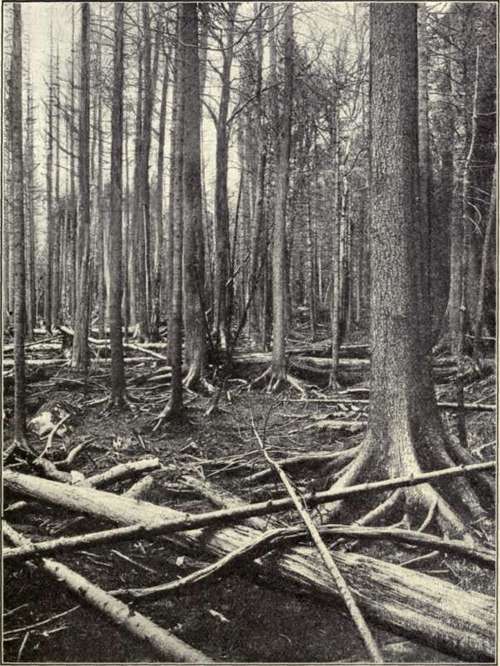
Fig. 21. - Red Spruce and Balsam FIR KILLED by FIRE.
Suggestive Exercises
8. How are small lumbering operations conducted? Large opera tions? What is the favorite method of bringing logs to the mill? Why? Compare the circular and the band saw as to economy. Why is scientific forestry a necessity?
9. What are the usual thicknesses to which planks are sawed? How much thinner is dressed than sawed lumber? How are 1/2 boards usu ally sawed? How should a log be sawed to get the most out of it? To furnish dimension lumber? Describe the advantages and the methods of quarter-sawing. Compare plain and quarter-sawed lumber as to economy. Compare and give reasons for their different shrinking qualities. What are the different names by which quarter-sawed lum ber is known?
10. Describe and demonstrate the four grades of lumber as they are commonly graded.
11. What will be the nature of the sound if a dry, perfect piece of timber is struck with the knuckles? A wet or decaying piece? What does it usually signify if there is a great variety of color in a board? How may decayed lumber be detected by its odor? How may in cipient decay be stopped? How may decay be prevented or cured?
12. How is lumber less than 1" in thickness surveyed? Lumber over 1" in thickness? How are joists and scantlings measured? To what lengths are logs sawed in the forest ? In surveying, where should a common board be measured? A quarter-sawed board? Demon strate the use of the lumber scale.
13. What should be the qualities of a good framing timber? Of timber for outside finish? To be buried? For floors? For inside finish? For shingles? For siding? How long should lumber be dried before using? How should lumber for inside finish be cared for while waiting for use? Describe the qualities and the uses of the following kinds of lumber: ash, apple, basswood, beech, birch, butter nut, cedar, cherry, chestnut, cypress, elm, hemlock, hickory, locust, maple, mahogany, oak, pine, poplar, spruce, sycamore, walnut.
Continue to:


My Books

