


Exercise 33. - Construction Of A Door
Description
This section is from the book "Exercises In Wood-Working", by Ivin Sickels. Also available from Amazon: Exercises in Wood Working.
Exercise 33. - Construction Of A Door
Doors are either batten or panel.
Batten-doors are made by fastening several tongued and grooved boards to two or three cross-pieces, with clinch-nails or screws. If heavy, the doors should be braced with diagonal pieces between the cross-pieces.
The parts of a panel-door to fit the frame of Fig. 5, Example 29, are shown in Fig. 1: a is the top-rail, b the lock-rail, c the bottom-rail, d the stile, e the muntin, and f a side view of the stile showing the mortises.
The joints are mortise and tenon, as indicated by the dotted lines. After the mortises and tenons are cut, the inner edges of the pieces are grooved to receive the panels.
Fig. 2 shows an enlarged view of the joint of the top-rail and stile: a is the tenon, 1/2" thick, b the relish, c the mortise, e the groove for the panel, and d the groove enlarged with a chisel to receive the relish. This may be taken as a sample for all of the joints. The tenon is at first the full width of the rail, and about 1/4" longer than the width of the stile.
The parts, of the door, after the panels have been fitted, are glued, forced together by clamps such as that shown in Fig. 4, Exercise 19, and wedged.
The panels are plain, according to the section (Fig. 1), or raised, in which the material is thick, the sides cut down to fit the grooves, and the middle portion molded around its edge, as in Fig. 3, Exercise 39; or a plain panel molded, as in Fig. 6, Exercise 16.
Fig. 3 shows a portion of the frame of a blind or shutter; it is made on the same principle as a door, but smaller; the joints, instead of being glued and wedged, are white-leaded and pinned, and in place of panels may have laths, the ends of which have a projecting pin to fit into holes in the stiles of the frame. These holes must be bored to the same depth, and the distance between the ends of the pins of the lath should be a trifle greater than that between the bottoms of the holes in opposite stiles, or the laths will drop instead of retaining any position given them.
The rod is fastened to the laths with staples, one set of which is driven into the rod, and the other into the middle of the inner edge of the laths.
Door
Ex. 33.

Fig. 1
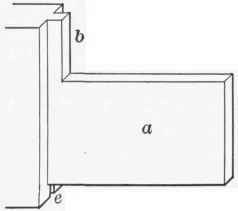
Fig. 2

Fig. 3
Continue to:


My Books

