


Chapter IV Suggestive Courses
Description
This section is from the "Handbook In Woodwork And Carpentry" book, by Charles A. King. Also available from Amazon: Handbook in woodwork and carpentry.
Chapter IV Suggestive Courses
Grading Of Exercises
In preparing the following courses, it has been the intention to suggest a series of models which will lead the student from the simple to the complex in gradual steps. For reasons that have been previously discussed, the writer realizes the futility of endeavoring to arrange a course which may be completed by a series of exercises as perfectly graded as is possible for instance, in piano practice. He has therefore been governed by the size and the importance of the models, and by the difficulties involved in combining the various forms of construction, rather than by the questionable basis of one tool being more difficult to use than another.
Time Necessary For Completion
In regard to the time necessary to complete the various courses, there is a wide difference in the amount of work that may be accomplished by different classes. These courses are planned to give ample work for the exceptionally capable student; consequently the conscientious teacher need not feel that he is doing less than he should, if his class does not accomplish all that is laid out.
Use Of Outlined Courses
It is not expected that the outlines will be followed implicitly, as no course can be devised which is the best for each one of any class, but they should each be considered simply as an indication of the grade of work that the average student should be able to perform at each step in his progress. They may also be used by the teacher in selecting work for his classes, and as a basis for comparison when a new model is being considered, in this way aiding the teacher to decide whether a certain model that some student may wish to make is suitable for that particular student to undertake at that time.
In fact, the courses are, in general, adapted to the more mature student of the normal schools, and, in connection with the rest of this handbook are intended primarily for the use of prospective teachers of manual training in preparing for their future work.
Some of the sketches illustrating the models of the courses, instead of being working or scaled drawings, are made in perspective, the student being given only enough to suggest the size. It is desirable that the student should not follow the design closely; therefore the details are suggestive only, and each student should be required to design the details of every model that he makes, being guided by the teacher.
To reiterate and to emphasize previous statements, the courses should by no means prevent the teacher from departing from them as individual cases may make it advisable, or from substituting others that he may deem better suited to his special work. The models mentioned are suggestive only of the approximate degree of difficulty that should govern the selection of the work of the average student.
A regular course to be followed under all conditions seriously hinders the development of many students, who should be encouraged, instead, to design their own work to the greatest extent possible. If necessary, models made by the teacher or by other students may be used as motives or suggestions, and each student required to make a working drawing of the model, changing or improving the design, instead of making a simple copy, and constructing his own model from the drawing.
The use of the arithmetic given in " Elements of Construction" may, in the manual-training classes, be optional with the teacher.
Research And Written Exercises
In using " Elementary Woodwork" and "Elements of Construction" as the basis of the work of classes in the carpenter's trade courses, research and written exercises should be required upon topics and exercises which treat of construction, the allied trades, and the use, strength, and durability of materials. An entire chapter upon tools, materials, or other subjects generally, should not be assigned for study at one time, as, in most cases, if the proper amount of research is devoted to the subject and it is written up as it should be, there will be too much work for one assignment. Each teacher will have to decide for himself the matter which should be discussed and the time which may be allowed for it.
Tests And Examinations
Periodic verbal or written tests should be given, reviewing the work performed since the preceding test; there should also be an examination at the end of the term or semester, covering the more important points of theory and practice.
The written exercises should, if possible, be arranged so that they will come at frequent intervals, during the whole term, and should be kept as nearly as possible parallel with the bench exercises. Class exercises may be performed by as many students as can work together to advantage, or by as few as the teacher may desire.
References To Other Volumes
In the following outlines of suggestive courses, special care has been exercised to use no unfamiliar term, and to mention no subject nor process which is not fully described in one of the volumes of the series. These volumes are indicated by the use of letters; for instance, the work of the manual-training classes, and of the first year of the trade classes, is taken from " Elements of Woodwork" and from " Elements of Construction," the former being indicated by the letter W, and the latter by the letter C. The work of the second year trade classes is taken from " Constructive Carpentry," which is indicated by the letters CC, and from " Inside Finishing," to which reference is made by the letters IF. These letters indicate the book, and the accompanying number indicates the topic in which the item mentioned will be found. If no letters appear, the sketch will be found in this volume.
Suggestive Courses in Manual Training
I. Seventh and Eighth Grades
1. Time required: two fifty-minute periods per week for four semesters of nineteen weeks each. Arithmetic optional. (C)

Note
In this and in the following courses, the teacher should use his judgment in distributing the talks upon theory throughout the course, reviewing and introducing matter not found in this series, wherever it seems best.
* W = "Elements of Woodwork." + C = "Elements of Construction."
2. Time required: two fifty-minutes periods per week for six terms of thirteen weeks each. Arith-metic optional. (C)

II. Eighth and Ninth Grades
1. Time required: two fifty-minute periods for four semesters of nineteen weeks each. Arithmetic optional. (C)

2. Time required : two fifty-minute periods per week for six terms of thirteen weeks each. Arithmetic optional. (C)

III. Seventh, Eighth, and Ninth Grades
1. Time required: two fifty-minute periods per week for six semesters of nineteen weeks each.
Arithmetic optional. (C)
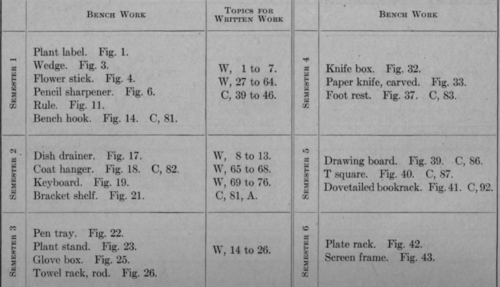
2. Time required: two fifty-minute periods per week for nine terms of thirteen weeks each. Arithmetic optional. (C)

IV. Sixth, Seventh, Eighth, and Ninth Grades
1. Time required: two fifty-minute periods per week for eight semesters of nineteen weeks eacli. Arithmetic optional. (C)

2. Time required: two fifty-minute periods per week, for twelve terms of thirteen weeks each. Arithmetic optional. (C)

Suggestive Trade Courses in Carpentry
First Course Time required: thirty fifty-minute periods per week for twenty-four weeks.
The work as planned for six terms of thirteen weeks, requiring ten fifty-minute periods each week, is adaptable to six school months of four weeks, working six fifty-minute periods per day, which allows the entire work to be completed in six months. In this case, each term's work as planned should be done in one school month of four weeks, of thirty fifty-minute periods per week.
It is well, in this course, to work six full hours per day, which will give five hours per week more than is required to equalize the time between the courses of six terms of twelve weeks, as described, and the time under this arrangement.
This extra time may be employed advantageously by doing additional work upon supplementary models, in drilling upon the problems of carpenter's geometry, or in visiting work under construction.
The average student will not receive as much from this course as he will from one of the courses that cover a longer period, as he loses the opportunity of doing work in other departments of the school which he is attending.
Note
The teacher will find that in this, and the following courses, much time will be saved if a supply of pieces of a suitable size to make the exercises is sawed to a width upon a circular saw. Care should be used that the students do not become possessed of the idea that these exercises are worthless and that they may be made carelessly. The teacher should be particularly watchful to be sure that the students' methods of work upon these are correct, as it is to prevent experimenting upon important work that the exercises are used. To strengthen the impression that the teacher himself considers them of the greatest importance, the best of them should be kept upon exhibition in a prominent place.
Second Course Time required: ten fifty-minute periods per week, for six terms of thirteen weeks each.
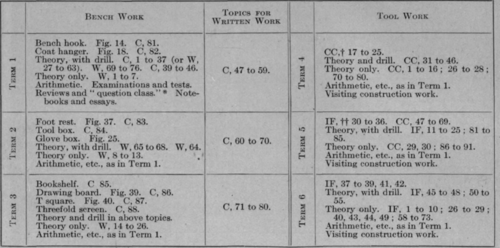
* The teacher should require each pupil to bring to class, at stated times, questions relating to some feature of building construction; these should be discussed before the entire class. The students should be encouraged to demonstrate and illustrate upon the blackboard as far as possible anything that they may have observed in their visits to buildings under construction. An open discussion of this sort never fails to be profitable.
+ CC = "Constructive Carpentry." ++ IF = "Inside Finishing."
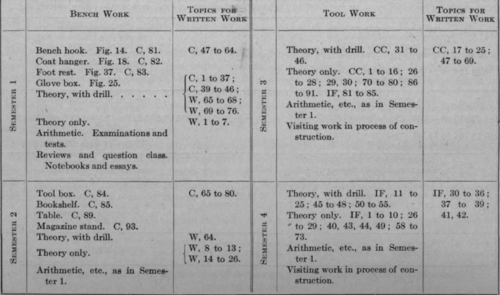
Third Course Time required: ten fifty-minute periods per week, for four semesters of nineteen weeks each.

Work of High School Students Bay City, Michigan
Continue to:


My Books

