


Fig. 39. Drawing Board
Description
This section is from the "Handbook In Woodwork And Carpentry" book, by Charles A. King. Also available from Amazon: Handbook in woodwork and carpentry.
Fig. 39. Drawing Board
See C, Topic 86.
New subjects: Gluing a wide board. Warping of a wide board. Its effect minimized. Traverse planing. Wood: Pine and maple, or oak. Preparatory.
A. Make working drawing.
B. Make stock list.
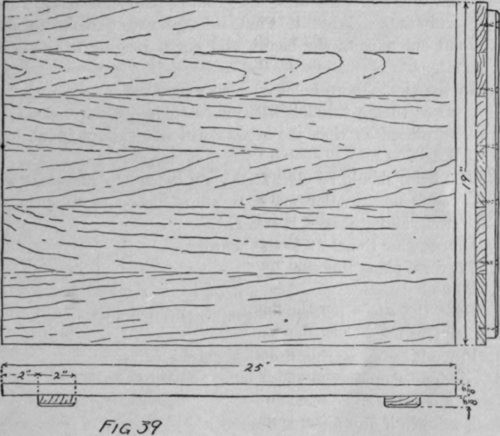
C. Cut pieces for the board, not over 3 1/2" wide, which will make the desired width after jointing and finishing.
D. Cut cleat from maple or oak. Exercises.
1. Joint the pieces together. Read carefully C, Topic 86 A. See also C, Topic 54. Use 1/4" dowels. Mark for them by the method shown in C, Fig. 110.
2. A. Glue the board together. Put the glue in the dowel holes not on the dowels, and along the entire length of both side; of the joint. Use clamps to bring the joints up, and hold them while the glue is setting. . B. If the board is not perfectly straight across its face when the clamps are on, make it straight with hand screws and straight edges.
3. A. Scrape off the surplus glue from each side of the board, and traverse plane the back side; that is, plane it crossways diagonally to straighten it. Plane it lengthways to make it smooth B. Joint one edge of the board, and cut it roughly to the desired size.
4. A. In the cleats, bore holes of a size that will allow a 1" No.
screw to slip through without catching. These holes should be placed so that the screws will not enter a joint in the board. B. The holes should be elongated upon the side of the cleat which comes next to the board, to allow the board to shrink and swell, and still hold it straight. Do not glue the cleat to the board.
5. A. Traverse plane the top.
B. Plane it lengthways. Make it perfectly straight and smooth.
6. A. Joint the edges perfectly straight, and make the board exactly square.
B. Prove it by measuring the diagonals.
C. Sandpaper crossways,diagonally, and lengthways.
7. Remedy defects.
8. Shellac finish, if any finish is desired.
Continue to:


My Books

