


Water Content
Description
This section is from the book "The Mechanical Properties Of Wood", by Samuel J. Record. Also available from Amazon: The Mechanical Properties Of Wood.
Water Content
Water occurs in living wood in three conditions, namely: (1) in the cell walls, (2) in the protoplasmic contents of the cells, and (3) as free water in the cell cavities and spaces. In heartwood it occurs only in the first and last forms. Wood that is thoroughly air-dried retains from 8 to 16 per cent of water in the cell walls, and none, or practically none, in the other forms. Even oven-dried wood retains a small percentage of moisture, but for all except chemical purposes, may be considered absolutely dry.
[Footnote 48: See Tiemann, H.D.: Effect of moisture upon the strength and stiffness of wood. Bul. 70, U.S. Forest Service, Washington, D.C., 1906; also Cir. 108, 1907.]
The general effect of the water content upon the wood substance is to render it softer and more pliable. A similar effect of common observation is in the softening action of water on rawhide, paper, or cloth. Within certain limits the greater the water content the greater its softening effect.
Drying produces a decided increase in the strength of wood, particularly in small specimens. An extreme example is the case of a completely dry spruce block two inches in section, which will sustain a permanent load four times as great as that which a green block of the same size will support.
The greatest increase due to drying is in the ultimate crushing strength, and strength at elastic limit in endwise compression; these are followed by the modulus of rupture, and stress at elastic limit in cross-bending, while the modulus of elasticity is least affected. These ratios are shown in Table XV, but it is to be noted that they apply only to wood in a much drier condition than is used in practice. For air-dry wood the ratios are considerably lower, particularly in the case of the ultimate strength and the elastic limit. Stiffness (within the elastic limit), while following a similar law, is less affected. In the case of shear parallel to the grain, the general effect of drying is to increase the strength, but this is often offset by small splits and checks caused by shrinkage.
| TABLE XV | ||||||
|---|---|---|---|---|---|---|
| EFFECT OF DRYING ON THE MECHANICAL PROPERTIES OF WOOD, SHOWN IN RATIO OF INCREASE DUE TO REDUCING MOISTURE CONTENT FROM THE GREEN CONDITION TO KILN-DRY (3.5 PER CENT) | ||||||
| (Forest Service Bul. 70, p. 89) | ||||||
| KIND OF STRENGTH | Longleaf pine | Spruce | Chestnut | |||
| (1) | (2) | (1) | (2) | (1) | (2) | |
| Crushing strength parallel to grain | 2.89 | 2.60 | 3.71 | 3.41 | 2.83 | 2.55 |
| Elastic limit in compression parallel to grain | 2.60 | 2.34 | 3.80 | 3.49 | 2.40 | 2.26 |
| Modulus of rupture in bending | 2.50 | 2.20 | 2.81 | 2.50 | 2.09 | 1.82 |
| Stress at elastic limit in bending | 2.90 | 2.55 | 2.90 | 2.58 | 2.30 | 2.00 |
| Crushing strength at right angles to grain | 2.58 | 2.48 | ||||
| Shearing strength parallel to grain | 2.01 | 1.91 | 2.03 | 1.95 | 1.55 | 1.47 |
| Modulus of elasticity in compression parallel to grain | 1.63 | 1.47 | 2.26 | 2.08 | 1.43 | 1.29 |
| Modulus of elasticity in bending | 1.59 | 1.35 | 1.43 | 1.23 | 1.44 | 1.21 |
| NOTE. - The figures in the first column show the relative increase in strength between a green specimen and a kiln-dry specimen of equal size. The figures in the second column show the relative increase of strength of the same block after being dried from a green condition to 3.5 per cent moisture, correction having been made for shrinkage. That is, in the first column the strength values per actual unit of area are used; in the second the values per unit of area of green wood which shrinks to smaller size when dried. See also Cir. 108, Fig. 1, p. 8. |
The moisture content has a decided bearing also upon the manner in which wood fails. In compression tests on very dry specimens the entire piece splits suddenly into pieces before any buckling takes place (see Fig. 9.), while with wet material the block gives way gradually, due to the buckling or bending of the walls of the fibres along one or more shearing planes. (See Fig. 14.) In bending tests on wet beams, first failure occurs by compression on top of the beam, gradually extending downward toward the neutral axis. Finally the beam ruptures at the bottom. In the case of very dry beams the failure is usually by splitting or tension on the under side (see Fig. 17.), without compression on the upper, and is often sudden and without warning, and even while the load is still increasing. The effect varies somewhat with different species, chestnut, for example, becoming more brittle upon drying than do ash, hemlock, and longleaf pine. The tensile strength of wood is least affected by drying, as a rule.
In drying wood no increase in strength results until the free water is evaporated and the cell walls begin to dry49. This critical point has been called the fibre-saturation point. (See Fig. 24.) Conversely, after the cell walls are saturated with water, any increase in the amount of water absorbed merely fills the cavities and intercellular spaces, and has no effect on the mechanical properties. Hence, soaking green wood does not lessen its strength unless the water is heated, whereupon a decided weakening results.
[Footnote 49: The wood of Eucalyptus globulus (blue gum) appears to be an exception to this rule. Tiemann says: "The wood of blue gum begins to shrink immediately from the green condition, even at 70 to 90 per cent moisture content, instead of from 30 or 25 per cent as in other species of hardwoods." Proc. Soc. Am. For., Washington, Vol. VIII, No. 3, Oct., 1913, p. 313.]
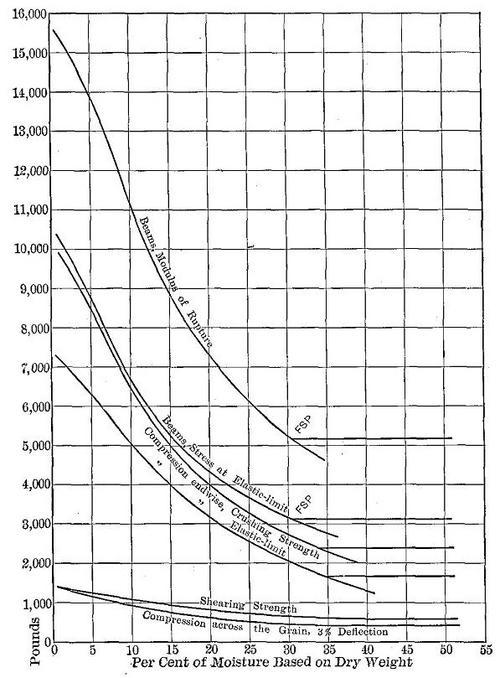
Figure 24
Relation of the moisture content to the various strength values of spruce. FSP = fibre-saturation point.
The strengthening effects of drying, while very marked in the case of small pieces, may be fully offset in structural timbers by inherent weakening effects due to the splitting apart of the wood elements as a result of irregular shrinkage, and in some cases also to the slitting of the cell walls (see Fig. 25). Consequently with large timbers in commercial use it is unsafe to count upon any greater strength, even after seasoning, than that of the green or fresh condition.
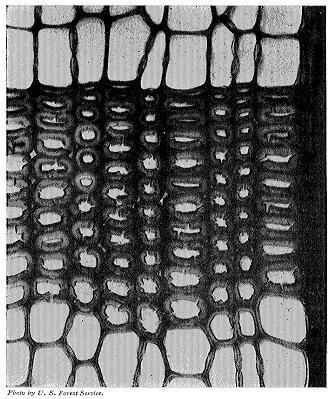
Figure 25
Cross section of the wood of western larch showing fissures in the thick-walled cells of the late wood. Highly magnified. Photo by U. S. Forest Service.
In green wood the cells are all intimately joined together and are at their natural or normal size when saturated with water. The cell walls may be considered as made up of little particles with water between them. When wood is dried the films of water between the particles become thinner and thinner until almost entirely gone. As a result the cell walls grow thinner with loss of moisture, - in other words, the cell shrinks.
It is at once evident that if drying does not take place uniformly throughout an entire piece of timber, the shrinkage as a whole cannot be uniform. The process of drying is from the outside inward, and if the loss of moisture at the surface is met by a steady capillary current of water from the inside, the shrinkage, so far as the degree of moisture affected it, would be uniform. In the best type of dry kilns this condition is approximated by first heating the wood thoroughly in a moist atmosphere before allowing drying to begin.
In air-seasoning and in ordinary dry kilns this condition too often is not attained, and the result is that a dry shell is formed which encloses a moist interior. (See Fig. 26.) Subsequent drying out of the inner portion is rendered more difficult by this "case-hardened" condition. As the outer part dries it is prevented from shrinking by the wet interior, which is still at its greatest volume. This outer portion must either check open or the fibres become strained in tension. If this outer shell dries while the fibres are thus strained they become "set" in this condition, and are no longer in tension. Later when the inner part dries, it tends to shrink away from the hardened outer shell, so that the inner fibres are now strained in tension and the outer fibres are in compression. If the stress exceeds the cohesion, numerous cracks open up, producing a "honey-combed" condition, or "hollow-horning," as it is called. If such a case-hardened stick of wood be resawed, the two halves will cup from the internal tension and external compression, with the concave surface inward.
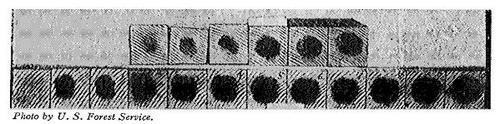
Figure 26
Continue to:


My Books

