


How To Build Log Houses
Description
This section is from the book "Carpentry For Beginners - Things To Make", by John D. Adams. Also available from Amazon: Make Magazine.
How To Build Log Houses
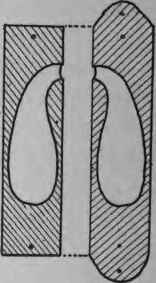
A very successful house of this type may be made by splitting a log in two and then hollowing out the two halves with a gouge, so that a deep, pear-shaped pocket will be formed when they are put together. The log should be quite dry, five or six inches in diameter, and about two feet long. Saw the ends off at an angle so as to shed the water, and fasten the two pieces together with a screw at each end. When necessary these may be removed for cleaning the nest. The accompanying diagram illustrates the proper form of cavity, which should be marked out from a pattern so that both halves will be exactly the same. The seam should be light-proof, and in order to keep out moisture it is advisable to cover the top with a piece of zinc or a shingle. Another very successful bird house may be made from a log having a decayed center. A large opening is to be cleaned out from end to end and the top sawed off at an angle, after which a projecting lug should be formed with the saw at the lower end as illustrated.
In fastening the house in place a screw should be put in through this lug and another at the top before the roof is put on. This latter should be large enough to shed the water, and the bottom is to be fitted in in a manner that will permit of its removal for cleaning. This may be accomplished by securing it in place by driving in about three nails through the sides so as to engage the bottom board. If the proper length nail is chosen and the heads allowed to project about a quarter of an inch they may be readily withdrawn when it is desired to remove the bottom.

After having placed the house, pour in a little clean sawdust to facilitate the building of the nest.
The most important consideration in the making of a bird house suitable for nesting is to have the floor space and depth of the proper dimensions, and to provide an opening of the requisite diameter at the correct distance above the bottom. The following table is taken from data compiled by the U. S. Biological Survey and will be found of great assistance in securing the proper proportions.

SPECIES | FLOOR SPACE | DEPTH | ENTRANCE ABOVE DIAMETER FLOOR ENTRANCE | HEIGHT ABOVE ground | |
Bluebird | 5x5 | 8 | 6 | 1 1/2 | 5-10 ft. |
Chickadee | 4x4 | 8-10 | 8 | 1 1/8 | 6-15 " |
Crested flycatcher | 6x6 | 8-10 | 8 | 2 | 8-20 " |
Dipper | 6x6 | 6 | 1 | 3 | 1-3 " |
Flicker | 7x7 | 16-18 | 16 | 2 1/2 | 6-20 " |
Hairy woodpecker | 6x6 | 12-15 | 12 | 1 1/2 | 12-20 " |
House-finch | 6x6 | 6 | 4 | 2 | 8-12 " |
House wren | 4x4 | 6-8 | 1-6 | 7/8 | 6-10 " |
6x6 | 6 | 1 | 2 1/2 | 15-20 " | |
Red-headed woodpecker | 6x6 | 12-15 | 12 | 2 | 12-20 " |
Tree swallow | 5x5 | 6 | 1-6 | 1/2 | 10-15 " |
Tufted titmouse | 4x4 | 8-10 | 8 | 1 1/4 | 6-15 " |
White-breasted nuthatch | 4x4 | 8-10 | 8 | 1 1/4 | 12-20 " |
Continue to:


My Books

