


Chapter XIV. The Ornamental Drill And Eccentric Cutter
Description
This section is from the book "Turning Lathes", by James Lukin. Also available from Amazon: Turning Lathes: A Guide to Turning, Screw Cutting, Metal Spinning and Ornamental Turning.
Chapter XIV. The Ornamental Drill And Eccentric Cutter
ALTHOUGH we have already disclaimed all intention of treating fully on ornamental turning, which would need many costly illustrations, and a vast extension of the size of this book, the two instruments heading the present chapter seem to call for attention. The first is, indeed, supplied very frequently with the overhead, and the latter enables certain work to be done which is not strictly of the ornamental class.
The Drilling Instrument,
Of which an illustration is appended (Fig. 25), consists of a square stem of steel, usually finished to the size of 9/16 in., which enables it to enter and fit accurately the receptacle of an ornamental turning slide-rest. It lies in the channel of this receptacle, and can be faced about in either direction, so as to stand parallel with the mandrel, at right angles to it, or at any other intermediate angle. The top or side of a box, or other article, may therefore be operated on with equal facility. At each end of the square bar or stem a steel collar is inserted, which is hardened to reduce friction and prevent wear. The front collar, next the drill, is coned out accurately. The spindle, with a socket at one end for the drills, and a steel pulley at the other, is also of steel, and is hardened where it passes through the collars. The utmost care is needed in fitting it; and when it begins to run loose, it is tightened in its bearings by giving a turn to the nut behind the pulley.

Fig. 25. - The Drilling Instrument.
So great is the accuracy required in this instrument, that the drills have to be turned in the spindle itself after fitting their shanks into it. In no other way can the cutting ends of the drills be made sufficiently true. Take, for instance, the drill used for beading, on which a few words have been written in a previous chapter. It is seen, by the annexed drawing (No. 1, Fig. 26), to consist of two cutting points, united by a semicircular hollow. If it runs accurately true, the result will be a hemispherical knob, or bead, perfect in form, and free from any fash or roughness on either side at its base. If, however, the points are not equally distant from the axial line, one will cut into the work of the other; and if the curved part, which is also keenly sharpened, is irregular in shape, the same result will occur, and no good work can be done. Or if, again, a pointed drill is used, and the point is a hair's breadth out of centre, it will describe a minute circle, and mar the work. Hence, also, the curved edges of these little tools cannot be finished with a file alone, but are ground upon little conical grinders of brass, fed with fine emery, which gives them the necessary accuracy, as well as a keen and polished edge. The drills with flat or stepped edges are finished with little square slips of oilstone.
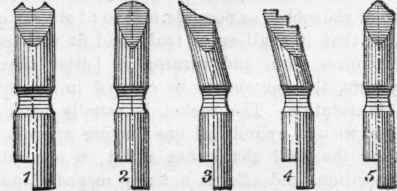
Fig. 26. - Ornamental Drills.
Evidently, tools needing all this care in construction cannot be very cheaply made, and, being costly, many amateurs leam to make their own. It is not a very difficult task, but it is decidedly a tedious one, and the better way is to be contented with a small set, and to take care of them. A good deal of very pretty work may be done with a dozen, carefully selected, and kept in good working order.
The way to make them is to take a small bar of steel, as near the size of the socket as possible, and to fit it very carefully with a file, so that it shall enter truly, and fit without shake. Even this requires care, and turning is better than filing; but, at any rate, the bar should be centred in the lathe, and filed while in rotation. The socket is usually made with a taper hole, or with a cylindrical one having a cross-mortice, in which case the drill shank has a flat on one side. This secures its position, and affords a ready means of pushing it out by the insertion of a small lever. That illustrated (Fig. 25) has a side screw, to secure the drills, and the screw will mark the tool, so that it can always be put into its socket in the same position. In fitting such a socket, the bit of steel must be secured by the screw before turning it of the required form, otherwise, the next time it is inserted the screw will force it out of truth. Supposing the bit of steel fitted and cut off, so as to stand out about half an inch, the shank is secured in the slide-rest, and a cord arranged to drive it from the overhead. A hand-rest is now brought up, and the drill is turned up by means of a graver and small files. If it is for beading, the end is turned cylindrical for a distance of about 1/8in., or rather less, which, when the sides are subsequently flattened, and the end forked by a rat-tail file, will insure the points being equidistant from the axial line of the spindle. The curve filed out, will, as stated, have to be finished to accuracy on a conical grinder. If, instead of a beading, a fluting drill is needed, the end will be turned to a hemispherical form, and the sides will be afterwards filed flat. There is an apparatus often sold to assist in grinding the curve of a fluting drill; but it is sometimes done by the eye. It will, nevertheless, make a great difference in the appearance of the work to have a perfectly-formed curve at the cutting end of the drill.
These precautions may be considered, by some of our readers, unnecessary; but if they could compare good ornamental work with that which is, at least, of indifferent quality, they would at once recognise the great difference between the two. In the one, the tool leaves not only a clean, decided cut, of well-defined outline, but a polished surface, which is due to the sharp, accurate, and burnished edge of the tool; in the other will be irregularity and indecision of outline, and a rough surface, which cannot afterwards be smoothed and polished. This polish produced by the tool is an essential of ornamental turning. No sand-papering or varnishing is permissible, as it rounds off edges, and gives a poor look to the work; all that is ever done is to give a rub with a hard, dry brush; and even this is often impossible with delicate tracery, for drilling can be so finely executed as to produce something comparable to lacework.
Continue to:


My Books

