


Chapter V. Preparation Of Paper, Ink, Colour, And Paste For Printing. Paper
Description
This section is from the book "Wood-Block Printing", by F. Morley Fletcher. Also available from Amazon: Wood-Block Printing.
Chapter V. Preparation Of Paper, Ink, Colour, And Paste For Printing. Paper
The paper made by the Japanese from the inner bark of young shoots of the mulberry and certain other plants of similar fibre is beyond all others the best for wood-block printing. It is in itself a very remarkable material, and is used in Japan for a great variety of purposes, on account of the strength and toughness due to its long silky fibre.
Paper of good quality for printing may be obtained directly from Japan, or through trading agents dealing with Japan. A case of five reams would be the smallest quantity obtainable directly, but it is by far the cheapest and most satisfactory way of buying it. In smaller quantities the paper is obtainable through many of the dealers in artists' materials. Several kinds of this paper are made, but unsized sheets of a quality similar to the print on page 95, and a thin Japanese tissue paper are the two kinds required for printing in colour.
In its unsized state the paper is too absorbent for use, and it should be sized freshly as needed for work. This is done by brushing a thin solution of gelatine over the smooth surface of the sheets of paper.
A drawing-board rather larger than the sheets of paper, placed as shown in fig. 17, with its lower edge resting on a basin of warm size, will be found a convenient arrangement.

Plate VII. Impression of a portion of detail from a Japanese woodblock (very nearly actual size).
The sheet gelatine sold by grocers for cooking makes an excellent size. Six of the thin sheets to a pint of water is a good strength.[3] The gelatine is dissolved in hot water, but should not be boiled, as that partially destroys the size. When dissolved, a little powdered alum is also stirred in, about as much as will lie on a shilling to a pint of water. The addition of the alum is important, as it acts as a mordant and helps to make a better colour impression.
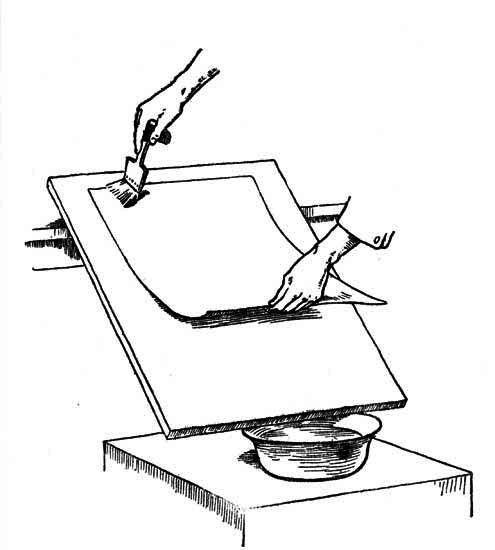
Fig. 17. - Drawing Of Sizing Of Paper
In applying the size to the paper a four-inch broad flat paste brush is used. The paper is laid on the slanting board and the size brushed backward and forward across the paper from the upper end downward. Care must be taken not to make creases in the paper, as these become permanent. To avoid this the lower end of the sheet may be held with the left hand and raised when necessary as the brush passes downwards. The waste size will run down to the basin, but the paper need not be flooded, nor should its surface be brushed unnecessarily, but it must be fully and evenly charged with size. The sheet is then picked up by the two upper corners (which may conveniently be kept unsized) and pinned at each corner over a cord stretched across the workroom. The sheets are left hanging until they are dry. The Japanese lay the paper on the cord, letting the two halves of the sheet hang down equally on either side.
The process of sizing and drying the sheets of paper is illustrated in a print shown in the collection at the South Kensington Museum.
When the paper is quite dry it is taken down, and if required at once for printing should be cut up into sheets of the size required, with sufficient margin allowed to reach the register marks. It is best to cut a gauge or pattern in cardboard for use in cutting the sheets to a uniform size.
A few sheets of unsized paper are needed as damping sheets, one being used to every three printing sheets. The damping sheets should be cut at least an inch wider and longer than the printing sheets. Two wooden boards are also required. The sheets of printing paper are kept between these while damping before work.
To prepare for work, a damping sheet is taken and brushed over evenly with water with a broad brush (like that used for sizing). The sheet must not be soaked, but made thoroughly moist, evenly all over. It is then laid on one of the two boards, and on it, with the printing side (the smoother side) downward, are laid three of the sized sheets of printing paper. On these another moist damping sheet is laid, and again three dry sheets of printing paper, face downwards, and so on alternately to the number of sheets of the batch to be printed. A board is placed on the top of the pile.
The number of prints to be attempted at one printing will vary with the kind of work and with the printer's experience. The printing may be continued during three days, but if the paper is kept damp longer, there is danger of mould and spotting. With work requiring delicate gradation of colour and many separate block impressions twenty or thirty sheets will be found sufficient for three days' hard work. The professional printers of Japan, however, print batches of two hundred and three hundred prints at a time, but in that case the work must become largely mechanical.[4]
The batch of paper and damping sheets should remain between the boards for at least half an hour when new sheets are being damped for the first time. The damping sheets, all but the top and bottom ones, should then be removed and the printing sheets left together between the boards for some time before printing. An hour improves their condition very much, the moisture spreading equally throughout the batch of sheets. Before printing they should be quite flat and soft, but scarcely moist to the touch. If the sheets are new, they may even be left standing all night after the first damping, and will be in perfect condition for printing in the morning without further damping. No weight should be placed on the boards.
Although no paper has hitherto been found that will take so perfect an impression from colour-blocks as the long-fibred Japanese paper, yet it should be the aim of all craftsmen to become independent of foreign materials as far as possible. There is no doubt that our paper-makers should be able to produce a paper of good quality sufficiently absorbent to take colour from the wet block and yet tough enough to bear handling when slightly damp.
If a short-fibred paper is made without size, it comes to pieces when it is damped for printing. But the amount of absorbency required is not so great as to preclude the use of size altogether. It is a problem which our paper-makers could surely solve. A soft, slightly absorbent, white paper is required. At present nothing has been produced to take the place of the long mulberry fibre of the Japanese, which prints perfectly, but it is far from being pure white in colour. A white paper would have a great advantage in printing high and delicate colour schemes.
Continue to:


My Books

