


Architectural Carving. Continued
Description
This section is from the book "Wood-Carving. Design And Workmanship", by George Jack. Also available from Amazon: Wood-Carving (Design and Workmanship).
Architectural Carving. Continued
The fifteenth century in England was a period of great activity among wood-carvers, and many beautiful choir-screens were added about this time to the existing churches, all in the traditional Gothic manner, as the Renaissance influence was a full century at work in other countries before its power began seriously to affect the national style. The West of England (Somerset and Devon in particular) is rich in the remains of this late Gothic carving, some details of which are shown in the accompanying illustrations, Figs. 75, 76, 77.
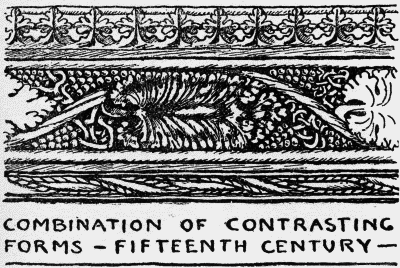 Fig. 75.
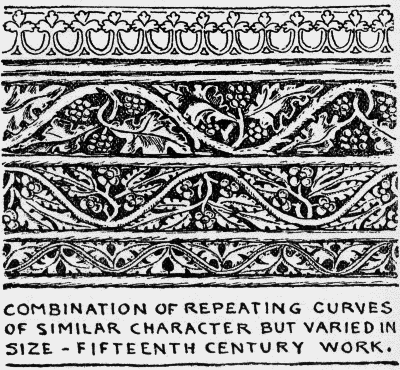 Fig. 76.
 Fig. 77.
As a general rule the supporting carpentry of these screens bears a strong resemblance to stonework; so imitative is it in treatment, that it is only by the texture of the wood and its lightness of construction that the distinction is made evident. Now a certain degree of modified imitation, where one craft models its forms of design upon those of another, using a different material, as in the case of woodwork imitations of arches, tracery, etc., is not only legitimate, but very pleasing in its results. To attain this end, the carpenter need only be true to his own ideals - there is no occasion to abandon the methods of his own craft in order to copy the construction which is peculiar to another. The resources of carpentry offer an infinite field for the invention of new and characteristic forms, and these may be made all the more attractive if they show, to some extent, the influence of an associated craft, but never fail to become wearisome if essential character has been sacrificed for the sake of an ingenious imitation. The structural parts of some of these screens are composed of elaborate imitations of stone vaulting and tracery, so closely copied as to be almost deceiving, therefore they can not be taken as good examples of suggestive opportunity for the wood-carver.
The carved work, on the other hand, is marked by a strong craft character, essentiallywoodyboth in design and execution. The illustrations referred to are typical examples of this kind of work, and, although the execution can not be indicated, they at least give the disposition of parts, and some idea of the contrast obtained by the use of alternate bands of ornament differing in scale, or, as in some cases, the agreeable monotony produced by a repetition of almost similar designs, varied slightly in execution.
Another prominent feature of church woodwork, which developed about this time into magnificent proportions, was the font cover and canopy. Many of these were, however, more like glorifications of the carpenter's genius for construction than examples of the carver's art, as they were composed of a multitude of tiny pinnacles and niches, the carver's work being confined to a repetition of endless crockets, tracery, and separate figures or groups. However, in Plate XIII an example is given of what they could do when working together on a more equal footing; although much mutilated, enough remains to show how the one craft gains by being associated with the other in a wholesome spirit of rivalry.
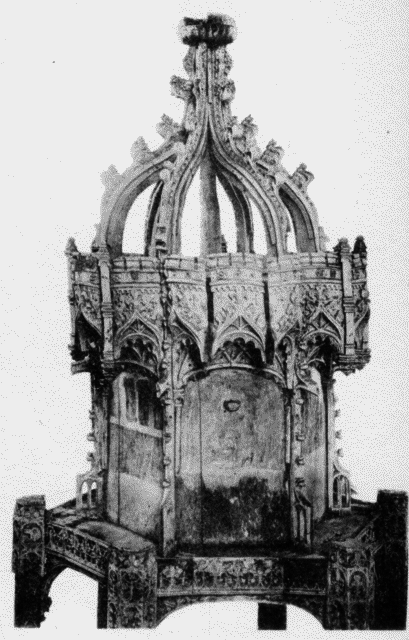 XIII. - Font Canopy - Trunch Church, Norfolk.
Plate XIII
Font Canopy, Trunch Church, Norfolk. The plate gives the upper portion only of this beautiful canopy; it is supported upon six posts richly carved on all sides, of which there are five to each post. The height of the whole canopy is about fifteen or sixteen feet - it presumably dates somewhere toward the end of the fourteenth century or beginning of the fifteenth.
Continue to:


My Books

