


Chapter VII. The Grain Of The Wood
Description
This section is from the book "Wood-Carving. Design And Workmanship", by George Jack. Also available from Amazon: Wood-Carving (Design and Workmanship).
Chapter VII. The Grain Of The Wood
Obstinacy of the Woody Fiber - First Exercise in Grounding - Description of Method - Cutting the Miters - Handling of Tools, Danger of Carelessness - Importance of Clean Cutting.
It is curious to imagine what the inside of a young enthusiast's head must be like when he makes his first conscious step toward artistic expression. The chaotic jumbles of half-formed ideas, whirling about in its recesses, produce kaleidoscopic effects, which to him look like the most lovely pictures. If he could only learn to put them down! let him but acquire the technical department of his art, and what easier than to realize those most marvelous dreams. Later in his progress it begins to dawn upon him that this same technical department may not be so very obedient to his wishes; it may have laws of its own, which shall change his fairy fancies into sober images, not at all unlike something which has often been done before by others. But let the young soul continue to see visions, the more the better, provided they be of the right sort. We shall in the meantime ask him to curb his imagination, and yield his faculties for the moment to the apparently simple task of realizing a leaf or two from one of the trees in his enchanted valley.
With the student's kind permission we shall, while these lessons continue, make believe that teacher and pupil are together in a class-room, or, better still, in a country workshop, with chips flying in all directions under busy hands.
I must tell you then, that the first surprise which awaits the beginner, and one which opens his eyes to a whole series of restraints upon the freedom of his operations, lies in the discovery that wood has a decided grain or fiber. He will find that it sometimes behaves in a very obstinate manner, refusing to cut straight here, chipping off there, and altogether seeming to take pleasure in thwarting his every effort. By and by he gets to know his piece of wood; where the grain dips and where it comes up or wriggles, and with practise he becomes its master. He finds in this, his first technical difficulty, a kind of blessing in disguise, because it sets bounds to what would otherwise be an infinitely vague choice of methods.
We shall now take a piece of yellow pine, free from knots, and planed clean all round. The size may be about 12 ins. long by 7 ins. wide. We shall fix this to the bench by means of two clamps or one clamp and a screwed block at opposite corners. Now we are ready to begin work, but up to the present we have not thought of the design we intend executing, being so intent upon the tools and impatient for an attack upon the silky wood with their sharp edges.
The illustration, Fig. 13, gives a clue to the sort of design to begin with; it measures about 11 ins. long by 7 ins. wide, allowing a margin all round. The wood should be a little longer than the design, as the ends get spoiled by the clamps. This little design need not, and indeed should not, be copied. Make one for yourself entirely different, only bearing in mind the points which are to be observed in arranging it, and which have for their object the avoidance of difficulties likely to be too much for a first effort. These points are somewhat to this effect: the design should be of leaves, laid out flat on a background, with no complication of perspective. They should have no undulations of surface. That is to say, the margins of all the features should be as nearly as possible the original surface of the wood, which may have just the least possible bit of finish in the manner I shall describe later on. The articulation of the leaves and flower is represented by simple gouge cuts. There should be nothing in the design requiring rounded surfaces. The passage for tools in clearing out the ground between the features must not be less than 1/4 in.; this will allow the 3/16 in. corner grounder to pass freely backward and forward. The ground is supposed to be sunk about three-sixteenths of an inch.
As you have not got your design made, I shall, for convenience' sake, explain how Fig. 13 should be begun and finished. First having traced the full-size design it should be transferred to the wood by means of a piece of blue carbon paper.
 Fig. 13.
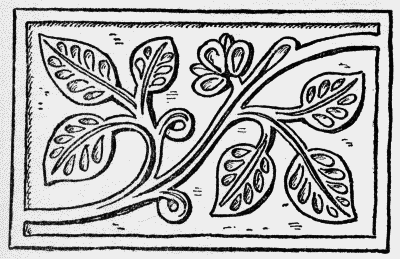 Fig. 14.
Then with either the Veiner or V tool outline the whole of the leaves, etc., about 1/8 in. deep, keeping well on the outside of the drawing. Ignore all minor detail for the present, blocking out the design in masses. No outline need be grooved for the margin of the panel at present, as it should be done with a larger tool. For this purpose take gouge No. 6 (1/4 in. wide), and begin at the left-hand bottom corner of the panel, cut a groove about 1/16 in. within the blue line, taking care not to cut off parts of the leaves in the process; begin a little above the corner at the bottom, and leave off a little below that at the top. The miters will be formed later on.
In this operation, as in all subsequent ones, the grain of the wood will be more or less in evidence. You will by degrees get to know the piece of wood you are working upon, and cut in such a way that your tool runswiththe grain and notagainstit; that is to say, you will cut as much as possible on the up-hill direction of the fiber. This can not always be done in deep hollows, but then you will have had some practise before you attempt these.
Now take chisel No. 11, and with it stab into the grooved outline, pressing the tool down perpendicularly to what you think feels like the depth of the ground. The mallet need not be used for this, as the wood is soft enough to allow of the tools being pressed by the hand alone, but remember that the force must be proportioned to the depth desired, and to the direction of the grain; much less pressure is wanted to drive a tool into the wood when its edge is parallel with the grain than when it lies in a cross direction; small tools penetrate more easily than large ones, as a matter of course, but one must think of these things or accidents happen.
Continue to:


My Books

