


Studies From Nature - Birds And Beasts. Continued
Description
This section is from the book "Wood-Carving. Design And Workmanship", by George Jack. Also available from Amazon: Wood-Carving (Design and Workmanship).
Studies From Nature - Birds And Beasts. Continued
The side-notes about the colors are valuable, as, although not translatable into carving, they do to some extent influence the manner of interpreting forms.
Photographs must not be despised, but they are only of use if read by the light of previous knowledge. For this reason you can not make too many notes of sectional structure through heads, necks, and legs, which will help to explain the mystery common to all photographs.
The bear shown in the frontispiece is traced from a photographic illustration which appeared in the Westminster Budget some time ago. By the merest accident it is suggestive of a subject almost ready for the carver's hand.
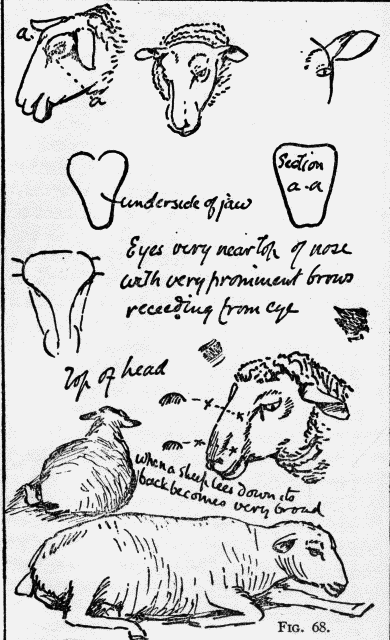 Fig. 68.
 Fig. 69.
Until tourists began to explore the beauties of Switzerland, there were no better carvers of animals than the serious but genial craftsmen of that noble country, more especially of such animals as were familiar to their eyes. This preeminence shows distinct signs of soon becoming a thing of the past in the endeavors to meet the demands created by thoughtless visitors. Still, it is possible to obtain a little of the traditional work, uninfluenced by that fatal impetus originating in modern commerce. A piece of this kind is shown in Fig. 70, bought by a friend only a year or two ago in the Grindelwald, and which, although forming part of the usual stock of such things made for tourist consumption, was picked out with judicious discrimination from a number of stupid and trivial objects which displayed neither interest of design nor other than mechanical skill of carving. This little bear, a few inches in size, is carved in a way which shows long experience of the subject, and great familiarity with the animal's ways. The tooling of the hair is done with the most extraordinary skill, and without the waste of a single touch. Now, a word or two more on studies from the life before we leave this subject. I have given you examples of diagrams made for this purpose, but much may be done without any drawings, further than a preliminary map of the general masses. In the case of such an animal as the horse, which can be seen in every street, I have myself found it useful to follow them in my walks, taking mental note of such details as I happened to be engaged upon, such as its legs and joints, its head or neck; another day I would confine my attention to eyes, ears, mane, etc., always with reference to the work immediately in hand, as that is the time to get the best results from life study; because the difficulties have presented themselves, and one knows exactly what to look for. Five minutes spent thus after the work has been started (provided the start has been right and involves no mistake in the general masses) is more valuable than hours of labor in making preliminary drawings.
 Fig. 70.
The use of experimental models in clay or wax has, of course, its advantages, but it will be well to know just how far such an aid is valuable, and at what point its use becomes hurtful to one's work. It is a common practise in large carving shops for one man to design the figure or animal subjects in clay, while another carves them in stone or wood. Now, apart from the difference in material and the unnatural "division of labor," which we have discussed before, it is beyond question that a model of this kind has even a more paralyzing effect on the actual carver than a drawing would have. Of course, the work is more certain to reach a recognized standard, and the risk of total failure is reduced to a minimum, but there is literally nothing left for the carver to invent; who, if he is a man with a turn for that kind of thing, and of a nervous temperament, must suffer untold irritation in its execution. The good and bad results of the use of a modeled pattern attend in a modified degree even where both are done by the same hand, but for all that it is a useful and convenient way of making experiments in doubtful passages of the work. The "how far" a model is to be carried must be regulated by the amount of confidence the carver has in his own foresight, but in any case it is always well to remember the difference of treatment required in plaster, clay, and hard wood, which lead to such different results that often fresh difficulty arises in having to translate the one manner into the other. For the purpose of roughing out the general scheme, the clay, if it must be resorted to, should be used in soft masses, then a drawing in outline made from this; but all doubtful detailed work should be carved, not modeled, and for this purpose the clay should be allowed to harden until it is nearly dry.
The opinions of the well-known wood-carver, Mr. W. Aumonier, on this subject, will be of value to you; he says with regard to the best method of going to work: "A fresh piece of wood-carving executed without a model is distinctly a created work," and that much good work may come by "chopping boldly at a block without any preconceived design, but designing as you go on." But he thinks it is best to work from drawings; "rough, full-size charcoal cartoons, which give the effect wanted by their light and shade." He also says that he "strongly protests against the too frequent use of clay or plaster models, because they are often worse than useless, and not infrequently absolutely immoral in their tendency, because they absorb time and money, which ought more legitimately to be spent on the carving itself."
Continue to:


My Books

