


Lathe Adjustment for Cutting Threads
Description
This section is from the book "Machine Shop Work", by Frederick W. Turner, Oscar E. Perrigo, Howard P. Fairfield. Also available from Amazon: Machine shop work.
Lathe Adjustment for Cutting Threads
The cutting of a thread demands that there shall be a certain definite ratio of motion between the rotation of the work and the travel of the carriage. For example, if a screw having a pitch of 1/4 inch-or with four threads to the inch, as it is usually stated-is to be cut, the work spindle must make four revolutions while the carriage is moving one inch along the bed.
If the screw is to have eight threads per inch, the work spindle must make eight revolutions to each inch of motion of the carriage or tool; if six threads, then six revolutions to the inch of motion, etc.
If, then, the apron lead-screw has four threads to the inch, it is evident that the speed of rotation of the spindle and of the screw must be the same, in order to cut a screw of four threads to the inch. In other words, for each revolution of the lead-screw, the carriage moves the distance of the pitch of the same, or J inch. Hence the gears J and L, Fig. 95, must have the same number of teeth. When a screw of eight threads per inch is to be cut, the spindle must make twice as many revolutions as the lead-screw. Then, for each revolution of the spindle, the lead-screw makes half a revolution, and thus moves the carriage 1/8 inch. In this case, the screw gear L must have twice as many teeth as the stud gear J. For six threads, the ratio of revolutions between spindle and screw is 1 1/2 to 1. This requires 1 1/2 times as many teeth in the screw gear L as in the stud gear J.
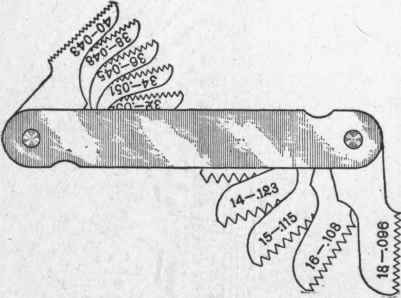
Fig. 163. Screw Pitch Gage.
Continue to:


My Books

