


Web Stress. Part 2
Description
This section is from the "Plate Girder Construction" book, by Isami Hiroi, C.E.. Also see Amazon: Plate Girder Construction.
Web Stress. Part 2
Now the bending moment M increases from the end toward the middle of the beam, and with it evidently the intensity f of the horizontal stress also; so that f varies not only in vertical direction on both sides of the neutral axis, but also in the direction of the length of the beam. Let x x and x x' be two sections of a beam very close to each other, and N N the neutral axis. Then the variation of the value of f in both sections may be represented by triangles with apices in the neutral axis, and the variation in the longitudinal direction between these two sections, by the differences of the areas of two triangles, as shown shaded in the figure. This increase of horizontal stress from one section to another produces at each longitudinal layer a force tending to slide it past the layer next above it, and is transmitted undiminished toward the neutral axis, where this shearing force, which has been increasing at every layer, attains its maximum intensity. This stress is called the longitudinal shear, and can be at once obtained from equation (1). Thus let f' >be the corresponding value of f' in section x' x; and let M and M' be the bending moment in the two sections x x and x x respectively, and a, an infinitely small cross area, distant y from the neutral axis. The total horizontal stresses acting in that part of the section lying between the extreme fibre distant h from the neutral axis, and the layer y' y' distant y' from the axis in x x and x' x' are respectively:

Fig. 1.
h h
Ʃ fa, Ʃ fa
y' y'
The longitudinal shear in the layer y' y between the two sections is therefore equal to
h h
Ʃ f a - Ʃ fa
y' y'
Substituting in the expression the values of f and f' given by equation (1) we obtain:

Since the area on which this horizontal shear is acting is equal to b Δ x when b is the breadth of the cross section at the layer y' y' and Δ x the distance between x and x', we obtain for the intensity of the shear:

The existence of such a stress becomes evident to any one, when, instead of a single beam, two beams be made to lie one upon another, which either by their own weight or specially applied forces will assume the shape shown in Fig. (2). If they are now joined together by bolts, they will act as a single beam, and the shearing stress on these bolts is indicated by the force required to bring the two points a and b together.

The vertical shearing action at any section of the beam is simply the reaction due to the load at one end minus that part of the load lying between that and the section, or in which S is that vertical shear at a point distant x from one end at which the upward reaction is R.


Fig. 3.
Thus at every point in a beam there are two shearing actions taking place at the same time. Imagine abcd (Fig. 3) to be an infinitely small portion of the side of a beam at a point distant y' from the neutral axis. Suppose the sides of this area element be Δx and Δy and the breadth of the beam at the point to be b. There are then found two shearing stresses on this element, one vertical and the other horizontal. These two shears form two pairs of couples acting arouud the body, as shown by the four arrows. Let tx. represent the intensity of the horizontal shear at this point and ty. that of the vertical. The amount of the horizontal shear is equal to tx.Δx.b.
That of the vertical shear is likewise =tyΔyb.
In order that the body be in equilibrium, the moments of these couples must be equal, i. e., tx Δx.b. Δy=ty. Δy.b. Δx
Consequently
tx=ty.---------------------------(4)
showing that at every point in the beam the intensities of the vertical and horizontal shears are equal, and we hereafter designate them with one common letter t. The value of tx has already been deduced in equation (2) namely :

But as will be shortly explained,

in which d represents the distance of loads w from the end at which the reaction is R. Likewise:

Consequently:

But:

Hence:
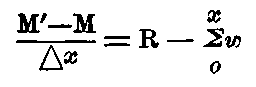
From eq. (3) we obtain:
(M'-M)/Δx=Sx
Substituting this value of:
(M'-M)/Δx
In eq. (5) we get:

This equation gives at once at any point of the beam the intensity of longitudinal and vertical shears.
At the neutral axis where y'=o eq. (6) becomes:

There still remains to be considered the stresses acting on the sides of the element (Fig. 3); one of which is the horizontal force f, whose value was given in equation (1), tending either to compress together or pull asunder the two faces a c and b d, according as it is on the upper or the lower side of the neutral axis ; and the other is the direct compression on a b due to the weight lying on it. The latter, however, is usually so small that it can be taken out of consideration entirely.
At the neutral axis where f=o, tx and ty are then the only stresses, and we know from mechanics that the resultant action of two equal shears at right angles to each other, exactly as tx and ty are, is equivalent to that of two equal and opposite stresses at right angles to each other, called the principal stresses, and making an angle o 45° with the shearing stresses. But at a distance each side of the neutral axis, the third stress f now comes in, which evidently gives a new direction to the line of resultant stress, turning the axis of principal stresses toward itself more and more as its intensity increases.
Since for all directions and intensities of stresses there can always be found two planes at right angles to each other, and in each of which the resultant action of these stresses is normal to its surface, forming the planes of action of the principal stresses, as soon as we know the itensities and directions of these stresses, we can determine, either graphically or analytically, the direction and intensities of the principal stresses; the values of t and f at any point will give us the direction and intensities of maximum tension and compression at that point.

Fig. 4 represents the appearance which the lines of principal stresses thus obtained present. The lines of maximum tension shown dotted, cut the lines of compression every time at right angles. Both lines cross the neutral axis at the inclination of 45° to the same, and run almost parallel to it in the middle of the beam in the neighborhood of extreme fibers. If we represent with p the intensities of stress along these curves, we have:
p=1/2f ± û(4t2+f2)--------------(8)
Giving us at every point two values of p, viz.: compression tension, and their directions being at right angles to each other.
Continue to:


My Books

