


Camera Back
Description
This section is from the book "Workshop Receipts For Manufacturers And Scientific Amateurs. Supplement Aluminium To Wireless", by The Chemical Publishing Co.. Also available from Amazon: Workshop Receipts For Manufacturers And Scientific Amateurs.
Camera Back
This depending upon the type, will take either plates or films, or both, while the films may be of roll type, or in cut sheets. In any case it is necessary that no stray light can enter through any of the joints of the fittings, etc. These joints, sliding or otherwise, must be watched, and if necessary they must be packed in some way, a strip of velvet glued into position with the pile making contact on to the moving part will generally give a satisfactory solution.
If plates be used, then the light-tightness of the plate holders must also be watched and rectified if necessary. As to the general movements and adjustments, in most cameras these provide for means to move the lens and shutter bodily up and down vertically, termed a " rising front," also frequently means to move to either side of the central position termed a " cross front," also means are provided to alter the angle of the sensitive plate with the camera base, termed a " swing back." These adjustments must all be simple, capable of very quick adjustment, and also of being locked firmly when desired. The use of these different adjustments is as follows, the rising front is used when it is desired to bring on to the sensitive plate the image of an object which otherwise could not be got in, due to difficulties of altering the position of the camera. The cross movement front allows the same freedom, but in a horizontal direction on either side of the centre line. The swing back is used when it is desired to take a view which cannot be got unless the camera be pointed up or down, i.e., not pointed horizontally, the camera being so tilted, the swing back is then operated to bring the sensitive plate surface to a vertical position. Fig. 18 shows a stand type camera having a rising front and swing back but no cross movement front. Fig. 19 shows a folding type hand camera, having rising front and cross movement, and in which the back can swing to some extent, but has no locking arrangement in that position. In the " autographic " folding hand camera, means are provided to enable the operator to write on the film any details desired regarding it, using a stylus or smooth pointed pencil (not an indelible or copying kind). Press hard on up and down strokes, leave the little flap open and expose, but not in direct sunlight, as given in following table :

Fig. 18.
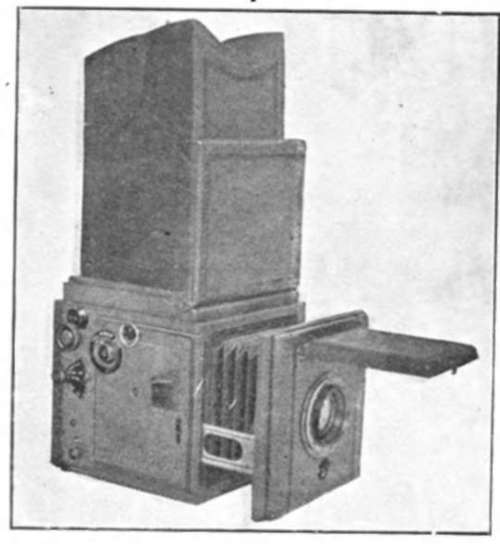
Fig. 20.
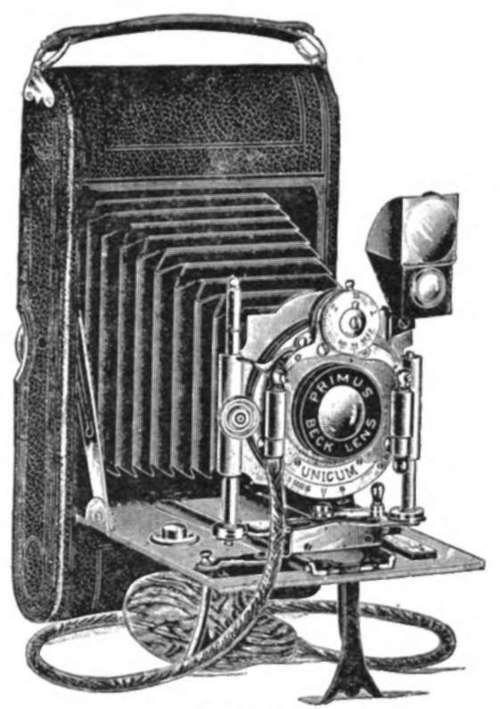
Fig. 19.
| ; | Out of doors | Indoors close to window |
Brilliant | secs. | secs. |
light | 2 to 5 | 5 to 7 |
Dull light | 5 to 10 | 10 to 15 |
Electric light, distance 2 ins., 30 to 60 seconds. Incandescent gas, distance 6 ins., 30 to 60 seconds. | ||
Close the spring door before winding a new film into place.
Fig. 20 shows a hand camera of the reflex type in which a full view of the image can be obtained up to the time of exposure, this particular camera is known as the Popular Pressman, and details are as follows.
Fig. 21 shows the essential working parts. The image is thrown by the lens on to a mirror, placed in such a position that it reflects the same image at right angles, upwards, on to a focussing screen.
Exposure is made by raising the mirror to the horizontal position, which action releases the focal plane shutter, and allows the slit to travel across the plate.
A special form of light trap for the mirror frame is fitted, to ensure perfect light tightness of the mirror mechanism.
The Popular Pressman camera may be regarded as the embodiment of all the essentials for a high-class reflex camera in compact form, at a reasonable price. The camera is square, covered with first-class leather, and carefully finished throughout, attention being given to the construction of the body, which is made of best seasoned mahogany, all joints and other vulnerable points being secured in the strongest possible manner.
The front is fitted with a panel, in which the lens is sunk, as shown in Fig. 20. Over this a strong flap is so adjusted that it serves the double purpose of a lens cap, to prevent dust or moisture getting on to the lens surface, when fixed down, and as a sky shade when open. This panel can be moved up or down, giving a rising and falling movement to the lens.
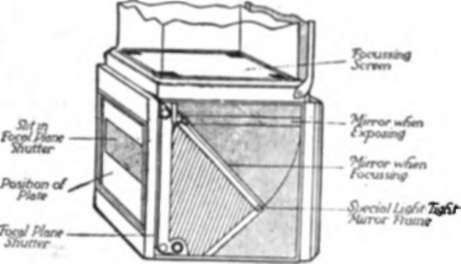
Fig. 21.
Continue to:


My Books

