


Letter Copiers
Description
This section is from the book "Workshop Receipts For Manufacturers And Scientific Amateurs. Supplement Aluminium To Wireless", by The Chemical Publishing Co.. Also available from Amazon: Workshop Receipts For Manufacturers And Scientific Amateurs.
Letter Copiers
There are devices for taking one or more copies of a letter, for reference or recording purposes later. Almost invariably these copies are taken on to thin paper. In the past many offices used to take their copies by placing the finished typed letters between the leaves of a bound number of thin sheets of suitable p a p e r, which sheets had to be moistened by a brush and water. The book of bound sheets with the letters to be copied therein, were then placed under a screw down press. After an estimated correct time Ihev were re-leased and the letters taken out, leaving the copies in the bound book. In theory only this met hod appeared to be good, but in practice it had serious drawbacks, such as the difficulty of making the copy sheets just moist enough and not too moist, also the difficulty of telling just when to draw out the letters, and just how much pressure to put on by the press. The appearance of the copied letters was also frequently spoilt by smearing due to too much moisture having been used, and in addition the whole process was slow and time wasting. Machines have been devised by which a copy of each letter is taken on a roll of the thin tissue paper, the letter delivered into a tray, and the tissue paper rolled up ready to cut, as and when required, into single sheets. Fig. 132 shows a typical machine for doing such work, the description of the various named parts are as follows :-

Fig. 132.
A Paper roll container, capacity 500 letters. B Tray to take letters to be copied.
C Automatic fingers to guide each letter. D Pressure lever. E Paper passing automatically to its work. F Copied latters delivered into tray.
G Impressed paper passing to cutting drum. H Cutting lever for severing letters.
I Indicator to show when letters are ready for cutting.
The whole operation is entirely automatic, even the old operation of moistening the tissue paper is cut out, by having a supply of paper that is obtained from the makers moistened ready for use, delivered and wrapped so that the correct moisture is retained for several months, and guaranteed to that effect, under a replacement clause. The roll of paper as delivered is unwrapped, put on to the carrier centre or spindle, and dropped into the paper container on the machine, a foot or two is pulled out and fed against the rollers. The handle is then turned and the machine is ready. It is possible to copy 20 letters in one minute from start to finish. When the last letter is done, the indicator I is watched, directly it drops we know that the paper is in the right position to be cut. The cutting lever H is then operated, and the whole of the copies are then free to be lifted out, and dealt with as desired. The great advantages of this type of machine are obvious, the attention required is but little, it is quite easy to watch that good copies are coming through, while the machine is being operated, and to see that no letters are put through face downwards, etc. Should the impressions not be up to the usual standard, then this is either due to the tissue paper being too dry, or that the pressure lever D wants adjusting, or that the typist's ribbon is very much too worn, inspection of the original letter will show this, the remedy is to use a better ribbon, as clcarlv no ink for the copy can be obtained off the letter if there is practically none there.
Addressing Machines
Another part of office routine work that can be done by automatic machines is the addressing of envelopes to a list, etc., already prepared, such as would be in more or less constant use in any Mail Order business. The addresses are cut by a typewriter in the usual manner on a series of small stencils, these are fastened suitably and easily on to small cards, which cards are fed through a machine with an inking device. Each card is brought forward automatically in turn, and the address thereon is impressed on to an envelope presented to it. The cards fall into a receiving box or container, preserving the same order of rotation, thus being ready for use again in the same order later on. The cards themselves may be just large enough to contain the addresses easily, or may be larger so that they can also be used as a card index to record other information on, but not of course on the stencil portion. Fig. 133 shows a pattern that will hold 72 address cards at once, will automatically skip a card if required, or repeat a card or cards when wanted. As by the shape of the cards and the design of the machine it is impossible to feed the cards in the wrong way, the whole working is very simple. The inking device is much on the lines of the other machines described above, in that the ink is contained in a reservoir, and when required a small lever is moved and the rollers ink themselves while the machine is being operated, when sufficiently inked a reverse turn of the lever disconnects the feed. Of course, instead of using the machine for envelopes, gummed slips can be used, or an attachment can be obtained whereby the names and addresses can be recorded on to a long strip of paper. Fig. 134 shows an addressing machine of a more simple design than that of Fig. 133, it has a capacity for holding 36 stencil cards at one time, and is thoroughly capable of meeting all demands for medium size mailing lists.
General
Now in each of the different machines dealt with above merely due care and attention are required to the makers' simple instructions, in order to get the desired results, but in common with all other automatic devices, the following rules should be maintained. Never allow anyone (unless with proved special qualifications) to get busy among the works with screwdrivers, hammers, or spanners, etc. In the event of any accident to the machines, such as being knocked over, or dropped, or having had something dropped upon it, then if possible have some one from the makers to attend to it, or if this for any reason is impossible, then get some one with skilled mechanical knowledge (professional or amateur) to go over it. Under no circumstances should force ever be used in these or any other machine, made to operate by hand, and if this ever seems to be wanted, then it should be treated definitely as a sign that some part or parts are out of order.
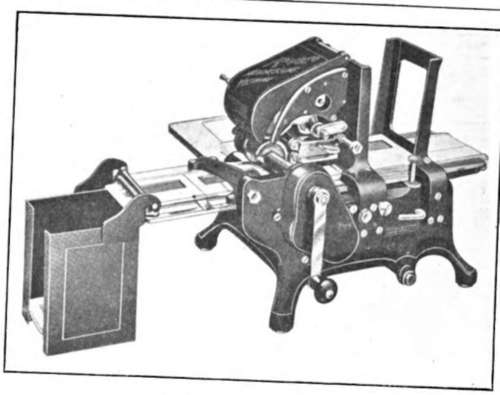

Figs. 133 & 134
Continue to:


My Books

