


Photographic Apparatus -Developing Systems
Description
This section is from the book "Workshop Receipts For Manufacturers And Scientific Amateurs. Supplement Aluminium To Wireless", by The Chemical Publishing Co.. Also available from Amazon: Workshop Receipts For Manufacturers And Scientific Amateurs.
Photographic Apparatus -Developing Systems
In designing the Butcher Developing systems one essential factor has been borne in mind, namely, the necessity for eliminating the handling of films singly. In both systems the film is fitted to a rack and passes through all the solutions on that rack and through the drying cupboard. Thus the films need not be handled in the wet state at all and consequently are not so liable to be scratched or damaged. The films are looped on the racks so that it is possible to make the tanks of convenient height, and staging is not necessary.
No. 1 System consists of a set of three Royal Doulton stoneware tanks of convenient size and height, fitted with taps for running off solutions.
The tanks are grooved to accommodate teak racks upon which the films are clipped by a special patent method, being attached at each end to a split movable bar and looped round a bar at the bottom of the rack.
Each tank contains six racks, and each rack is capable of holding five 31/4x21/4 films or an equivalent quantity of other sizes. I he films are sorted into their various sizes for " peeling," and a suitable number of racks adjusted to the various sizes. More, of course, will be required for the more popular sizes. Once adjusted, these racks need never be moved again except one or two which would be kept aside for special sizes which are not in common use.
No. 2 System is a modification of the No. 1, and is designed for a smaller quantity of films.
The System consists of three cylindrical Royal Doulton stoneware tanks of convenient height, fitted with taps for running off the solutions.
Each of these tanks is supplied with one rack system which is designed so that it will accommodate all sizes of films, and has a total capacity of sixteen 31/4x21/4 films, or an equivalent quantity of other sizes. The films are attached to this rack in the same way as the No. 1 System, and will remain on it through processes of developing, fixing and washing.
The ideal system for small workrooms. The films are attached to racks in a most simple manner, all sizes on one rack up to 6 exposure post-card size. These films are then passed through the various solutions on the racks and need not be touched until they come from the film dryer - perfectly dry- therefore they are not touched at all in the wet state.
Specification
Tanks, set of three Cylindrical Royal Doulton stoneware fitted with taps. Height 25 inches, diameter 10 inches. Capacity when filled 5 gallons. Floor space 3 x 1 feet.
Racks
Complete units for all size films. Wood parts, teak, metal parts nickelled. Capacity 36 31/4 x 21/4 films, 12 (per rack) or equivalent quantity of other sizes. Speed 36 per hour, normal developing speed. One assistant only required.
Electric Film Dryer
Guaranteed to dry cupboard-full of films in 30 minutes. This most efficient piece of apparatus works on an ingenious system by which maximum efficiency is obtained. Gas or electrically heated air is passed from two external flues in to the main chamber, and is there forced down on to the films which hang suspended in it. As this air constantly tries to rise again, a " billowing " effect is obtained, and no heated air is wasted. The dryer when not in use for drying films may be used for glossy prints squeegeed to ferrotype plates, which can be hung in ; also for plates by means of the special plate rack, Fig. 150.
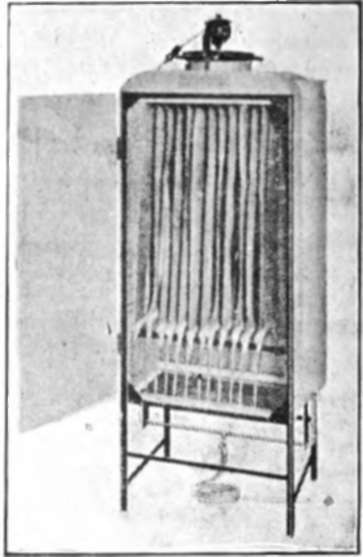
Fig. 150.
Specification
Built of galvanised iron on angle-iron framework and provided with electric fan at top.
Fig. 151.
Twelve bars with clips, for suspending films from top, twelve bars on spiral springs at bottom. Thermometer.
Gas Heating
By Bunsen burners placed at lower end of each flue. Consumption of gas negligible, regulated by tap.
Electric
Two heating units placed one each side in shortened flues-connected to 3-way switch, controlling " full power " and " half power." Consumption-full power, 2 units her hour ; half power, 1 unit her hour. (Full power only required for first heating up-about 10 minutes.) Fitted with fan regulator.
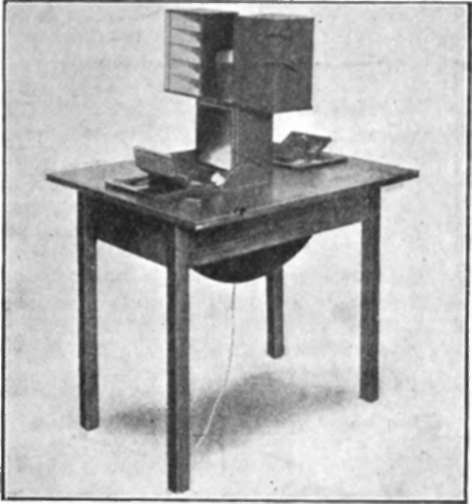
Twin Printer (Electric Or Gas)
For Strip, Single or Repetition Printing. A well-designed, economical and practical piece of apparatus for two operators working independently from one light. Extremely simple to use and free of all complications, Fig. 151.
Specification. Operating Table
Made of solid timber. Size, 3ft. x 3 ft. 2 ins. Height, 2ft. 7 ins. Two operating positions, fitted with plate-glass and automatic lifting pressure pad in spring frame for holding masks. For negatives up to 7 x 5 inches.
Exposure
Gaslight paper. Electric : average, two seconds. Gas : average ten seconds (lamps not included).
Lamp Section
Russian iron, 4-in. cowl, storage shelves for masks and paper. Illuminates table and darkroom.
Masks
Two sets of eight interchangeable for standard sizes. Single films or uncut strips can be printed with one-eighth white margins. Rotary Print Dryer.-Designed on the simplest lines and free from all unnecessary complications liable to go wrong at critical moments. Prints, glossy, semi-matt or matt, are inserted at one end and come out dry and flat after one revolution of the drum, which occupies five minutes. For highly-glazed finish prints should be squeegeed on to ferrotype plates, which are then put through Fig. 152.
Capacity
1,400 31/2 X 21/2 prints per hour ; other sizes in proportion.
Specification
El e g a n t and strong cast framework, 24-inch drum, galvanised. Thick absorber band. Thin, specially treated conveyer allowing steam and moisture to get away quickly. Jockey roller-automatic take-up for expansion and contraction of conveyer : pressure roller-hand-controlled for absorber. Detachable print box. Gas heating controlled by tap. .Motor heating by two-way switch giving " full power " and " half power." Consumption-" full power " 1 unit per hour (for hea ting-up only). " Half power" 1/2 unit per hour.
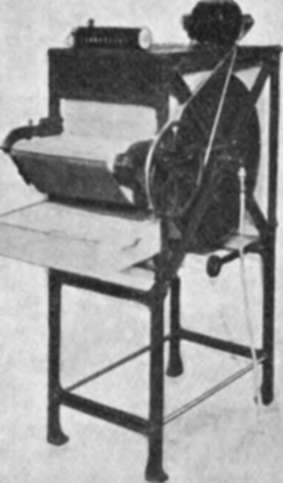
Fig. 152.
Continue to:


My Books

