


Photographing Small Objects
Description
This section is from the book "Workshop Receipts For Manufacturers And Scientific Amateurs. Supplement Aluminium To Wireless", by The Chemical Publishing Co.. Also available from Amazon: Workshop Receipts For Manufacturers And Scientific Amateurs.
Photographing Small Objects
Perhaps the most fascinating of all the various ways by which the Autoprint can entertain us is the photography of small objects, the size of which comes within the scope of the baseboard.
Use Of The Stop
When the object to be photographed is more than 1 inch high, it is advisable to use the special stop provided for the purpose. The increased depth of focus obtained will give a sharp picture overall.
N.B. If the object is of considerable height, say overall 5 to 6 inches, assistance should be given to the lens by moving the Autoprint up half the height of the object above the number on the main standard, also moving the lens in the same proportion. (This is only necessary when very high objects are being photographed.)
Exposure varies according to the type of subject. Use an ordinary plate (11. and D. 45) and make test. The factors which govern the exposure are the density of your light, the number of tones in the subject, the colour of the subject, etc., in fact, all those common to ordinary photography.
Making Lantern Slides With The Autoprint
The Autoprint lends itself well to the making of Lantern Slides in contact size, or where portions only of the negative are to be used. The bellows should be extended to the full amount, and the body moved to the bottom of the main stay.
Sizes Chart For Reproduction, Copying, And Photography Of Objects
No. 1 Autoprint with 31/2 x 21/2 Plate | No. 2 Autoprint with 41/4 x 31/4 (1-plate) Plate. | ||
Minimum space | For automatic | Minimum space | For automatic |
required by ob- | Focus set to | required by ob- | Focus, set to |
ject, plan, etc. | No. | ject, plan, etc. | No. |
15 x 12 inches | 1 | 20 x 16 inches | 1 |
12 x 10 „ | 2 | 15 x 12 „ | 2 |
81/2 x 61/2 „ | 3 | 12 x 10 „ | 3 |
61/2 x 43/4 „ | 4 | 10 x 8 „ | 4 |
51/2 x 31/2 „ | 5 | 81/2 x 61/2 „ | 5 |
| ; | ; | 61/2 x 43/4 „ | 6 |
To make Lantern Slides by reduction, a special extension tube is available which screws into the lens flange and to which the lens is then fitted.
Exposure varies very considerably with various makes of lantern plates and should be ascertained by testing, as with enlargements and gaslight papers.
The Dualite. A Simplified En-Larger For Electric Light
The Dualite will appeal to those who cannot afford the Autoprint. In design and construction the aim has been to provide efficient apparatus at the lowest possible price, and the price at which the Dualite is supplied represents exceptionally line value.
The main feature is the illumination, which is obtained entirely by reflected light. This type of light is second only to daylight as an illuminant for enlarging purposes, and produces enlargenents of exceptionally high quality. Flaws, scratches, and hard lines in negatives are so reduced as to render retouching almost entirely unnecessary.
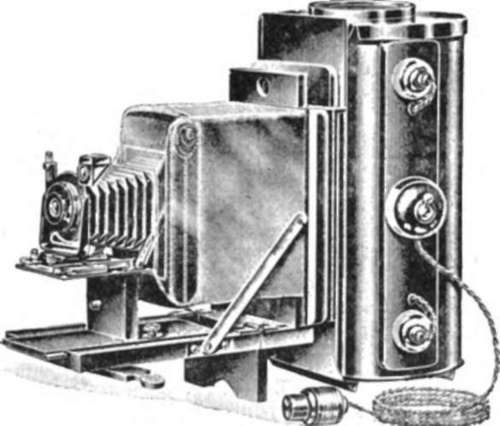
Fig. 154.
The Baseboard is fitted with a moving platform, operated by a radial lever, making accurate focussing a very simple operation.
Model 1. Is constructed for use in conjunction with a camera, which is screwed on to the enlarger by the tripod bush and connected to the Lamp House by an elastic-mouthed bag. Any 1/4-plate or 31/2 X 21/2 camera (the back of which is removable) can be used without any special adaptation. Thus, for a very small sum your roll film camera can be turned into an enlarger, Fig. 154.
Model 2. Embodies all the characteristics of the No. 1, but is fitted with a bellows, lens, and lens front, and thus forms a complete enlarger.
The Vertical Stand
By means of a specially designed vertical stand, either the Model 1 or Model 2 Dualites may be converted into enlargers working vertically, which is so very much more convenient. The enlarger is raised or lowered by a chain and sprocket system. When not in use this Stand folds up.
Continue to:


My Books

