


Protection Of Kdges
Description
This section is from the book "Workshop Receipts For Manufacturers And Scientific Amateurs. Supplement Aluminium To Wireless", by The Chemical Publishing Co.. Also available from Amazon: Workshop Receipts For Manufacturers And Scientific Amateurs.
Protection Of Kdges
Plymax sheets are vulnerable only at the edges and it is important that adequate steps be taken to prevent access of moisture to the core. Again, if the edges are left quite exposed, as in the case of a table top or the outer edge of an unframed sign board, the steel is liable to be turned up by rough usage, thus presenting a ragged edge, which is dangerous and unsightly.
Sufficient protection is often afforded by the nature of the structure itself-panels can be recessed into wooden frames or rivetted to angle iron-joints are almost invariably covered with mouldings. As a further precaution, however, red lead should be used freely on the edges of sheets during the course of erection, in order to make the joints waterproof.
Where edges are not protected by the arrangement of the structure, as in the two instances cited above, a light galvanised channel made from the 30-gauge sheet should be soldered to the edge of the panel as shown in Fig. 159. Sheets can be delivered made to finished size with the edges protected in this way, or channel lengths can be supplied loose.

Fig, 159.
Where a perfectly clean face side is required, sheets can be supplied with the metal turned over the edge (Fig. 160). As this entails the special manufacture of the panels concerned, it always is of very great assistance from a production point of view and to the user from an expense standpoint, if sizes are standardised and orders placed for as large a number as possible of each size at one time.
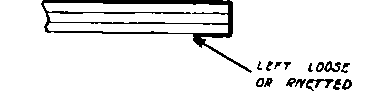
Fig. 160.
When the steel is on one side only of the sheet (Type 1.GS.12.) the channel flange on the wood side can be either left loose or secured with bifurcated rivets.
In cases where channel flanges even on one side of the sheet are objectionable, the edges can be sealed by recessing a narrow strip of metal between the two steel faces and securely soldering it in position (Fig. 161).
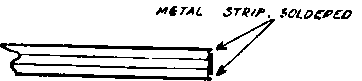
Fig. 161.
Channel protection is advisable when panels are exposed to hot moist atmospheric conditions, although joints and edges may be still further covered by the structure itself.
Where necessary, the edges of circular holes in Plymax sheets can be protected by bushing. The bush may take the form of a short length of light tube expanded or curled over at the ends. The tube may also be made to hold a washer in position-as shown in Fig. 162.

Fig. 162.
The question of edge protection cannot be too strongly emphasised as it is of the utmost importance if complete and permanent satisfaction is to be assured.
Methods of Jointing 2.GS.12.- A very strong type of butt-joint is illustrated in Fig. 163, and is most suitable for partition work, especially where the outer framing is of steel.
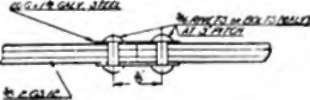
Fig. 163.
A similar butt-joint using wood battens instead of steel butt-straps, is shown in Fig. 164, and is perhaps more in keeping with wood framing. The battens are usually of Teak or Deal and the joints are quite strong enough for all general purposes.

Fig. 164.
In some instances, particularly in sign-board construction, a flush surface is required on one side. This can be achieved by slightly bevelling the butted edges of the sheets forming a V groove, which can be filled up with low melting point solder. Since there is very little strength in the solder, the joint should be supported at the rear of the panel by a batten (Fig. 165). Screwholes can be filled up flush with solder after screwing the panel to the batten. This type of joint is not suitable for vehicle panels as the continual vibration has a tendency to crack the solder and thus destroy the appearance of the joint and its efficacy as a means of preventing the access of water to the core of the panels.
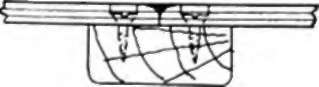
Fig. 165.
Methods of Jointing Type 1.GS.12.-With this type of Plymax it is advisable to arrange for all joints and edges of sheets to coincide with members of the frame. As stated in the paragraph on Edge Protection, joints should be covered with wood or metal mouldings to prevent risk of damage to the butted edges of the sheets.
As a means of further ensuring that the joint is watertight, the metal of one panel can be left overhanging about f in., so that when the sheets are butted it will overlap the other sheet, the whole being covered with the usual moulding. This is particularly useful in the case of the side panels of vehicles. If the metal of the top panel overlaps the top edge of the bottom panel, any moisture getting behind the moulding would run down the van side and no risk of damage to the core would be incurred. It must be remembered, however, that the fact of the metal being left over, entails the special manufacture of the panel concerned.
Attachment To Frames
A simple, but very efficient, method of attaching Plymax panels to steel angle or " T " frames is demonstrated in Fig. 166. If desired the 20-gauge strip can be replaced by washers under each rivet head ; but special attention should then be paid to the exposed edge of the panel.
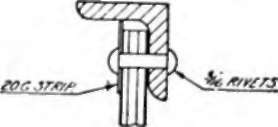
Fig. 166.
Where a wood frame is used the panels can be recessed into the wood or held in position with fillets. The latter is most useful for the rapid and cheap erection of partitions.
Note
It is important that all joints (either Type 1.GS.12. or 2.GS.12.) should be well stopped with red lead when not sealed by soldering.
Curved Surfaces
Plymax can be readily bent to simple curves, provided that the steel is on one side (Type 1.GS.12.), and on the outside of the curve. For the sweep on the side and back panels of motor vans, sheets may easily be pulled round on the frame of the van without any previous bending.
If curved panels are required with the steel on both sides (Type 2.GS.12.), the sheets must be manufactured to the required curve by using special moulds. It will be readily appreciated that the manufacture of a special mould is justified only when a large number of similar panels is required.
Attachment To Sheets
Attachments can be made to Plymax sheets by means of wood screws when the sheets are f in. or more in thickness, or with bifurcated rivets when less than that thickness. Where the articles to be attached are heavy, or subject to considerable loads, coach bolts, rivets, or some similar type of fastening, passing right through the sheet, should be used. Small attachments are conveniently made by soldering.
Case Construction
For this class of work it is undoubtedly preferable to use Plymax Type 2.GS.12. (steel on both sides), as its use results in a much stronger and a more serviceable case.
Various methods can be adopted to join the corners of Plymax cases. Figs. 167 and 168 give examples.
For small light boxes it is sometimes an advantage to use Type 2.GS.8. (i.e., with lead-coated steel on both sides). This steel is of a lighter gauge than the galvanised steel and being lead-coated, it solders very neatly. This type is most generally used in conjunction with the methods of jointing shown in Figs. 167 and 168.

Fig. 167.
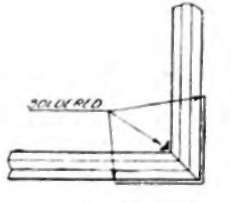
Fig. 168.
Hinges, hasps, staples, handles, etc., should invariably be solid riveted to the cases. If rivets with small heads are used, a plate or washer should be fixed on the inside.
Continue to:


My Books

