


Time For Carburising
Description
This section is from the book "Workshop Receipts For Manufacturers And Scientific Amateurs. Supplement Aluminium To Wireless", by The Chemical Publishing Co.. Also available from Amazon: Workshop Receipts For Manufacturers And Scientific Amateurs.
Time For Carburising
It is extremely difficult to fix definite times for varying depths of case as these vary considerably with the type of furnace, the box and the class of work.
The use of test bars will soon enable the operator to gauge the length of time necessary to give the required case with special conditions obtaining in his own shop.
Special Instructions relative to DBS Carburising Compound.-DBS
Carburising Compound, consisting as it does entirely of carburising material of special composition, has an extremely long life, and it is consequently unnecessary to throw away the compound after being once used. A satisfactory procedure is to add 15 to 25 per cent, new material to make up for handling losses.
The best results are obtained from DBS Carburiser by the mixture of new and used compound, the proportion of new compound not exceeding 60 per cent. ; in this way any tendency of the new compound to clog when used in connec-ion with small and intricate articles is obviated and the carburiser leaves the work absolutely clean.
DBS Carburising Compound shrinks so little in use so that there is no necessity, as with many other compounds, to bury the work under a very deep layer in order to prevent the work from being exposed during carburisation.
Although the carburising proper is a result of the gases generated from the compound, the fineness of grain of DBS Carburising Compound greatly assists the uniform action of these gases on the surface and thus leads to even penetration particularly in the case of work having recesses and hollow portions. Furthermore it serves to give greater support to the piece and thus minimises distortion and warping.
The results of the following experiment will serve to illustrate this point.
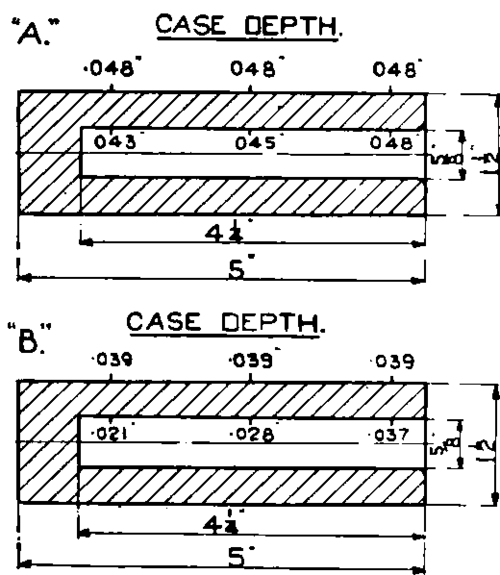
Fig. 24.
Two pieces of steel were machined as in Figure 24, " A " being carburised with DBS compound and " B " with another compound having a much coarser grain, under identical conditions. After carburising the pieces were sectioned, polished and etched and the depth of case measured microscopically. The results are indicated on the diagram for the various points at which measurements were taken ; the greater depth and uniformity of case resulting from the use of DBS carburiser are clearly shown.
Selective Carburisation
It frequently happens that port ions of the work require to be left soft and some of the ways in which this may be carried out are described below. Ends of shafts and the like may be covered with a nonshrinking clay before packing, which prevents to a large extent the absorption of carbon. If after the final hardening the ends are dipped in a lead bath and brought up to a temperature of about 700 degs, C. and allowed to cool in the air, the ends will be quite soft enough for easy machining. During the cool ing down after the lead bath treatment, the shaft should be allowed to stand in water, the portion requiring to be left hard being immersed to prevent softening by transmission of heat.
A paste composed of asbestos powder, ferric oxide and silicate of soda if painted over the warmed portion in a coating l/16in. thick will give fairly satisfactory results.
There are several proprietary compounds of a similar nature on the market which will give more or less good results if properly applied.
One of the most widely used methods of preventing the steel from absorbing carbon is to electrically deposit copper on the portion on which no case is desired. Those portions on which the case is required are varnished and the parts immersed in the plating bath. The copper deposits on the unvarnished portions and the parts are subsequently packed without removing the varnish. The copper deposit need not be thick, but it must be dense. 0 003 in. is quite a sufficient thickness to prevent entire carbon absorption if properly deposited with a low current density.
The following method, if it may be conveniently applied, is equally satisfactory. The surface to be left soft is covered with a piece of pure copper and held in position during carbonisation. There is no necessity to have an extremely good contact between the copper piece and the surface of the article, nor is there any need to clamp the piece tightly to the article, so long as there is not more than 1 /64in. gap between the copper and the article, carbon absorption will be prevented.
The Use Of The Pyrometer
It is impossible to do really high-class work on a commercial basis without the help of pyrometers.
It should not be inferred from this that good work is bound to accrue if pyrometers are installed, as unless extremely elaborate and expensive automatic and mechanical controls are instituted, much still depends on the skill and experience of the operators. Pyrometers are, however, an almost indispensable help in producing a first-class case-hardened product. The choice and selection of suitable equipment will depend on the nature of the work and plant, but the following remarks pertain to generalised cases.
Pyrometers may be broadly divided in two types-optical and thermo-couple.
The optical types do not find such an extended application as the thermo-couple type as the accuracy of their indication is largely dependent on the condition of the heated surfaces on which they are focussed-i.e., whether the surfaces conform to what is known as black body or bright body conditions.
Where the carburising operations are conducted continuously a record -ing indicator is a big advantage and forms a continuous check on the regulation of the furnaces.
Pyrometers embodying base metal thermo-couples give, perhaps, the most economical and satisfactory service, through rare metal thermo-couples are possibly more reliable. Rare metal thermocouples are, however, expensive both to instal and to maintain.
It is of the utmost importance that thermo-couples be placed in such a position in the furnace that the end attains exactly the same temperature as the work. The operator can then see that the pyrometer is reading the correct temperature, and that the work is of the same temperature as the end of the thermo-couple, by matching them in colour.
Where a number of furnaces with pyrometers arc installed a standard instrument should be kept and the thermo-couples and indicators in use checked regularly.
Continue to:


My Books

